Thursday, February 14, 2013

Love Is All Around Us

Unless you happen to live in Mongolia, various Stans, Syria, and Belarus:
http://www.washingtonpost.com/blogs/worldviews/wp/2013/02/14/a-color-coded-map-of-the-countries-where-people-feel-the-most-and-least-loved/


Morocco also stands out.

The other way to enjoy Valentine's Day as a Political Scientist to follow the #PoliSciValentines thread on twitter.  My contributions:
With you, there is no security dilemma #PoliSciValentines and
You are my principal, I will not shirk #PoliSciValentines
Also, today, it was revealed that Canada is extending the C17 mission to Mali for another month.  That is lovely in two ways--to help Mali and to make my one solid prediction quite accurate.  I said on the various TV spots that the first and then second deadlines for the mission were unrealistic and that I expected the mission to be extended yet again.  Whoo hoo me!

The title of this post was inspired by Love Actually, but here is what I found online.

Enjoy your VDay.

New Blog in the Virtual Street

Folks,
My new institutions (well, still new-ish) now has a blog: http://npsia.wordpress.com/  Yes, you can guess who is to blame.  Check it out. We hope to get a rolling selection of content from the various profs and occasional PhD students at the Norman Paterson School of International Affairs. 

Your prolific blog-spewer.

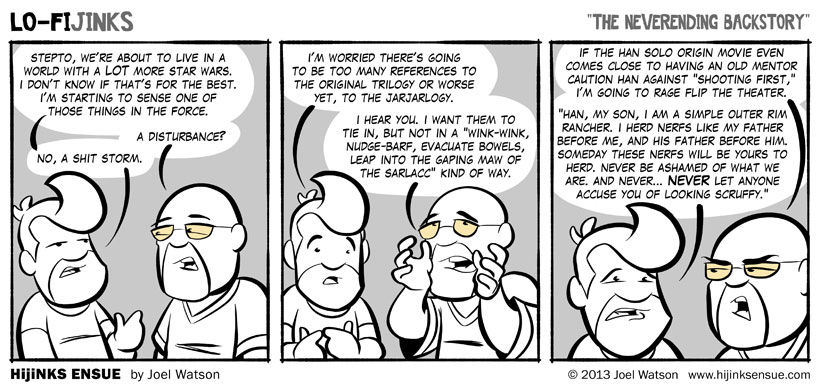
P-A and Star Wars

I ended up jumping into the Duck conversation of understanding the failures of the Empire during Star Wars.  My take relies on P-A theory, as my latest book project has definitely pushed me deep into the dark side.

Wednesday, February 13, 2013

Dark Side Nostalgia

Wired went from a fun post about the Battle of Hoth to a great conversation among people I follow on twitter.  Behold, the power of a fully armed and operational community of IR scholar-geeks.  My own attempt at this stuff earlier this week pales in comparison to the sharpness of these posts.

In grad school, we often joked that principal-agency theory was the real dark side.  My friends who specialized in American politics (or even took American as their second subfield) found themselves inevitably drawn into the dark side, using, deploying, applying P-A theory.  By focusing on IR and Comparative, I avoided the dark side during my time there.

But alas, my fall was inevitable.  As soon as I began to co-author with one of the disciples (David Auerswald), I was tainted.  As a result, the new book on NATO and Afghanistan, with the final draft to be sent to Princeton University Press tomorrow for processing, contains delegation, discretion, oversight.  These are of the dark side.  I have become so infected that I pondered at length the P-A dynamics of the Avengers.  As a result of the betrayal of my former self, I cannot help but think of P-A relations when it comes to Darth Vader, the Emperor, Luke and all the rest.  The series of pieces in the uber-geek symposium reek of the dark side.  They ponder who was monitoring whom, they implicitly indicate that there was agency slack, hidden information and hidden action aplenty.

It is true as say, that once you step into the dark, forever it will dominate your destiny.  If only I could figure out that force lightning....


Irrational Service, Rational Shirking

Phil Arena posted a series tweets this morning pointing out some contradictions between people's theories and their behavior:


Phil goes on to suggest that most academics are rational shirkers/voters regardless of their theoretical dispositions.  I do not find this surprising.  In the great battles of the 1990s when Phil was just a wee lad, dreaming of formal models, there was a fun (from the standpoint of an outside observer) conflict between the rational choice crowd focused on utility maximization and an unholy alliance of Realists, feminists, post-modernists and others who only shared one interest--maximizing utility (gaining control of the APSR and other publications).  And the rat choicers felt guilty enough to give in a bit.   This old listserv post put it best:
The proponents of value-free social science are compelled by their sense of 
justice and fair play to hand over significant power to those who reject 
value-free social science.  At the same time, those who argue for a more 
straightforwardly normative approach to the discipline make common cause 
with their mortal ideological enemies in order for both sides to pursue 
the blatantly self-interested goals of tenure, promotion, wealth, and fame.
So, just as Stephen Krasner found that hypocrisy is not new to IR/sovereignty, political scientists often behave in ways that contradict their models.  This perestroika debate was at the level of the profession, but Phil's observation is more at the departmental level--that most folks tend to shirk, vote strategically and so on.  Actually, yes on the former, no on the latter.  We suck as political animals, so most of us do not count votes ahead of time, most of us do not lobby all that effectively, and most of us suck as administrators.

On the shirking thing, well, every department has folks who are reliable and those who are not.  Those that are reliable end up doing far more than their share of service.  Those who are unreliable find themselves doing less service since they are .... unreliable.  They may not show up at meetings, they may not do the paperwork, they may not read what they are supposed to read, they may not be appropriate advisors for about half of the human population, whatever.  And this may be a rational strategy to avoid work or it may just be that being unreliable is in their nature.  The challenge for any academic leader--chair, director, dean, whatever--is to find ways to reward the reliable so that shirking is less attractive.

I tried to be unreliable, but I sucked at it.  During the dark days before the move, I tried to avoid doing anything that would help out those that did me wrong.  Yet, I still ended up serving on more dissertation committees and I still met the service obligations of the profession.  Now that I am in a new place, I have re-set, saying yes to nearly everything.  Perhaps by over-doing it, I will miss deadlines and under-perform, leading to a reputation for unreliability--if only I was so strategic.


Tuesday, February 12, 2013

Immature Parties, continued

I have been ranting here and elsewhere about the crappy oversight that exists in Canada (but the US, with its farcical confirmation hearings, is making oversight a joke as well).  Well, this piece drove me up a twitter wall this morning. In the defence committee report on the F-35, the majority party removed heaps of interesting stuff to protect the government from embarrassment, and thus caused the government some embarrassment. When the Auditor General and the Parliamentary Budget Office say you messed up, and then the committee writes a report omitting such stuff, well, folks notice.  Indeed, folks leak.

The Conservatives are a majority party with no real threat in sight, yet they continue to deny, deny, deny that they did anything wrong ever.  So, they word-smith this report to make it appear as if any mistakes were solely done by folks at the Ministry of National Defence.  Given Harper's micro-management of stuff, this is pretty funny.

What drives me crazy is that committees in legislatures are supposed to do something other than be the lapdogs of the government.  The opposition must, of course, oppose in Westminster systems, but, again, the automatic gainsaying just leads to less credibility.  When the NDP actually had good reasons to criticize the F-35 and showed that its reps knew their stuff, well, their party's cred went up.  When the Liberal opposed a war that it had started (Kandahar), it made them look foolish. To criticize and to oppose are not identical.  A constructive opposition can figure out how to criticize a policy without having to mindlessly oppose to score points.  And a government and its party in the legislature needs to be able to respond to criticism intelligently rather than censoring documents and engaging in denials.  When you deny reality, you lose credibility. 

Am I naive to expect the parties to act maturely?  Only sort of. The parties have some incentives to attack the other party thoughtlessly, but they also have some reason to develop reputations for being transparent and constructive.  Voters might actually vote for the party they respect.  Sure, that seems naive, but we shall see.  Message control may or may not lead to the Conservatives as the natural governing party of Canada, but developing a reputation for denial, censoring reality and the like might not be that helpful in that ambition.

Belated Super-Nerd Analysis

I love this post for thinking about the Battle of Hoth, where the Empire fails in all of its objectives.  For me, the really confusing part of this battle is at the start, when Vader kills the Admiral for appearing out of hyperspace too close to the planet, losing the element of surprise.  It would seem to me that appearing further out would be helpful perhaps for surrounding the planet, but would also be detected sooner since the fleet would then be crossing through the star system for a bit of time.  This would give the Rebels more time to react, not less.  Unless one assumes that the Rebels cannot detect a fleet in the neighborhood.  I find that hard to believe, given the rest of the state of technology existing in that galaxy at that time. 

So, anyone care to make sense of that for me?


Monday, February 11, 2013

Out-Pandering the NDP

I have often criticized the NDP for pandering to the Quebec nationalists by taking weenie positions on a possible Quebec referendum.  Well, the Immigration Minister of Canada, Jason Kenney, has out-pandered the NDP.

In a press conference with Tamil-Canadian media last month, Citizenship and Immigration Minister Jason Kenney said Canada acted against its own interests by listing the Liberation Tigers of Tamil Eelam (LTTE) as a terrorist group in 2006.
Acted against the interests perhaps of Canadian politicians seeking the Tamil-Canadian vote, but Canada had stood out as one of the few advanced democracies not recognizing the reality that the LTTE were a terrorist group.  Of course, perhaps we should have given the LTTE a pass because it only perfected the art of suicide bombing including the use of apparently pregnant women.  Perhaps we should give the LTTE a pass because it was more equal opportunity for women than many other terrorist groups?

Of course, this was a session only for Tamil-Canadian media so it took a month to get out.  If this was not pandering, Kenney should have said it widely and loudly.  So, the media here really is the message--talk to an ethnic lobby in a way that you cannot say publicly.  Good times.

Yes, the Sinhalese majority of Sri Lanka have abused the Tamils in many ways--providing the textbook case of ethnic outbidding--where two parties compete for a majority's vote at the expense of a minority.  But in 2006, the LTTE were still alive and kicking and causing much in the way of civilian casualties.

To be clear, the Tamil-Canadians are not the only community that has supported those using violence in the homeland and where local politicians have pandered to them (Irish-Americans are a famous case).  I expect (in books 1 and 2) for people to seek policies that aid their kin back home.  I also expect politicians who need their votes to support their positions.  But I don't have to approve of it. So, excuse me if I call a pander a pander, but Kenney is the new pander bear of Canada.*
* As this picture suggests, I am not the only person to think of the phrase "pander bear"

Sunday, February 10, 2013

Is Mali Afghanistan?

Last night, I was asked once again is Mali Africa's Afghanistan?  Hell if I know.  Well, I didn't say that, but it really depends on what you mean by "Afghanistan."  Mali experts will say no, because all experts hate when their place is considered to be very comparable to another, especially one of the objectively worst places on earth (not just violence, but corruption, economic situation, etc., Afghanistan always ranks at the top or bottom of those lists).  I am an expert on neither country, but have followed Afghanistan for much longer since the books in progress focus on outsiders mucking around in Afghanistan.  Plus ten days there in 2007 make me an expert, right?

So, when I think is Mali like Afghanistan, I tend to say no because:
  • Who is the Pakistan in this analogy?  Maybe Libya played the role of outsider feeding/fostering unrest, but not anymore.
  • Indeed, the neighbors seem to be constructive.  Imagine a world in which India and Pakistan and Iran were working together to support the government of Afghanistan and the NATO effort?  Yeah, unrealistic, but Mali, as far as I can tell, is getting help from multiple countries in the region to regain control of the north.
  • Does Mali have poppies or the equivalent?  Afghanistan has been greatly complicated by the reality that poppies are one of the very few profitable exports with efforts to substitute/eradicate/minimize raising all kinds of problems.  
  • While the various groups that seized the north share some identities with the people who reside there (Tuareg, Muslim), they apparently wore out their stay quite quickly and don't have the reservoir of support that the Taliban has had among certain tribes within the Pashtuns. 
What makes Afghanistan and Mali similar?
  • Limited trust/capacity at the center.  Afghanistan has Karzai, and Mali has a new military regime promising to have elections soon.
  • A crappy "security sector."  Afghanistan's police systematically abuse the populace.  Mali's military seems to be killing folks who have little to do with the various separatist groups.
So, yes, there are a few similarities, but violence, state collapse, and intervention do make Mali Afghanistan.  Mali's road will be tough and bumpy, and it may not head where people hope it is heading.  But it ain't Afghanistan.  When we apply analogies, we really need to think not just about the apparent similarities but the core properties and see how many of them apply.  In this case, a few but not that much.

Limited Expertise, Always Pushed Beyond

The danger in doing live TV/radio is that the interviewer almost always goes beyond the pre-interview.  So even when I make it clear that I am no expert on Mali politics, they ask about it anyway.  This time, I pretty much said: "Your guess is as good as mine." 

I do this stuff because I feel obligated--by the university that hired me in part to help raise the visibility of the institution, by the grant agencies that want public engagement, by my profession's anguishing about relevance, and by my deep desire to poop on myths that keep getting spread, like Mali is like Afghanistan.  Also, I am a self-admitted narcissist.

Anyhow, check out it and tell me what I should do better or if I should just shut up.

Saturday, February 9, 2013

Five Rules of Dodgeball and Regime Change

To continue this morning's musings about Libya and such, I realized that the rules of dodgeball can make sense of US strategies in the aftermath of regime change:
  • Dodge: Once you break the opposition, try to get an international organization to do the very minimum (Afghanistan with non-NATO ISAF at first)
  • Dip: Once you break a country, hand over the reins to emigres and run out of the country (Iraq, plan A)
  • Duck: Once your effort to dip has failed, create a half-assed agency that is only slightly connected to the inter-agency back home, let it make bad decisions but then avoid responsibility (Iraq, Bremer and his Can't Produce Anything authority).
  • Dive: Break a government without any commitment of troops, and then wait for others to manage the place (Libya)
  • Dodge: Once an ally breaks the opposition, try to get regional/international organizations to run the place (Mali).
Did I miss any rules?

Non-Buyer's Remorse

There has been a lot of gnashing lately about the failure of the US/NATO to stop the flow of arms from Libya.  Well, given the "no boots on the ground" components of the UN resolutions and of the policies of the NATO countries, how could the outsiders have done anything to stop the flow of arms.  NATO has been trying to stop the flow of arms into Afghanistan for the past decade (plus or minus) without too much success, and it has had a heap of troops in the neighborhood plus much in the way of intel and air assets nearby. 

My basic point here is a simple one: the flow of arms beyond Libya is not a surprise, but very few folks were advocating a serious NATO deployment two years ago.  So, we now have some remorse that more was not done, but it was quite unrealistic to expect outsiders to do much/enough to make a dent the past few years.  It is not that we forget about Libya, it is that we didn't care enough about Libya to invest sufficient resources to affect the flow of arms.  After two American wars in the Mideast, the US was not up to another war (again, my concept of a war cap seems to apply).  NATO, exhausted by Afghanistan, was not going to send enough troops to make up for the missing Americans. Who was left?  Exactly. 

Of course, the funny thing is that when the US did focus its effort on a country, it still messed up on containing the weapons, but I blame that on Rumsfeld.

Anyhow, I am waiting for someone to figure out how one can stop the flow of weapons without putting troops on the ground.  Anyone?

Friday, February 8, 2013

Fear Not


I am not fearful.  Fear leads to anger, anger lead to hate, and hate leads to suffering

Grad Students Watch Just Enough TV

Check out this rant by William Spaniel


The context is in his blog.  Just heaps of fun thinking about how to play a game and where it goes awry.  I want William to watch a few weeks of Price is Right so that he can rant about bidding strategies in the opening game and then on the showcase showdown.


Known Knowns and All That

I saw this tweet today.

And I have so many reactions to it.  First, Rumsfeld would probably say that it was true from a certain point of view.  That the war, in terms of a conventional land campaign, was indeed over in weeks.  The US toppled the Iraqi government later than the impatient would have expected but still pretty quickly given how few forces were deployed to Iraq.  But, of course, the problem is that Rummy and his pals thought that they could easily handover Iraq to Chalabi and other emigre pals and then the US forces could run back home.

Which gets to the known knowns as Rummy would say: we knew in 2002 that the Office of the Secretary of Defense was broken.  That is the military term for a dysfunctional organization, and OSD was quite dysfunctional.  The people there lived in fear of Rummy--I saw it on a regular basis during my year on the Joint Staff.  And these folks were given the job of running the "post-war" phase.  I knew they would screw it up, which is one reason why I argued at the time that this was the wrong war at the wrong time by the wrong people.  But little did I know that they would use the list of things that they should not do and use it as a checklist instead.  Disband the army and free up 400,000 or so men who were trained in fighting and knew where all of the guns and explosives where?  Check!

So, the first moves by the US as the Iraqi government fell was to insure that "war" would last for years rather than months. Not providing enough troops meant that the infrastructure needed to run Iraq was decimated by looting.  Disbanding the army and extreme de-ba'athification gave a weak insurgency heaps of oxygen to burn brighter.  I could go on.

The biggest known known of 2003--that Rumsfeld was incredibly arrogant.  What was unknown at the time that he was so arrogant that he was willing to use his war strategy as a tool for domestic political purposes: using only a small number of troops and having the Marines go further inland than in their entire history was designed less with victory in Iraq in mind and more about fighting a bureaucratic battle against an Army he disliked (that would be the US Army).  While Rumsfeld was not the only one responsible for the debacles of 2003-2006, he certainly bore a heap of responsibility that he continues to deny.

Worst SecDef ever?  Almost certainly.  McNamara made poor decisions due to his arrogance, but had a learning curve.  His mistakes were not nearly as profoundly ... stupid as Rumsfeld's.  I guess the question is whether failing in Vietnam did more or less damage to American interests than the Iraq war.  Both wars raised concerns about American decline, caused loss of political capital around the world, did heaps of damage to the American military, and significant harm to the US economy (and world economy as a result).  It would be a toss-up, I guess, if not for the fact that Rumsfeld's focus on Iraq meant that the US did not reinforce victory in Afghanistan, wasting a huge amount of time that gave the Taliban a chance to recover.  Afghanistan may not have been winnable anyway, but the turn to Iraq made failure in Afghanistan far more likely. 

Or is there a SecDef that did a better job of undermining US national security?

Thursday, February 7, 2013

Cool Map

This here is a cool map.  I am too busy to think about it now, but perhaps my learned readers can offer a few thoughts to prime ye olde Spewe pumpe.


Army Training, Suh!

I got a comment on my post about Germany's drones that referred to the problems resulting from Germany given responsibility for police training.  NATO not only divvied up the country into different areas of operation with the Germans getting the north, Italians getting the west, the Canadians/Brits/Dutch sharing the south and the Americans leading in the East, but they also had functional division of responsibilities as well.  The Germans got policing, the British got counter-narcotics, and the Italians got judicial reform.  Yeah, incredibly problematic and more than just a bit funny, that last one.

Anyway, the Germans were poorly suited to do police training for several reasons, but particularly because of two key restrictions: their army and police were not allowed to cooperate much due to historical stuff, and German troops faced geographic restrictions as well.  So, other than training in Kabul, the training could otherwise only take place on German bases in RC-North (I could be slightly wrong on this, but I am basing this on interviews with Germany Interior Ministry folks as well as others who experienced/observed some of this). 

Eventually, the US took over and poured a heap of resources into this.  But it led to a set of perceptions that I don't think were accurate.  That police training was just a few years behind training the Afghan National Army, illustrated thusly:*
* I hereby demonstrate why I did not major in graphic arts


The green line on the left is ANA training, the blue line on the right is ANP.  The basic idea is that both training efforts have the same trajectory.  The problem with this is that training police may be fundamentally and inherently more difficult than army training.  Police need to do a wide variety of tasks, they need to be deeply engaged with local populations, they face constant temptation to exploit those that they should be protecting and serving, and so on.  While being a member of an army unit also has its own challenges, most enlisted troops have fewer skills to master, local knowledge and engagement is less important (again, for the enlisted folks), and so on.  So, I would expect the comparison to look more like this:


The basic point here is that we cannot simply blame the Germans for delaying the police training.  Nor should we expect police training to be progressing at the same rate (if a few years behind) as the army training.  And of course, this all assumes that army training has been swell.  Army training can only be done overnight in the movies:


Wednesday, February 6, 2013

Oversight Overboard

Check out my latest at CIC--where I call both CA and US legislators a bunch of babies.

Silly Sunday is Late

But this is just silly enough to merit a quick post:

Musical Chairs, Military Style

The Canadian Forces/Ministry of National Defence just announced the changes in command.  I am bummed because some of the folks I have met are retiring.  LTG Peter Devlin will be retiring from his post as head of the Land Staff (commander of the Canadian Army).  I met him a few years ago to interview him about his time as commander of NATO forces in Kabul in 2004.  It was a fascinating interview and most helpful in my research.  I bumped into him last week when I was at conference co-hosted by the Combat Training Centre.  It was nice to catch up, and he had some really interesting things to say in our conversation.  Let's just say that he would be on my side with the bet with


The downside of researching the military in any modern democracy is that the people you meet move up and out so quickly.  There are only one or two officers I worked with in the Pentagon that are still around in the military, but most are gone.  The same is increasingly true here--most of the colonels and generals interviewed for the project are out of the CF.  A few remain and in interesting spots.  So perhaps hanging out last week with the Captains and Majors might have been a good idea.

The Educational Political Peter Principle

Germany is about to lose yet another minister to plagiarism.  This time it is the ..... what for it..... Minister of Education.  Before, it was the Minister of Defense.  For some reason, politicians in Germany think that a PhD is a requisite for higher office, so they end up cheating along the way to get there.  I think the Germans would do themselves a huge favor by changing expectations--that an MA in a policy-oriented program, perhaps just with classwork and no thesis, might be sufficient for high political office.

Am I posting this due to schadenfreude?  No.  I am posting this because it gives me an excuse to post my favorite video: the retirement ceremony of former Minister of Defense Von Guttenberg

There are Priorities and then There are Priorities

I got in a twitter conversation with Robert Caruso yesterday about Kerry's prioritization of diplomatic security.  Kerry has been pushed by the events of Benghazi and Congressional pressure to say that diplomatic security:
[E]verything I do will be focused on the security and safety of our people."youtu.be/cdFMJcXB9w8
My basic point is that this should not be the focus of the Secretary of State.  Yes, he (or she as it has been the past decade and a half) should care about the people he puts in harm's way, but put in harm's way they must be.  We need to do a better job of providing insurance and other personal benefits for non-military but at risk folks*, and security needs to be a consideration.
* One of the key revelations of "whole of government" efforts in Iraq and Afghanistan is that the military often had a hard time working with the civilians since the latter were far more exposed to the risks without adequate benefits programs.
But it cannot be THE consideration or the most important focus of the Secretary of State, whose primary focus must be on the national interest, on maximizing what is best for the US in the world.  That is the job description.  Just as Generals ought to develop battle plans that manage risk so that the soldiers' lives and limbs are not wasted, the State Department needs to develop engagement strategies that manage but do not eliminate risk.  Otherwise, the State Department can continue the trend of building fortresses and minimizing access.  This is great for those who want twitter to be how the US engages the publics of other countries, but it will risk losing key sources of information and of influence.

So, I do not mean to be flippant here but stress that the safety of diplomats is significant but ought not to be the focus of Secretary of State Kerry nor of the Senate Foreign Relations Committee. 

Tuesday, February 5, 2013

German Drones Uber Alles?

The news today has Germany is now purchasing armed unmanned aerial vehicles (UAVs).  Yep, Germany will be firing away with its own drones.  Look out for a new more assertive Germany. 

Give me a break.  While Germany gets more grief than it should, it certainly underperformed in Afghanistan.  It has the third largest contingent for most of the time, yet did not make much of an impact.  Stories abounded of their soldiers gaining weight while in Afghanistan, which is kind of like Hurley maintaining weight during the Lost series.  Germany had far more capabilities than it deployed.  No tanks, little or no artillery, only a handful of helicopters, and its contingent faced pretty tight restrictions through 2009 and a bit less so thereafter.

Then Germany opted entirely out of Libya.  This was out of character.  I would have expected Germany to participate in the naval embargo and maybe even in the no fly zone once there was nothing to shoot at in the air over Libya besides other NATO (and partner) planes.  But Merkl overreacted to the Afghanistan malaise.  No Germany in Libya either.

So, Germany will acquire a new capability, one that is pretty much expected for any 21st century military, but as long as Germany has coalition governments, I would expect it to be quite limited in how it deploys such capabilities. 

It seems to me that those covering Europe are required to write the same stories over and over again:
  • Germany becoming assertive.
  • NATO's imminent demise. (checking old posts, I think I have more than a dozen responses to past predictions of NATO's death)
  • The EU's new defense cooperative enterprise and how it will supplant NATO.
Am I forgetting any?

Base Closing Nostalgia

This piece addresses one of the key challenges facing the US in Afghanistan--getting our crap out of the country.  Given the lack of ports, the need to either cross Pakistan or heaps of former Soviet space, and given the lack of time, this will get pretty interesting.  In Iraq, the US had dangerous roads but they led to Kuwait, where stuff could be put on ships quite easily. 

Canada has already experienced the challenges of this on a much smaller scale--for a force of 3k vs. the current American force of 66k.  The Canadian problem became Pakistan---that stuff was stuck on the border in cans (containers for those who missed the second season of the Wire) as Pakistan closed the border for a while (well, sort of, they closed to shipments of NATO material, not so much to Taliban/Haqqani folks). 

Anyhow, this got me thinking--logistics is not just logistics but politics.  When the US was closing bases in Bosnia in 2002 as its contingent was getting smaller, it had an opportunity: the bases were desired by the Bosnians for their militaries.  Yes, militaries since at the time there was still the challenge of unifying the Bosnian armies--the Bosnian Croatian military, the Bosnian Muslim military and the Bosnian Serb army.  The idea in the US interagency (that would be the bureaucracy) became--hey, let's offer the use of our old bases if they were used for joint efforts.  Sounds good.  But it ran into a big barrier--the US Army felt very strongly about its obligation to Congress to recoup all of the investments and ship everything that it could back to the US.  Which meant that the carrot would not be bases with buildings and fences and air conditions but concrete pads where the buildings used to be. 

And who won this interagency battle with the Joint Staff, State, and even the Office of the Secretary of Defense on the same side (if I recall correctly, a rare moment where OSD was functional) versus the Army?  The Army did.

So, do not expect the US to leave much behind, even if it made sense to let the Afghans inherit the US bases.  Congress, apparently, is a cruel mistress/accountant, so the Army (and Navy and Air Force) will be focused on sending home whatever it can.

Monday, February 4, 2013

Speaking of the Super Bowl

Every year I whine about missing the American ads.  This year, the Canadian ads were particularly tired, old, repeated, abysmal.  They were perhaps even worse than CBS coverage of the power outage.  Hard to imagine.  So, of the ones I have seen on the internet, I have to say this is my favorite:


Green Goblin plus Rolling Stones?  Count me in.  Of course, the only Mercedes under $30k probably lacks an engine.

But this one hits closer to home:


Wow, two good car ads.  The Mayans might have been off by a year.

and my sister's company did pretty well:

I am a big fan of Meatloaf so I appreciate a good spin.


This internet thing makes missing the ads a bit less annoying, but the problem is watching the game live and seeing such utter crap.  I could flee the room while the ads are on, but you never know if one of the good ones will leak through. 

Canadians are Bad Canadians

In my time here in Canada, I have long wondered if Canadians are more interested in the Super Bowl or the Grey Cup (the CFL final).  At least for the 2012-2013 winter, the answer is .....


Sunday, February 3, 2013

Brutal Take on Immigration Reform

Brian McFadden brings the heat, burning many sides of the immigration reform debate:

I think the last two panels are perhaps the most cutting. What say you?

Saturday, February 2, 2013

Love Un-Bites


Warm Bodies (2013) PosterThe Spew Family just came back from seeing Warm Bodies--the first ZomRomCom that I have seen. Yes, a Zombie Romantic Comedy.  It was very good, with spoilers below, so you should see it if you like a good human-zombie romance.


Friday, February 1, 2013

Doctor, Doctor, Give Me the News

You can call me doctor, and I will not be offended.  But I prefer professor.  Hey, dude! or Steve! are clearly out of abounds for a first time approach from a student. 

This piece actually surveys academics and finds that US/UK cultures are a bit different.  As I said, I prefer professor since there are all kinds of doctors in the world but professors are a distinct brand of folks.  I can see why some folks might want to be called doctor, since they have earned a doctorate and all.  Either one is going to be fine most of the time.  Informality is fine after a relationship has been established and expectations have been set. 

And, yes, of course, women probably get more grief and are treated more informally than the men.  Miss, Mrs., Ms. are all << to prof/doctor.

Yes, I have blogged about this before, but now folks have data!  Woot!  Anyhow, the problem, of course, is that the most likely offenders are the least likely to be aware ... well, of anything, but certainly of blogs that provide some stats.


Thursday, January 31, 2013

Learning from Lessons Learned Exercise

I spent the past two days at a conference in Fredericton, New Brunswick.  The U of NB's Gregg Centre and the Canadian Force's Combat Training Centre held a two day conference on what the Canadian Army can learn from its Afghanistan experience.  I presented on the lessons about multilateral military operations--drawing from the Dave and Steve book (coming to a bookstore near you late in 2013).

It was a bit different of a crowd.  I have presented my stuff to military audiences before, but these folks were almost entirely Captains and Majors and senior enlisted folks (plus a general or two and some colonels).  So, they had experienced a tour or two (or more) in Afghanistan and perhaps Bosnia, Cyprus and beyond.  They knew countries varied in how they conducted the war, but not about the sources of such variations.  Ta da!

I also learned stuff.  I learned that these folks had far more multinational experience than "joint."  Joint refers to working with other parts of the Canadian Forces, but, outside of helo support (all helos are RCAF), these folks didn't have much interaction with the other services. 

Today's sessions were breakout groups or "syndicates" as they called them.  I chose the multinational one.  Someone raised the idea of multilateral ops as a carpool--that someone is always driving the rest.  Often the US, sometimes the Brits.  The problem with the metaphor is that it gives way too much control to the driver---how many cars do you know move in four directions at once?


It was interesting to see the Marines come up a lot, as they used to have little multilateral experience.  But the Canadians often used them as examples.  Perhaps because, like the Marines, the Canadians pride themselves on adaptability produced by having old/lousy/too little equipment.


I had an interesting conversation with a female FOO.  This would be a forward observation officer--a person that manages the infantry's connection to artillery and air support.  In 2006, Canada had its first female KIA--Nichola Goddard--who had been a FOO.  I wondered if the CF got more protective of their FOOs, female or otherwise, after Goddard's death, but the officer I was talking to said that they were far more protective of the new grunt in the group--an 18 year old kid.  

I realized that knowing acronyms is not sufficient to faking being a military person.  It is necessary but not sufficient.  What you also have to do is say the following things alot:

  • sort.  As in: "we need to get x sorted."  Lots of sorting going on.  
  • piece.  As in "he was assigned the training piece, she got the int piece (not intel, just int)" and so on.  
  • construct as a noun.  As in "the training construct served us well in the short term, but can we build a similar construct somewhere else."  
  • enable. Heaps of enable and enablers around.  
One of my contributions I made to the discussion was to point out that referring to the other services constantly as enablers meant that, yes, you might value their role in helping you out (enabling you to do what you need to do), but then you are also making the service feel as if they are secondary to you.  Thus, I was suggesting that if one wants better jointness, better relations among the services, one might want to stop referring to them as enablers.  "Who you calling an enabler?"  Somehow, I doubt that I will change this habit.  I do hope, however, that my stuff on multilateral military operations does enable the CF down the road.  

Finally, they kept calling me sir.  Always feels strange--me a sir?  

Oh, and I learned more than this.  A smart group of interesting people with much experience and have thougth much about it.

Message Mismanaged

I was tempted to entitle this Mischief Mismanaged but not all of my readings are Harry Potter fans AND I don't think the Canadian government is up to mischief.  I do think that it is mismanaging its message management.  The Globe and Mail has a good piece documenting how it has screwed up the messaging around Mali.  The Harper folks have to do more to assure the public that it will not send folks into combat because it keeps sending mixed signals, denying then affirming various decisions.  To be clear, I still believe that there will be no combat troops sent by Canada to confront the Islamists in Mali.

I am at a conference in Fredericton with the Gregg Centre at the University of New Brunswick and the Combat Training Centre at Gagetown as hosts.  The audience is mostly Canadian army people.  When I asserted in my talk that the CF will not be going into combat anytime soon and mentioned my bet with Phil L, an American colonel on exchange in Canada wanted to join the bet on my side--taking the over--no major combat anytime soon.  A senior Canadian officer basically indicated that he would be in a wheel chair the next time Canada goes off to combat--which would be years and years down the road.

On a related note, a general wanted to speak with me about stuff that I had written--and that clearly became my piece at CIC on "Do they teach denial in basic training?"  I thought, uh oh.  But the conversation actually turned out to be quite good.  I didn't have to retreat but did appreciate the clarifications he suggested.  Divisions within CF more than denial CF denies.

But now I must go to the conference again. 

Tuesday, January 29, 2013

Deja Snooze

I saw this (23 Awkward Sleeping Positions Of People At Airports) and realized this is about the fifteenth anniversary (the 1998 job market season) of the one time I did sleep in an airport.  I did not use any of the tricks shown in the series of pics.  Nope, let's go to the videotape.


Ok, no tape.  Here is the tale:
I gave probably the best job talk of my life (spoiler--didn't get the job), and then got to the airport very late due to bad traffic and a less than rushed professor.  So, I got to the airport with no food since lunch, and had to jump on the plane.  The plane had no food.  And then got diverted to Tulsa or Oklahoma City due to thunder-storms at my least favorite airport--DFW.  So, we finally got to DFW after 11pm, which meant that my connection was missed.  It also meant that all of the local hotels were already full since we were the last ones in.

And I was frickin' hungry.  So, I will always have a soft spot for TGIFridays, as the rest of the airport's concessions were closed.  I asked them: are you still serving food.  They said: yes, would you like something to drink.  I said: yes!  I used the TGIF as a base of operations and would scamper out as various items were being distributed to the lost and left behind--pillows (teeny ones), blankets (teeny ones) and then cots (smallish). 

So, I took the stuff to a gate and tried to sleep.  I managed to do so, as I remember being startled to awake around 5:30am to a bunch of big boxes with blue legs sticking out of them.  A bunch of air force cadets were using the boxes that the pillows, hats, and cots came in to block out light and sound.  Smart folks.

So, that is the one time I slept overnight at an airport.  Oh, and I didn't get the job because, despite a very solid performance, I was too junior and not sufficiently skilled/practiced/published in quant stuff at the time.  Their decision actually made sense--they should not have interviewed me.   But I made some good contacts and an enduring connection with TGIFridays.

Montreal Under Water (cont)

Here is some video focused on the other side of campus:


When I said that one of the reasons I left Montreal was the collapsing infrastructure, I was more focused on the roads.  Still, this event is not the first time this has happened, but clearly worse than the previous time.  Ug.  Will there be any accountability for this?  I doubt it.


Party Down? No, Party Death!

Fun re-mix of Party Down clips.


the Spew family is still catching up on the show.  If you have not started, you should.  Much less murder in the show than this clip suggest.


Are Liberals Insensitive?

Nope, not about Canada's Liberal Parties (federal or provincial) but a bit about American folks on the left end of the spectrum and a bit about Liberal IR theory.   The fun part, of course, is that we have multiple meanings of Liberal in contest below.  Sorry.

My problem du jour is that while Dan Drezner wrote a really sharp column about where Obama might be, in terms of his approach to international relations, I think he is being unfair.

Dan quotes Obama:
And what I have to constantly wrestle with is where and when can the United States intervene or act in ways that advance our national interest, advance our security, and speak to our highest ideals and sense of common humanity.
And as I wrestle with those decisions, I am more mindful probably than most of not only our incredible strengths and capabilities, but also our limitations. In a situation like Syria, I have to ask, can we make a difference in that situation? Would a military intervention have an impact? How would it affect our ability to support troops who are still in Afghanistan? What would be the aftermath of our involvement on the ground? Could it trigger even worse violence or the use of chemical weapons? What offers the best prospect of a stable post-Assad regime? And how do I weigh tens of thousands who've been killed in Syria versus the tens of thousands who are currently being killed in the Congo?
Those are not simple questions. And you process them as best you can. You make the decisions you think balance all these equities, and you hope that, at the end of your presidency, you can look back and say, I made more right calls than not and that I saved lives where I could, and that America, as best it could in a difficult, dangerous world, was, net, a force for good. (emphasis added by Dan, color added by me)
 Good stuff here, but the next move is a bit problematic.  Dan says:
"First, liberal values do matter to Obama -- they just don't matter as much as other things."

This implies* that costs and benefits and calculations of efficacy, efficiency and likely outcomes are not in a liberal calculus--just values.  Doing right even if it will not work is the right thing to do?  Are good liberals insensitive to the costs of the policies they advocate?  This frustrates me to no end.  It reminds me of a big problem in the simplistic takes on IR theory, where the Realists (Structural, Neo, Neo-Classical, whatever) seem to be the ones that can take costs and benefits into account, and the other approaches not so much. 
* or perhaps I am inferring.  Maybe I am reading too much into Drezner when this disease is more virulent in other places.  But I am going to use Dan as my excuse to rant about this [it is my blog, I can do what I want ;)]
 The old distinction between Realists and Idealists let the former monopolize realistic thinking.  But Realism vs Liberalism should not.  The former is about power and security, the latter is about interests being more complex, and that rational calculations of costs and probabilities of success can and are part of both approaches to International Relations.

That Obama does not engage in a low probability, high cost effort to help the Syrians does not mean that he is not a Liberal (by any of seventeen different definitions).  It just means he is not idealistic.  He is reality-based, unlike much of the previous administration.  But seeing reality does not make one a cold-hearted, principle-ignoring, power/security maximizing realist.  Being a "force for good" is distinct from being focused on maximizing US security.  Liberal IR theory suggests that states have multiple interests and confront challenges as these multiple interests do not always point in the same direction. 

Dan concludes with:
Barack Obama neither an appeaser nor a liberal internationalist.  He's someone who has a clear set of foreign policy preferences and an increasing risk aversion to the use of force as a tool of regime change.
But one can be a liberal internationalist precisely by having a clear set of preferences and an increasing risk aversion to the use of force as a tool of regime change.  Indeed, Liberal IR theory is partly defined by the idea that the utility of military force is in decline (a problem, since it has been in decline for a long time but still remains pretty handy).

Perhaps my problem here is that there are two meanings of Liberal at work here.  That there are left-wing foreign policy preferences and there are Liberal theories of international relations.  BUT in either case, the idea that liberals/Liberals should be insensitive to the costs of the policies they might advocate seems mighty unfair and tilts the game too much into the hands of realists/Realists and everyone else who can then portray their opponents as fuzzy-headed idealists.

To paraphrase my favorite Liberal: "who are you calling fuzzy-headed?"


Wrong about Mali? Not Yet

There are now reports that the Canadian Forces deployed its super-secret folks, Joint Task Force Two,* to Mali.  Does that make me wrong about no Canadian troops going into combat there?  Nay.  This unit is being used to protect the Canadian diplomats there, perhaps because of what happened to the American diplomats in Benghazi last year.  While it is possible that these forces might get into a firefight, it does not seem to be the case that these folks will be sent into combat up north where the war is going.
* JTF2 makes me ponder--what happened to JTF1?

Precisely because these folks are usually super-secret (and thus largely assuring message control remains with the Prime Minister), I did provide a caveat in most (if not all) of my media appearances that Special Operations Forces types might be the only folks who do get on the ground.  And given what we learned about Libya, SOF don't wear boots--that is, boots on the ground refers to conventional forces and not SOF.

Some will look at the SOF deployment as a significant escalation, but, as long as their mission is diplomatic protection, it is not such an escalation.  It is not war or going to war.  Saying so stretches the concepts too much.

Still, plenty of opportunity for me to be wrong here as I have been elsewhere.

Separatism is Back!

Well, it never left.  When I moved to Quebec in 2002, wishful thinking (a desperate desire to get out of Lubbock) led to the temporary belief that separatism goes away.  I knew better, but was focused on other stuff at the time.

Anyhow, there are a couple of interesting stories:
  • CBC Montreal tweeted: "Separatist Scottish First Minister A. Salmond to meet with Premier Pauline Marois, but has cancelled any public appearance with her."  Of course, as I tweeted, I would be embarrassed to be seen with Marois, too.  Just teasing.  Well, not really. If I wanted to a successful separatist, being seen with the perpetually falling short Parti Quebecois would not be such a good idea.   It would just remind folks that separatism in advanced democracies is pretty useful for extracting some autonomy and a heap of cash from the federal government, but not so good at facilitating independence.  Of course, given that Scotland's process seems almost entirely Quebec deja vu, perhaps that is all that Salmond really wants?  
    • I will find out more on this next fall, as I am going to Scotland for a conference that will take place a year before the referendum.  My role is to speak on the implications for the rest of Europe.  Given my usual "confirmation bias means that folks learn what they want" tact, I will be arguing that Scotland will not matter that much for the Belgians, for instance.
  • The NDP is sucking up to Quebeckers with an attempt to revise the Clarity Act.   Given that the Conservatives are not going to bend on this, this effort is symbolic.  It shows, as we have seen before, that the NDP is not a federalist party as we have come to know the term.  They previously campaigned in ways that suggested they would sell out Canada for Quebec votes, and this proposal is more of the same.  I happen to agree with ye olde Liberals and the Supreme Court that a separatist referendum needs to be quite clear--the stakes are too high to let a confusing question or a very bare majority swing the outcome.  If you want independence, prove that it is something the people really want and not just a passing fad.  
    • Thus far, Quebec has proved that it has no real hunger for independence.  Besides Montenegro (55% plus), I cannot think of separatist movement that could not get overwhelming majorities in favor.  That Quebec separatists cannot says much about Canada, about Quebec, and about the nationalists.
    • The article linked above points out the NDP: "requires a two-thirds vote to change its own party constitution while deeming 50-plus-one sufficient to break up the country."  Hmmm.
Anyhow, been a while since I have posted in separatism.  I really do not see that much of a risk in the near term--can the PQ blame the latest infrastructure disaster (see below) on the federal government?  We shall see.


Dude, somebody should probably save the NDP from pandering too much.

Monday, January 28, 2013

Women in Combat

There has been a heap of commentary about the decision to let women into combat positions that they were previously not allowed to enter.  To be clear, women have been doing heaps of combat for the US armed forces.  They have been flying fighter planes and combat helicopters for a while now, AND they have served in various positions that exposed them to combat.  In Afghanistan, the Marines developed units of women to attach to infantry patrols so that the US could have some folks that could talk to the Afghan women. 

What is different now is that the fiction of women not serving in combat will be removed AND women will be able to serve in those posts that often seem necessary to get promoted--armor, infantry, artillery. 

Some people are saying stupid stuff.  Luckily, I was too busy to blog on this, so someone else did a very fine job of taking down a noted commentator on military stuff.

My favorite line in this piece:
But perhaps most disturbing is Martin Van Creveld’s conclusion, in which he summarizes the traditional role of men and women in society–that men fight wars abroad, so they might protect the childbearers remaining at home.  Some might call it mysoginistic, others anachronistic.
I call it historically inaccurate.
The piece then uses Van Creveld's previous work to show that VC is wrong.  Lovely.

Anyhow, this is good news.  While the Iraq and Afghanistan wars have been incredibly costly, they would be costlier still if we did not learn from them.  This decision shows that the learning curve is not as shallow as it once was.

NATO's Dead, part 45

People keep arguing that NATO's demise is nigh.  I am skeptical.

Backing In? The More the Kids Learn

What you lose in sleep, you gain in updates?  Having a kid can mean learning about changes in how people think about things.  For instance, when my daughter took a course in CPR, I learned that the rates of compressing and breathing one is supposed to do are now different than when I learned.

Well, Teen Spew is about to become Driving Menace to Society Spew.  This weekend, she learned that the current recommendation is to back into parking spots and into driveways as it is safer to go forwards out of such spots than to drive forwards and then back out.

This is relatively new to me.  I guess I heard of such arguments, but did not have the weight of the safest driving school in Canada behind it.  I guess I kind of believe it, but I am not sure it is going to change my behavior as much as the lesson that one should use the lane to be closed for as long as one can--the new science of merging.  Why?
  • because my two car garage is pretty narrow so backing in is problematic.  Also, far easier to access the trunk if it is pointing towards the street.
  • my street does not get that much traffic, so backing out is fine as long as I am watchful for the 60 plus kids on the block.
  • because backing in raises the risks of denting another car whereas backing out means that my car is more at risk.  
I do back in a decent amount of the time, but not to get into my driveway.  I do drive through a parking space in a shopping center to get to the next one so that I can head out.  But I think habit here will probably dominate the new lesson for me, unlike the new science of merging.

How about you?

Saturday, January 26, 2013

Denial Is Nothing New to the NFL

This piece does an excellent job of showing how the NFL denied, denied, denied that concussions were a huge problem.  The bits and pieces here sound like cigarette companies denying the science of cancer research.  So much conflict of interest between team doctors and the players. 
 2010 - In March, the NFL creates a new committee to study concussions, distancing itself from Pellman and Ira Casson. Prominent neurologists Dr. H. Hunt Batjer and Dr. Richard G. Ellenbogen are appointed as co-chairs. Batjer says the following about the MBTI: "We all had issues with some of the methodologies... the inherent conflict of interest... that was not acceptable by any modern standards or not acceptable to us."
 It is not time for the players to have player doctors on the sideline--it is way, way, way over due.  And I do think that much of the talk (not action) that the NFL is spitting out these days is only of the cover your ass variety.  Force the players to wear the best helmets--there is no way so many helmets should be flying off every week.  Forget the talk about an 18 game season.  Do not return players to the field if they are seriously hurt (like RGIII).  This really is not rocket science. 

We talk about bubbles all the time, like an education bubble.  But what if the NFL is just one big bubble ready to pop?  What happens to the game if the players cannot get hit in the head?  Just wondering.

Bags of Milk, The Saga Continues

After my posts on bags of milk, Frances Wooley, a Carlton Econ prof, posted on this topic.  She ended up getting a heap of interesting responses including this one from Dan Wong at the B.C. Dairy Council:


You asked why milk is distributed primarily in bags in Ontario vs. cartons in other provinces. The answer is a combination of economics, market dynamics and regulation. Plastic milk bags first made their appearance in Canada in the mid-1970s and were introduced concurrently with the nation-wide adoption of the metric system. This led to some resistance in the marketplace (consumers felt it was being forced upon them) and strengthened the role of paperboard cartons as glass bottles (for the most part) disappeared from store shelves.

In the late 1980s, British Columbia in particular was confronted with a massive wave of cross-border shopping (not unlike today). The rigid plastic jug was already established in the United States, and began to show up in BC as a result of cross-border shopping. Its popularity led dairy processors in BC and Alberta to start selling milk in rigid plastic jugs. Consumer acceptance of the jugs was very high -- in addition to being safe, convenient and easy to handle, they were positioned as the 'price fighter' in a suddenly competitive retail marketplace (retail price controls having disappeared in most provinces by the early 1990s). In a relatively short time, jugs supplanted plastic bags as the container of choice, along with cartons which continued to dominate the smaller (two litres and under) formats.

However, Ontario was still subject to a 'legacy' regulation which stipulated that companies distributing milk in rigid containers greater than two litres in size were required to charge a refundable deposit at point of sale. The regulation dates back to the 1960s and has had the effect of maintaining the market for flexible plastic containers (i.e., bags) in the province which manufactures them. Over time, dairy processors, who much like other businesses went through a protracted period of consolidation, standardized production in rigid plastic jugs (primarily four litres) and paperboard cartons (primarily two litres and under) throughout most of the country -- except in Ontario where the regulation ensured that plastic bags continued to dominate the large formats.

Consumer acceptance of plastic bags is high in Ontario largely because that province has had limited exposure to plastic jugs. Cartons remain popular in all provinces primarily in the smaller formats. More recently we are seeing some 'de-standardization' as processors use packaging to differentiate their products -- thus we are now seeing more small-format rigid plastic bottles and, in niche markets, glass bottles.

In my mind, the fact that gallon jugs beat milk bags in Canada when regulations did not get in the way of competition suggests to me that gallon jugs are "better".  Of course, I can be reading into this what I want, but, anyway, the bags of milk question obviously deserves more research.  If only I did IPE.

Saturday Silliness: Zombie Method Acting

The entire Spew household is most eager to see Warm Bodies, a zombie romcom.  Yes, really.  Here is a behind the scenes look:

Friday, January 25, 2013

HRC as the Anti-Mansplainer

I posted previously about Mansplaining (so not worth it, by the way).  So, I figured I ought to link to this piece showing how Hillary Clinton combats the mansplaining she faced on the Hill yesterday.  An impressive performance indeed.  I am just glad Secretary of State Clinton did not read my post on mansplaining, as she can kick some serious ass. 

Pontificating? Me?

For those interested in what I say on Canadian TV (that would be my mother), here is my latest bit talking about Canada and Mali.  Not entirely incoherent.

Understanding Canadian Bipartisanship

My latest at CIC, where I ponder the strange bipartisanship around the Mali mission.  Glad I wrote it as it gave me something to talk about when I did some TV later in the day.

Thursday, January 24, 2013

Momma, Don't Let Your Kid Get a PhD, part seven

This report should make most academic types sick:
From 2002 to 2012, the highest rate of increases in education attainment levels were doctorate and master's degrees, according to new statistics from the U.S. Census Bureau. The population with a doctorate grew by about 1 million, or 45 percent,
Sure, more educated people is a good thing. But at a time where universities are cutting tenure-track slots, it just feeds the beast.  What beast?  The beast that is the adjunct job market.  Folks who cannot get a full time gig have to cobble together a living by working at multiple institutions, getting paid per class.  This can often be something like $2k-5k.  The math becomes obvious--working many, many hours to perhaps get by .... without benefits. 

I blogged recently about how universities are now adjusting the hours of adjuncts to avoid Obamacare regulations, but, of course, the entire adjunct-ization of teaching is about avoiding the costs of benefits.  I didn't realize at the time that this set of strategies was fed by such a glut, such an oversupply.  It may not be the case that the excess supply in PhDs caused the harsh working conditions, but it does mean that more are experiencing them than before.  Of course, it may vary by field.  Actually, we know it does--that humanities job markets are worse than the sciences.  Poli Sci is in the middle--better than English lit, worse than Chemistry.

All I can think is that I am incredibly lucky and so have been my students.  If we continue to over-produce Phds, it s not clear how universities will feel any pressure to change their ways.  And to be clear, this sucks not just for the adjuncts but for everyone associated with universities.  Tenure track professors find themselves facing greater pressure since there are heaps of replacements for their job.  Students suffer because adjuncts face many more distractions from teaching and it is hard to develop relationships with those who do some driveby teaching.  Administrators suffer because .... of guilt?  Ok, maybe this does not hurt everyone, but it is not a good trend at all.

I don't see universities cutting back on PhD programs--the prestige of the programs matters as does the continued supply of the next generation of adjuncts.  Indeed, I still see plenty of places creating new PhD programs, which is extremely problematic.  Have they done their market research?  Are they just as blindly optimistic as the law school aspirants of five years ago?  If so, they should notice that law school applicant numbers are crashing.

Does anyone have a learning curve?  And, yes, as this old post suggests, people are pretty resistant to reality.