Tuesday, May 3, 2022

Tweet Too Much? Nay

On this occasion of my, yes, 300,000th tweet, I ponder whether I tweet too much.  

Uum, yeah.  How do I know it is too much?  Well, back in the olden days of twitter, I wouldn't add someone to my feed if they tweeted as much as I did, as I tried to read everything that went through my feed.

So, why do I tweet so much?  Part of it is that I respond to folks and engage in conversations.  This can lead to a lot of tweets in a short period of time.  And I like to chat with a lot of people on twitter. 

Part of is that I prefer to retweet rather than like a tweet, as I save my likes for bookmarking tweets.  I also like to amplify emerging scholars, but I am not sure how much that adds to my tweet total.  

I almost certainly tweet less about pop culture stuff than I used to, but my work stuff has been far more relevant these days--the civ-mil crisis in Canada, the end of the allied war in Afghanistan, the failed Russian irredentist campaign--which might be replacing some of my older twitter stuff.

Oh, and twitter has replaced some of my blogging--that I will do a ten tweet thread rather than blog about something. 

Plus, these days, I do a fair amount of tweeting to advertise and amplify the CDSN and the activities/outputs of its partners/members.  

Much of it is that I lack focus, so I engage in conversations and respond to tweets all over the map--not just in my area of expertise but in pretty much anything that catches my eye. There are many squirrels out there.

This kind of covers it:

To celebrate this milestone (or is it a benchmark?), I am bringing back one of my oldest blogging bits: how twitter has surprised, troubled, enchanted, and humbled me.

  • I am surprised where twitter has taken me.  Through this app and network, I have been able to connect with journalists, policy-makers, academics, politicians, and others around the world.  This has facilitated my research as I have found important articles that I would otherwise have missed, it has connected me to people I then interviewed for my projects, it has given me new perspectives so I can see things from beyond my narrow lenses, and, yes, I have been corrected on many occasions when I professed without a good understanding of the facts of the situation.  
  • I am most troubled by how my twitter experience is so different from other people.  I haven't faced anything like the abuse some people get on twitter--that being a white straight guy is just a very different experience.  I stopped being a super twitter-evangelist when I realized that my experience is not so typical, and I started being more conscious about following and retweeting and responding to those who tend to be targeted-- women, the LGBTQ+, religious minorities, and people of color.  I could and should do more, and this milestone will remind me to do so.  
  • I am enchanted by the communities of support that have arisen in this space even though/despite of/in reaction to the stuff I just noted.  For instance, the #civmil community of scholars is a great group on twitter, where folks provide citations, feedback, info, and coordinate for panels/conferences/etc.   I am also enchanted by the interactions I have had on twitter with some of the stars that made an impact on me way back when, whether it is the Fonz, Luke Skywalker, or the muse of NatSecTwitter, Morgan Fairchild.  That Nigella Lawson responds to my tweets about her great recipes is very enchanting indeed.  Twitter may not be a leveler, but it is a connector.
  • I am humbled that people follow me and engage me even though I spew too much on twitter and am all over the place. That I have had more tweets get far more interaction than any one of my publications or even perhaps all of my publications should make me more cautious about what I say.  When people meet me in person and say they follow me on twitter, my first instinct is to blush and apologize for tweeting too much.

This reminds me of a story from my year in the Pentagon (you can hear my students groaning at another reference to that experience) where a colonel complimenting me on speaking up at a small meeting involving our three star boss.  I told him my problem is not the need to speak more but the inability to speak less.  And, yeah, at 300,000 tweets, I really haven't learned to talk less.  Yeah, I have some self-awareness but not a lot of self control.  So, there's that.

Which means I can conclude with only one song: 


Friday, April 22, 2022

Calling For New CDSN Undergrad Excellence Scholars

We launched the Undergraduate Excellence Scholarship two years ago to try to encourage more students from historically excluded communities involved not just in the Canadian Defence and Security Network but in the larger defence and security community.  It is one part of our effort to foster a more diverse, inclusive, and equitable defence and security community.

We are still figuring out how best to involve the students in our efforts.  In year two of this effort, our two scholars, Safia Hafid and Alexander Rizkallah, have

  • applied for and gained Young MINDS Grants from the Department of National Defence;
  • planned and are executing the events that they proposed in their grants--a conference on the changing power dynamics in the Indo-Pacific with a declining US, rising China, and uncertain Canada and a hackathon to generate ideas of how to address unconventional threats;
  • joined us at our Capstone Seminar where they not only asked sharp questions but got to meet and then dined with the Capstone Laureates;
  • used the CDSN to find internships with the Dallaire Centre of Excellence for Peace and Security and Project Ploughshares;
  • participated in some of the CDSN's planning meetings to give us ideas about how we can do more and do better.

We are now seeking our next cohort (is two large enough to call it a cohort?) of Undergraduate Excellence Scholars.  If you qualify (you will be a third or fourth year student next fall at a Canadian university), please apply.  If you aren't, please share news of this opportunity.  

Send applications and questions to info@cdsn-rcds.com


Thursday, April 14, 2022

CDSN Capstone 2022: In Person and Loving It

 Yesterday, we held the third annual CDSN Capstone Seminar.  The idea is to bring together some of the best presentations from last year and from across Canada to one place to give these folks a chance to strut their stuff again, to give our partners a chance for their events to live again, and share with a different audience the insights these sharp folks have developed.  We solicit nominations from CDSN Partners as well as the MINDS Collaborative Networks.  Our first one was at the Canadian Forces College in Toronto just before the pandemic closed things in North America.  Our second one was online.  This time, we did a mix--one presenter was online, our audience was primarily online, but most of the presenters were in person.  

We had two panels.  The first featured Danielle Cherpako discussing the use of sanctions, Zohra Bahrami focusing on what has been doing on in Afghanistan since the collapse last summer, and Devan Prithipaul discussing the discourse of climate change.  


Our second featured Shannon Nash presenting on how terrorism is labeled in Canada mostly in ways that target Muslims and not white supremacists, Johanna Masse talked about gender and women in the ground combat occupations of the CAF, and Caroline Batka discussed how private military contracts do and not integrate with the rest of the defence team.

Widely varying topics but we had some of the presentations speak to each other. We had good Q&A sessions with combinations of those in the audience in person and those online asking the questions.  We had our two Undergraduate Excellence Scholars, Safia Hafid and Alexander Rizkhallah, attend the event so we could finally meet them in person and feed them a nice meal with the Capstone Laureates, and they asked some sharp questions as well.

Speaking of feeding them, it was great to have an in-person event so that we could chat beyond the presentations and have the Laureates get to know each other and our staff.  We didn't build the CDSN so that we could eat well and hangout, but ...

For the video of the event:


Sunday, April 10, 2022

CDSN Book Workshop 2022: Shannon Nash and Agents of Terrorism

 One of the things I have stolen from other organizations is the book workshop.  The idea is to bring together both outside scholars and members of a person's academic community to give feedback, hopefully constructive, to an emerging scholar so that their book can be improved and then published at a good press.  I had been an outsider for a few book workshops along the way, and I also found resources and receptive audiences once or twice along the way (especially at William and Mary for the NATO book thanks to Mike Tierney, who went to grad school with me and my co-author).  

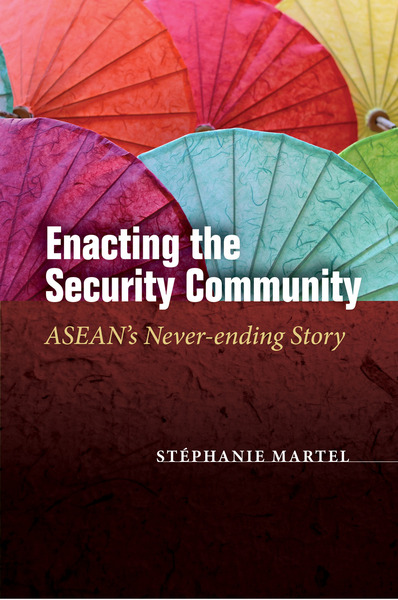
Getting published is not easy.  Turning a usually turgid dissertation into an interesting book that publishers will want is not easy either.  I thought the book workshop would be helpful so I built the book workshop into the CDSN's activities.  Last year, Stephanie Martel was our first CDSN book workshop survivor, and her book is now coming out of Stanford University Press.  Last year, it was entirely online.


This year, we worked to have the workshop be in person, and we almost got there.  Shannon Nash is based in Waterloo as the Director of Operation of one of the MINDS-funded Collaborative Networks: North American and Arctic Defence and Security Network.   Her book is this year's book workshop subject.  We had Tim Naftali and Karen Greenberg as the outside readers, Veronica Kitchen and Lorne Dawson were the "locals."  The former zoomed in, and the latter joined Shannon and myself in a conference room at the Basillie School of International Affairs.  It was great to see the three of them in person.  I didn't have much to say as I am not a terrorism expert, but I did have some suggestions about writing and organization.  Shannon got a lot of very constructive suggestions from the group, and I am sure her book will rock.  

I had not been to Waterloo since an edited volume conference about eight years ago.  I found a place that serves edible cookie dough, so that was an additional highlight of the weekend. 


It was great to see an original CDSN initiative come to fruition for a second time.  We still are looking for applications for the third one, so if you know of a Canadian scholar working on defence or security, broadly defined, let us know!

Oh, and look for Shannon and other sharp folks at the 2022 CDSN Capstone Seminar on Wednesday, April 13th! Tis online and in person!


Thursday, April 7, 2022

Civilian In Control of Military Teaches Civ-Mil Class

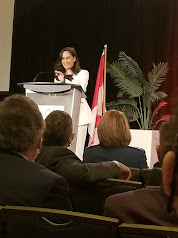
 Today was a pretty remarkable moment for me, as I don't think I ever had the subject of my course's content in the classroom.  Minister of National Defence Anita Anand had committed in our podcast interview a few weeks ago to join my Civil-Military Relations class, and today she followed through.  It was arranged at the last minute as her schedule is pretty crazy, what with a war going on and a budget dropping.

Minister Anand started by talking a bit about how she got here--that her academic law prof work on corporate governance caused her to enter the policy space via op-eds and other engagement.  This led to invitations for her to run for office.  She ultimately won a contested nomination and then ran in a not so safe riding, and did not expect to either be in cabinet or that the post she got (Minister of Procurement) would be so central.  But her background in contracting helped out when she was able to get vaccines for Canada quicker than most non-producing countries.*

* I tried to take the best notes I can, but having lawyers as colleagues, I have been informed that they are very precise about their words.  So, I need to be clear that I may not have gotten everything you see below word for word.

After her intro, I asked the first question.  I had noted that the coverage of the budget yesterday had indicated that we would be having a defence review which I had thought was in contradiction to an answer she gave at the CDAI Ottawa Conference on Defence and Security.  Today, she said that she very much favors having regular defence reviews as they serve to form the "backbone of defence policy."  She did note that we need to accept that some decisions must be made given the events of our time before a review will be complete. So, we will have a review, but that will not stop her from making decisions as they arise.  She said it was good to have a good, multiyear plan.

I pointed out that most IR types recommend that defence reviews best take place within a foreign policy review and that, well, we can't really expect a timely foreign policy review.  She indicated that she works closely with the Foreign Minister, but there are plenty of issues, such as procurement decisions that can essentially stand alone. 

Then the students asked questions.  The first was on continental security and NORAD.  She said that the government was already spending some $250 million to do the research to figure out what is needed--sensors, communications.  When pushed on priorities, she said that climate change was a greater concern than Russian encroachment--that is deterred in part by membership in NATO.

The second question was more civ-mil-ish (most questions were not): does one need to be an expert to be a Minister?  She said that her law degree was the key--that she could not function without understanding legislation, policy-making, processes to be accountable and to ensure others are accountable (sounds like an MA in International Affairs or Public Policy would be handy).  She notes that she has plenty of experts giving her advice and so the key is to know her authorities and to make the best rational decisions.  Her job is to "stay engaged with what Canadians need."  She "doesn't need to be an expert in military strategy, but does need to understand the National Defence Act."

A student asked if Canada might serve as a guarantor of any Russia-Ukraine agreement.  She indicated that was more of a Foreign Minister question.  She then noted all that Canada has been doing for Ukraine, including talking twice this week with their Minister of Defence.

The next question focused on China, and Minister Anand indicated she is a supporter of the sail throughs, where our ships go through international waters.  In response to a cyber question, where she noted that the Communications Security Establishment is her area of responsibility, she noted that part of Canada's assistance to Ukraine was helping Ukraine in the realm of cyber surveillance and that continues even as the training mission has been withdrawn.  That bit was the most surprising/newsy thing she said.

I wish I had primed the students to ask more civ-mil questions given the focus of the course and my desire for them to ask questions that I want to ask... but it was a fascinating 30 minutes.  We got a lot in and were most grateful she made time for us on this very busy budget day.

Sunday, April 3, 2022

The All Bad Faith Teams

 At the end of the NBA season, folks start to wonder who will make the first, second, and third All NBA teams.  Things get difficult as each team is supposed to have essentially one center, two forwards, and two guards, and sometimes the league has more terrific guards than forwards.  I raise this as I have been thinking about the All Bad Faith Teams.  That each team would have two Senators, one media person, a member of the House, and then one governor.  This makes it hard since there are so many strong competitors in most categories.

What do I mean by bad faith?  Individuals taking whatever argument they want to try to accumulate power and then hopping on the other side if it becomes more convenient.  The handy example du jour is of Tom Cotton talking about child abuse in the current confirmation hearings after spending much time codding child abusers who happen to be his pals.  The classic case, of course, that puts Mitch McConnell on the first team now and until he retires or dies, is of Mitch flipping on appointing people to the Supreme Court during an election year.  Against it, when a Democratic was doing the nominating, for it when a Republican was.  

So, who are on the 2021-22 All Bad Faith Teams?

1st Team:

Senate:  Mitch McConnell, Ted Cruz.  Neither one of them has met a principle that they would not flip on if it was convenient.  For Mitch, this is as much about past as present performance.  For Cruz, well, his performance in the hearings this week just remind us how skilled he is about being entirely without principle.  

House: Kevin McCarthy.  His turnaround on January 6th makes him an easy decision here.  

Media: Tucker Carlson.  To be fair, he is a fairly consistent white supremacists so he does have principles.  Still, he flips on all kinds of issues as soon as it is convenient.  

2nd Team:

Senate:  Ben Sasse, Susan Collins.  Sure, there are other Senators of bad faith, but these two get this honor for appearing to be moderate while actually betraying whatever commitments they appeared to make and supporting the most awful of stances.  

House:  Jim Jordan Matt Gaetz.  For the House, the 2nd team is reserved for those who engage in crime against the young or facilitate it and then claim that the Dems are the threat to the youth.

Media: Glenn Greenwald

3rd team

Senators: Josh Hawley as illustrated thusly,  Ron Johnson for being the sack of merde that he is.

House: Gosar, Gohmert   (MTGreene does not count--she is just evil, not of bad faith).

Media:  Ben Shapiro

Dishonorable Mentions: Mike Lee, John Kennedy, Marsha Blackburn, Joe Manchin.


I didn't address Governors as that would be too damned depressing, but it would be DeSantis, Abbott, and then Kenney. 


Monday, March 21, 2022

Testifying Before the Defence Committee

 Today, I got to be one of three academics to be part of a panel testifying on threats facing Canada and the military's readiness to address them. 

Here's what I said in my opening statement (and video):

Tuesday, March 15, 2022

The Challenge of Confronting Putin

 After President Zelensky spoke to parliament, we got another wave of people arguing for the No Fly Zone and other more aggressive responses.  I, of course, pushed back since a No Fly Zone = War.  As a reminder, a No Fly Zone would involve killing Russians in and above Ukraine and probably in Belarus and Russia and ... it wouldn't change much.  This is not Syria where barrel bombs and the rest were a huge part of the destruction. This is atrocities by missile and artillery, and a No Fly Zone would not stop either missiles or arty.  

Folks are rightfully frustrated, and so they end up making a bunch of arguments that I have to address.

If we don't do the NFZ, we will watch people be killed in front of us.  
--Yeah, and that is awful, but we have done that before.  Syria, Bosnia, Rwanda, Myanmar, etc.  

If we don't stop Putin now, he will keep attacking, eventually attacking a NATO country directly.
--First, it is not inevitable that he would go beyond Ukraine (more on this below)
--Second, the war in Ukraine demonstrates that the Russian army is not ready for prime time
--Third, the war in Ukraine will simply drain the Russian military so it won't be able to attack again anytime too soon.
--Fourth, thus far, Putin has treated NATO and non-NATO differently, and it is not clear why that would change.

If you let Putin win in Ukraine, you are appeasing aggression, and you can't appease dictators.
--Actually, you can appease dictators, countries do it all the time.  Not everyone is Hitler.  The US made deals with Stalin and Khrushchev, not to mention Gorbachev.  The US made deals with China in the 1970s.  Plenty of dictators don't engage in global conquest efforts.

We have to do something!
--We are doing a lot, far more than we would have expected a month ago.  Very significant sanctions, very energetic/public arms transfers, providing intelligence, giving humanitarian assistance, and more.  We are doing pretty much everything we can short of going to war.

How about a humanitarian corridor?
--Unless Russia agrees, this too involved war.  And I can't help but be reminded of the "safe havens" that the UN negotiated in Bosnia which became killing fields. 

A bigger war is inevitable so let's fight it now rather than later.
--The idea that war is inevitable is the worst self-fulfilling prophecy, making war more likely.  Let's not do that.  Because, you know what, a larger war is not inevitable.

We have been fighting limited wars since Korea where we didn't nuke China or otherwise attack the Chinese mainland (and they didn't attack Japan).  Limited war is actually more of recurrent thing in history than total wars.  Most importantly, Rule #1 of the Cold War and since has been for the US and USSR/Russia not to engage in direct conflict, and it has worked pretty well in terms of avoiding global thermonuclear war even if it mean that we watched oppression, persecution, and mass murder.  What Russia is doing in Ukraine is horrible, but intervening would probably be even more horrible as it presents a real risk of escalation.  It again sucks.  But proponents of intervention, including an NFZ, need better arguments.  Because the ones they have now are not persuasive at all.

Saturday, March 12, 2022

Two Years of Anger and Frustration: Happy Anniversary!

 Yesterday was the cotton anniversary of the pandemic in Canada.  I missed marking it as I was busy conferencing.  That and I am exhausted.  I look at last year's posts on the high's and low's of the first year, the lessons learned, and the feelings, and I marvel that I could write three separate posts on this.  I just don't have the energy this year to discuss this stuff all the time.  So, instead, let me just consider those three posts and what has changed, and then rank the years of the pandemic, because ranking is an old Spew theme.

I learned a lot in the first year of the pandemic.  Did I learn more in year two? Not really.... it was mostly more of the same.  Either that or I don't have the energy to figure this out (a recurring theme).

I charted the high's and lows after year 1.  Year two did have more highs and less lows, although it may not have felt like it:

  • More losses in poli sci (three big figures from my time at UCSD plus a few gods of IR), but no close friends or family this year.  We did lose Bob, our cat, who became super friendly in his last months with us. 


  • More covid in the family--all the nieces and nephews have had one bout, I believe.  My daughter has dodged it entirely--her discipline and enthusiasm for testing are marvels to behold.  One niece has had a series of injuries on the mountains--bike and ski--which absolutely sucks, but no serious cases of covid.
  • Vaxxed--everyone in my family is vaxxed, and only one side of the family is short of boosters.
  • Last year, I missed most not seeing my daughter.  I got to see her at the summer vacation, Thanksgiving, and Winterfest this year.  Much, much better.  And I got to see the rest of my family multiple times.  My sister crashed the 30th anniversary celebration as she joined me on the slopes of Whistler! Definitely a highlight.
  • Did I mention I got to ski Lake Louise, Whistler, and Fernie in the same winter?  I was definitely willing to fork out a heap of $ to make this work after a year of denial.  
  • Most regretted pandemic decision of the second year: probably the VR headset as I, well, suck at VR games too and haven't made the time to play.  
  • Furthest I traveled: Copenhagen.  For a civil-military relations conference that pissed off the Danish military.  It was a great trip--I learned a lot, got to hangout with some civ-mil scholars who are sharp and silly, meet new people, and enjoy a terrific city (I even dared to bike!)
  • Average pants-wearing: went up a bit as I started teach in person a few weeks ago, but probably only 1.3 days a week as I stayed home most of the time, except for grocery shopping.  My wife was shocked to see me wear my pj's as I would go get the mail at the community mailbox.  
  • Until classes started, I had gone to campus only three or four times--to deliver baked products to thank the Dean for travel permission, to get a shot, to swap out books for the new terms.  Only in the past few weeks have I been on campus for more than a few minutes at a time.
  • Ultimate!  I played last summer until my body said nay, nay.  And then I started again this winter and have been able to stay on the field!
  • The fave recipes remains mostly the same although the NYT gnocchi/cheese/burst tomatoes recipe rocks mightily and is super easy.  I did make another batch of CCCPD's to celebrate the pandemic anniversary.
  • Not much snowshoeing or cross country skiing this year--it was often too cold and then travel (downhill skiing!) got in the way.  
  • Favorite mask is now the Costco KN-95.... so much for style as the focus is now on efficiency.
  • Less re-watching this year as we got a heap of great new stuff with the faves being Hawkeye, Free Guy, Invincible, Mitchells vs the Machines, We Are Lady Parts, Only Murders in the Building, Yellow Jackets, and now the Adam Project.
  • Movies in the theater: Shang-Shi and No Way Home!!  Black Widow was fun, too.  The Batman was ok. 
  • Podcast of the year: Dead Eyes, about an actor who got fired by Tom Hanks from a small role in Band of Brothers.  It finished beautifully.
  • Biggest Surprise: that 2022 would be worse than 2021.
  • and the highlight of the year was the silliest poker game at Chez Saideman

Are the feelings the same at the end of year two as in year one?  I think I am even more angry.  That the availability of vaccines should have made things much better, but we had people and parties push back hard against something that could have saved even more lives.  The wasted lives, the wasted time, the unnecessarily stressed health care workers, the fucking idiots who occupied Ottawa, all of this is so enraging.  That everyone is reopening now even though rates of vaccines in the US and boosters in Canada are below where they should be, that there will be a new wave even without a new variant simply because governments are opening too soon does indeed trigger this lib.  Frustration? Hell yeah for the same reasons. The learning curves seem to be so flat.  The ups and downs can be most frustrating--that we thought last summer that we had this thing beat and the Delta kicked our ass and then things got better and then Omicron was all over the place. The second year was less lonely as we did start to go out and do things again.  I had an awesome poker game at my house in between waves (just barely).  I have traveled a bit to go to a Copenhagen conference that might have done damage to their civil-military relations, to three, yes, three ski trips to hang out with friends and family and celebrate 30 years of Mr. and Mrs. Spew! So, year two was less lonely, although not as good as pre-pandemic life certainly.  Fear?  Having three shots has mostly reduced the fears.  Relatives and friends have gotten very mild bouts of covid, but travel still is a bit unnerving with the need for tests and the concern of being a vector. Grief?  Jeez, the casualties from this thing have mounted--that year 2 was far more deadly than year 1 and mostly unnecessarily so.  Still lucky that no immediate kin or friends paid the highest price for this, but I am mourning the loss of yet another year in the life of younger folks and older folks, for which one year is such a big thing.  Relief? Damn, I don't know any more.  Things are better, but I worry about more waves and less willingness by people and politicians to do the right thing.  Which means, yes, the second year did diminish my hope.  Vaccines had so much promise and yet here we are.  The treatments are better, the promise of even better vaccines is around the corner, and all that, but, damn, so many people seem determined to value their political identity more than their health, their families, their friends, or their communities.  So, perhaps less acceptance than last year?  Definitely more exhaustion even though I am baking less.  Maybe I need to bake more?

2020 seemed to be the worst year of this thing because of the uncertainty and the change in how we lived our lives.  But more people died in 2021, and year 2 of the pandemic had more toxic politics even if Trump was no longer in power.  That we have vaccines is great, that many folks aren't getting them because their political identity gets in the way or because they are in parts of the world that we have failed is awful.  So, I'd have to rank the second year of the pandemic as being worse than the first even though I got to see more of my family in the second year. Year three starts with a tragic war in Europe, so.... yeah.

Best of luck to you and yours as we keep working our way through this thing.

Conferencing on Ottawa Defence and Security

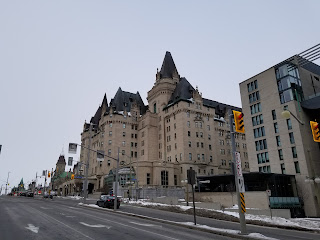
So great to be in quiet downtown at Hogwarts.
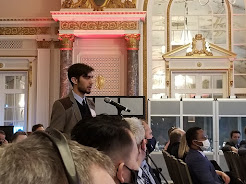
Today, I watched and participated in the Ottawa Conference on Security and Defence, a 90 year tradition run by the Conference of Defence Associations Institute (the think tank associated with the various veterans associations).  I have attended regularly in the past and appeared once or twice before.  CDAI is a CDSN partner, so we try to support them in this and their other efforts.  This big show is THE Canadian defence conference of the year, with the Minister of National Defence, the Chief of the Defence Staff, and other bigwigs from here and elsewhere giving talks.  There have been US 4 star officers regularly on the program and even, once, an ex-defence minister/plagiarist from Germany. In the past, I have live tweeted and summarized the conference.  Today, I did a little bit of the former, and here's my attempt at the latter.

To start, I missed the virtual first day and the in-person second day due to competing commitments.  I missed the big speech by the Chief of the Defence Staff yesterday alas.  This morning kicked off with Dr. Cynthia Watson of the US National War College having a conversation with Richard Fadden, the former National Security/Intell Adviser (the closest thing Canada has to a National Security Adviser), focusing on China.  It was very interesting.  The focus at the start was on what does the Ukraine situation mean for Taiwan, with the possibility that it might change the timeline but not alter the CCP's stance--that Taiwan can't become independent and that it might just be invaded someday.  One thing I hadn't thought of--the war in Ukraine has important implications for China's food security since it gets much grain from Ukraine and Russia. 
Because she had to go after about 25 minutes, Fadden shared his thoughts, and he was quite sharp and coherent despite his assertions to the contrary.  The big question: now that there is pressure to increase the defence budget, who much and to what end?  He argued that while the developing countries support the sanctions against Russia, they will blame the west for the higher food prices that will harm them. He then asked whether the government is thinking beyond the short term--what is our strategy down the road?

This was not a manel as the French MoD
speaker was zoomed in

The next panel was on the Indo-Pacific with a mix of Canadian naval officers, retired American admiral (who spent way too much time talking about his background), French defense civilian, and Aussie attaché.  I found it interesting, but I took poor notes.  


I cleaned up
for this event

The next panel was the one where I chatted with Darren Bricker, who has written much on Canadian politics and works for the polling firm IPSOS.  He once wrote a book about the Laurentian elite, so he took my question about the Ottawa bubble and ran with it.  He discussed how it is not really inflation that is upsetting Canadians but the high price of housing--that the young folks are upset that they may not be able to buy a house.  We discussed public opinion and the Canadian Armed Forces--that the scandals have had an impact on how the public views the CAF.  


Most people were waiting for Minister of National Defence Anita Anand's talk, and the number of folks with multiple leafs on their shoulders increased by quite a bit.  I don't think they were disappointed.  She didn't say anything very controversial, but she was far more dynamic, interesting, and engaging than her predecessor.  She made prof jokes while also doing a nice prof job of outlining her talk--focusing on Ukraine first, the wider international picture, and then the CAF.  Her talking points were similar to other NATO leaders--that we would defend "every inch of NATO territory" which does not make Ukraine or Moldova or Georgia feel great, but, well, these various lines do matter quite a bit. She emphasized that the weapons and other equipment we promised to Ukraine have been delivered, which is remarkable for a government that decides slowly and procures even more slowly (except for vaccines). 
She emphasized the focus on NORAD/northern warning modernization--that it is in her mandate letter--with $250m allocated and that is just the start.  This was very much in line with the new consensus in town--that defence budget cuts are not going to happen anytime

soon thanks to Putin/Russia.  In the Q&A, she was asked about whether we would go farther on NORAD stuff--to join the US anti-ballistic missile efforts.  This is where she got the most careful in her wording--that we would be working very closely with the Americans.  The ABM stuff is controversial because Canada didn't opt in way back when Bush was president since he was tossing out a key international agreement, and the Liberals are huge fans of the rules-based order.  I think at this point, the ABM treaty is dead, so resisting is moot (that the US still can't reliably shoot down ballistic missiles is an issue, of course), but this seems to be a Liberal bugaboo. 
Regarding the efforts to reassure the Baltics and deter the Russians, Canada is now indefinitely extending (which makes much sense and here's the episode of #BattleRhythm with a former commander of the battlegroup), surging a bit, and committing to another rotation of air policing in Romania (see this episode of #BattleRhythm for my interview with the officer who commanded the previous rotation).  She noted that having more than 3k troops on alert is straining the force.
In the last part of her planned comments, she talked about the CAF.  Much of her discussion was rah-rah--that the troops are doing amazing things in a very difficult time.  And this makes sense--she needs their buy-in for the reforms she will be pushing AND the troops have been doing great things.  However, resistance is already building to the culture change and other stuff that needs to be done as the past year has been a bit of a reckoning for the CAF--that the abuse of power scandal has revealed much about the CAF, and we need more clarity of what is being changed to inflict civilian control upon the military.  She discussed procurement, committing to the 15 ships (of course) and to making a decision about the fighter replacement (seemed like she committed to this happening this year, but I may have heard wrong).
In the Q&A, Anand pushed back against having a new defence review, arguing that she is moving now to change stuff, and does not want to wait for a review.  I would argue that Canada needs to have regular reviews, like other countries, so that we have a regular set of benchmarks that get evaluated and revised, that we adapt in a more regular fashion.  She brought up the domestic operations (floods, fires, pandemic) in the Q&A, but I would have liked to have seen her discuss that as part of her comments.  We need to move from domestic ops as an afterthought or as a fourth priority towards making that aspect of the CAF's work as important as expeditionary operations/alliance support.
Anand noted that she does not know how long she will be in this position as they have a minority government, so her focus is on doing what she can every day.  Anand did a far better job yesterday answering a question I asked Vance when he was CDS in 2018: how do you make sure this stuff lasts beyond you?  She talked about institutionalizing the reforms, so that these things will continue after her party loses an election (or if she gets elevated to another post). I didn't ask her any questions as I will have an opportunity to do that in the near future.

Dan does NPSIA proud.
The last thing I'd like to note is that in the one day I was present, I'd say the majority of audience questions were asked by NPSIA MA students who did us proud.  They asked sharp, interesting, relevant questions of the various speakers.  Well done!


The view from the stage


Wednesday, March 9, 2022

Russian Irredentism: Killing the Kin to Save Them

Watching recent events (and inspired by this tweet about Latvia's PM's take on this), I am reminded of the misquoted from the American war in Vietnam: we had to destroy the village in order to save it.  Seems like Putin's Russia is killing the kin in order to save them.  That the attacks on the Russian-speaking parts of Ukraine are hurting those that Russia is supposedly trying to help.  This speaks to a variety of aspects here that I want to address.

First, when a country tries to reclaim supposedly lost territory, the ethnic kin in the lost territory don't have to demand this effort but it does help legitimate (or at least soften the illegitimacy) of the cause. It also might impact the domestic politics of the redeeming country.  In our book, Bill and I found that irredentist foreign policies did not seem to be related to how endangered the kin are (see middle column of the table to the right), but, of course, we didn't consider whether the danger came from the irredentist state.

Second, the plight of the kin (real or imagined) can operate in at least two ways: putting pressure via domestic politics on the leadership of the kin state to do something about it or providing an opportunity for the leadership to focus the domestic audience on this threat to the nation (which includes those outside the country).  That is, it can be a bottom-up or top-down dynamic.  In this case, it is pretty clear it is top-down--that Putin was under little or no pressure to do something about the plight of Russians in the Ukraine.  Instead, among his motives may have been a desire to strengthen Russian nationalism at home by emphasizing the us-ness of Russian speakers within and outside of Russia at the expense potentially of other conceptions of the Russian nation.  But I can't imagine that killing Russian speakers in Ukraine helps the building of domestic support within Russia or to define the Russian nation in ways that abet Putin's desires to stay in power.

This reinforces my conclusion (and my bias) that irredentism does not have to be sincere, and that Russia's irredentism towards Ukraine, besides maybe Crimea*, is entirely insincere.  I never thought that the separatist groups in the Donbass were genuine efforts at greater self-determination but rather created by Russia.  Putin's speech to kick off the war was very much an irredentist appeal--that Ukraine never really existed and has always been Russian, etc.  Despite this speech, I am not so sure he is all that sincere--that he would have been happy in 2013 with a pro-Russia Ukraine, he would have been happy in 2021 with a pro-Russia Crimea-less Ukraine.  I don't think Putin is really motivated to create a Greater Russia despite his apparently longing for the good old Soviet days.  I do think he wants domination--that dominating Ukraine and Belarus and other parts of the former Soviet space would have been sufficient.  

The threat to that domination was never NATO but the European Union.  That is, an alternative, west-leaning model has been a threat to Putin's domination of Russia and much of the former Soviet space.  Again, the timing here is suggestive--2014 when Ukraine starts looking to the EU; 2022 when Ukraine keeps looking westward.

And here is an irony and a stupidity: that Putin, by absorbing Crimea and by taking the eastern regions of Ukraine out of Ukraine's political system, altered the balance of political power in Ukraine.  He removed the most Russia-leaning components, which meant that even if the rest of Ukraine wasn't pissed off, the balance of voters shifted by subtraction, making it more likely to have pro-western leaders.  Putin improved Zelenskyy's chances of getting elected.  When folks talk about California seceding, I push back, saying that would alter the balance of power in the US, making it impossible for the Dems to win at the national level.  Well, Putin did this--he made it far harder for a pro-Russian Ukrainian politician to win just on the numbers, not to mention antagonizing many Ukrainians via his bullying.

This conflict is an intersection of many things: irredentism and other elements of ethnic politics (see the Ukrainian diaspora mobilize), civil-military relations, alliance politics, sanctions, coercive diplomacy, nuclear strategy (stability-instability paradox), and more.  From most perspectives, Putin has screwed up bigtime, including the third classic error of thinking regime change will be easy (don't wager with a Silician when death is on the line is the second).  Which, of course, is not reassuring because there is plenty of room for Putin to get into deeper and deeper trouble, hurting more and more people and risking a wider and wider war. 


* The referendum was a sham, but there did seem to be a fair amount of Crimean Russians who wanted to be in a Greater Russia.

Saturday, March 5, 2022

The Disease of MOAR

 Pat Reilly, the NBA coach and then general manager, apparently would talk about the disease of me or of more--that after winning a championship, repeating becomes hard because players focus more on themselves and less on the team.  This is not what I am discussing today, but this is where the phrase came from.

 Today, the disease of MOAR is the nearly constant demand for leaders to do more than are currently doing.  The status quo can never be quite good enough--leaders must do more. The media often ask: there is this thing you are doing, why aren't you doing more?  The opposition, if they like a policy, can argue that it is insufficient and demand MOAR.  The two, the opposition and the media, feed off each other as they demand more.

Why am I thinking about this now?  Because folks are demanding that the US, Canada, and NATO do MOAR to help Ukraine.  Let's see...they have cooperating more than we thought possible two weeks ago to levy and enforce very painful sanctions.  They have almost competed with each other to arm the Ukrainians.  They have reinforced the defenses of neighboring countries.  They have engaged in much diplomacy both to build the cooperation on this side and to try to get Russia/Putin to relent.  They have given Ukrainian President Zelenskyy heaps of platforms.

BUT WE NEED TO DO MOAR!!!  We need to do a no fly zone, we need to intervene directly.  I have written about the NFZ and memed as well [here's my very blunt tv hit on this]. I won't get into it now except to say that it is quite normal for Ukrainians to demand that the west does more including getting involved quite directly via a NFZ that would lead to Americans and Canadians and Germans and Brits and French and others killing Russians in Ukraine and in Russia.  This certainly would be MOAR, but given that Ukraine is facing horrific assaults, these folks can demand MOAR.

The media?  Probably not. They should be aware that certain steps on the escalation ladder are more risky than others.  We have spent nearly 80 years trying not to engage in wars with nuclear power states because we don't know that they will stop at the conventional level.   In this crisis, we are very close the threshold where MOAR means a real risk of nuclear war.  Which means that asking for MOAR is pretty damned irresponsible (unless you are Ukrainian).  

But it is so easy and tempting to ask for MOAR because it puts the government on the defensive, having to explain that having the technical ability to do MOAR does not mean that MOAR is a good idea.  The good news is that in this case, MOAR is so very bad that it isn't going to happen.  Biden won't do it, and he won't be pushed by Trudeau and others to do it.  

I just wish folks would take seriously that MOAR is not always better and be critical of those who demand MOAR.

Tuesday, March 1, 2022

Why No No Fly Zone?

 I made this a few days ago and it appears to be still required


Why?

Because a retired general in Canada (as well as some elsewhere) have been calling for NATO to enforce a No Fly Zone over Ukraine.  People seem not to be too concerned about the risk of, well, global thermonuclear war.  So, let's play it out, shall we, with a general X and a Minister of National Defence A:

MND A: So, what do you recommend for us to do?
General X: We should declare a No Fly Zone over Ukraine so that the Russians can't bomb civilian targets.
MND A: What about missiles and artillery?
General X: Oh, the Russians have plenty of those and use them to devastate Ukraine.
MND A: So, why enforce a No Fly Zone?
General X: It is the least we can do, we need to do MOAR!
MND A: Ok, so if we do the NFZ, that means we fly over Ukrainian air space and shoot down Russian planes and helicopters and drones, right?
General X: Well, sure, but we would also want to shoot them down while we are flying in allied airspace to take advantage of how far our weapons can fly and reduce the risks to our pilots from their fighter aircraft.
MND A: Oh, so we would be attacking from allied airspace, but keeping our attacks focused only on planes in Ukrainian airspace.
General X: oh, and anti-aircraft batteries.
MND A: In Ukraine?
General X: well, the Russians have built up anti-aircraft systems nearby--on Russian territory including Kaliningrad. 
MND A:  So, we'd leave those alone, right?  We wouldn't want to attack anything in Russian territory, right?
General X: We'd have to take them out.  To enforce a No Fly Zone, the first step is to take out the anti-aircraft systems of the adversary so that our planes could fly safely.
MND A: So, if we attack Russian weapon systems in Russian territory, what would stop them from doing the same--attacking our weapon systems in allied territory?
General X:  Well, if they did that, they would be escalating and risking a war with NATO as it would potentially lead to the invoking of Article V.
MND A: Let me get this straight, we would attack Russian units in Ukraine and probably Russia, but we would expect them to be restrained?
General X: Sure, because they wouldn't want to start World War III.
MND A: Wouldn't we be starting with our attacks on Russian military units, something that everyone has tried to avoid for about 70 years?
General X: I don't think it would raise the risk of nuclear war by that much.
MND A:  So, it would raise the risk of nuclear war.
General X: Sure, but only by ... say ... 10%. 
MND A: So we have gone from nuclear war being improbable to being possible but not likely?
General X: Well, yeah, but, see, we would be doing something more than what we are doing now.
MND A: And we would only be risking a smidge of nuclear war... General, you are fired.

End scene

 To be fair, Hillier is retired, and retired generals can spout reckless stuff all they want.  The nuclear era is a dangerous place, and one of the rules to avoid nuclear war has long been not to shoot at countries that have nuclear weapons.  Sure, we had some pilots from various opponents engage each other over the skies of Korea and Vietnam, but there was heaps of plausible deniability and no risk of allied/enemy territory being hit.  In this case, the NFZ would be most public--no deniability--and NATO/Russian territory would be implicated.


Tuesday, February 22, 2022

Putin and Ukraine: Irredentism 101

 Irredentism is refers to efforts by groups or countries to reunify lost territories with a homeland.  I wrote a book with Bill Ayres about the irredentism that did and did not occur in the 1990s: Greater Armenia, Greater Croatia, Greater Serbia vs Hungary, Romania, and Russia not pursuing such efforts.  We got to release a paperback edition with a new preface in 2015 thanks to .... Putin's irredentist move where Russia seized Crimea.  Here's what I know about irredentism from my previous work and from other people's work in this area and how these basic rules apply here.

  1. Irredentism is always costly for the country engaging in the effort--it generally requires war since countries do not part with their territory without a fight (well, almost always).
  2. What is bad for the country may or may not be good for the leader.  Irredentism is a nationalist effort that can tie folks together towards a common identity.  Politicians may use irredentist appeals (whether they follow through on it or not) to refocus the country's nationalism on this cause rather than other aspects (see Hungary and Viktor Orban where Hungary was optimally obnoxious to the neighbors--enough to get support domestically, not enough to risk war).
  3. #2 suggests a third rule--Realists have a hard time explaining irredentist efforts because they do not help the country become more secure or even gain more power.  They just gain perhaps some territory and some new citizens.  In the 21st century, this does not help Russia become more powerful or more secure.  Maybe it will make Putin more secure, but that ain't the same thing, is it?
  4. Irredentism is driven by domestic political dynamics more than international.  Some would argue that countries engage in irredentism when there is a good opportunity, but I can summon examples where countries not only jump through open windows but also attempt to jump through brick walls.  Somalia engaged in irredentism both when it was relatively stronger than its neighbors and when it was weaker.  Croatia engaged in irredentism even as it was being taken apart by an irredentist war thanks to Serbia.
  5. What about these domestic political dynamics?  It is not just pure nationalism since nationalisms are around all the time--it takes a political entrepreneur to push for "reunion" and one has to figure out their game.  And that is where I am mostly stumped since I don't know contemporary Russian politics these days.  All I can say for certain is that the domestic game matters quite a bit.  
  6. One thing that enables Putin is that Russia is already a multiethnic country dominated by one group.  This war doesn't change that, and irredentism is easier/more desirable for countries in this position.  In our book, we found that fear or hate of others, xenophobia, can actually inhibit irredentism since a successful irredentist foreign policy is the equivalent of a giant wave of immigration--adding many new others to one's country.  But Russia is not so xenophobic so it can do this without the nationalist backlash (unlike, say, Hungary).   

Update:  7.  Irredentism need not be consistent.  The actor may not claim all disputed/historical territory.  The key is what is digestible--who lives where, how easy are they to rule, what do they do to the domestic political balance of the irredentist state.  In this case, that means maybe Eastern Ukraine gets absorbed formally or informally but perhaps not all of Ukraine.  

Russian irredentism here is more than just imagined since the territory in question used to be part of Russia and there are Russian speakers who may identify with Russia and want to be part of Russia (#notallUkranians or even residents of Eastern Ukraine).  Saddam Hussein's moves against Kuwait were not really irredentism since there was not really a people or land to be be redeemed.

This does not make Russia's moves legitimate at all.  But it does give this a bit more heft within Russia than Poland or Bulgaria.  The Baltics?  Oh my.  The history gives Putin something to play with and he seems to have his own grievances at stake in all of this--resenting the breakup of the Soviet Union.  International law, such as it is, is not on his side.   Conquest is not hip as the Kenyan rep at the UN made clear.  And while the US has committed many awful acts including a pretty illegitimate war in 2003, it has not engaged in conquest lately.  Who has?  Um, China with Tibet and perhaps Taiwan in the near future.  So, rule 6: don't expect the UN to stop this.  

This is a bad move for Russia and the Russian people and much worse for Ukraine.  Whether it pays off politically for Putin is not clear.  Many irredentist efforts are gambles that do not pay off very well.   And, yeah, there was not much anyone could do to deter Putin and Russia in this.  As long as the US/NATO weren't willing to risk WWIII over a non-ally, we had few cards to play.  

In sum, irredentism means war, and it is not easy to deter or prevent.  Ukraine is screwed, and there is not much we can do about it but make it costly.

Saturday, February 19, 2022

Rooting for the Cops? Well, Yeah

Some say yesterday was a sad day in Ottawa, but I was pretty elated.  After two years of watching cops repress Black Lives Matter protestors, I am now rooting for cops as they arrest far right extremists that have occupied downtown Ottawa.  Does that make me and mine hypocrites?  No, for a couple of reasons focusing on both the conduct of the protests and the content.

First, I don't remember BLM protesters using kids as shields.  I don't remember BLM groups trying to use arson as a tool of mass murder (yes, some BLM protests had fires, but no attempts to lock down and then burn an apartment building).  BLM groups did not harass and assault health care workers, the media, or passersby who were masks.  This has not been a peaceful protest despite the hot tubs and singing.  The far right extremists in town have been bullying storeowners and threatening the residents.  

Second, the content also matters.  BLM protesters were protesting police brutality, and the police kept on providing more evidence that the BLM cause was just.  The far right extremists in Ottawa were opposing ... heaps of stuff as their crazed conspiracy shit metastasized.  They oppose vaccine mandates and mask restrictions at a time where these are two of the best ways to mitigate a pandemic.  Their MOU (a memorandum of understanding because a manifesto would have sounded too commie?) called for the elected government of Canada to be tossed out by those who don't have the power to do so (the Governor General and the Senate).  They are really upset that Trudeau is in power--but that is because the parties they favor and that pander to them lost.  The election was partly over mandates with the Conservatives pandering to the far right and the far right party focusing very much on this.  And they lost.  60% of Canada voted against these two parties.  Yes, Trudeau only got a third of the vote, but the pro-vax mandate, pro-mask restrictions parties won bigly.  Oh, and most of the restrictions are actually set at the provincial level.  

For three weeks, Ottawans were not upset at the cops for being too brutal, but that they didn't do anything at all except seemingly empower the worst of the worst.  We sincerely worried about white supremacists within the police force.  So, when we finally saw the police carefully, slowly, methodically push back and use much less force than the police forces of the US at the various BLM protests, we were and are elated and relieved.  The behavior of these cops has been quite restrained--so far, no one has been beaten.  Yes, windows were broken when folks refused to get out of their vehicles.  But they had been repeatedly warned.  I do wonder if any kids were taken into protective custody, but that is on the parents, who were repeatedly warned.  

While the far right media are trying to make this thing a colder version of Tianamen square, we have to remember that (a) the protesters in China were pro-democracy while those in Ottawa are anti-democracy; and (b) we have no idea how many were killed that day in China, and we know how many were killed in Ottawa (zero).  

Ultimately, it comes down to this: we want the cops to protect and serve the public, not themselves and not far right extremists.  Yesterday and again today, the police in Ottawa are serving the public.  

And, yes, there might be a hint of bias in all of this because:


Tuesday, February 15, 2022

Why Does Canada Need the Feds to Intervene?

 Yesterday, Justin Trudeau invoked the Emergencies Act, which significantly escalates the role of the federal government in dealing with the far right extremist occupations of Ottawa and various border spots.  Will this make a difference?  Well, the various tools that were brandished yesterday suggest so.  The threat of anti-terrorism financial tools potentially destroying the organizers' ability to, well, function in the economy could make a big difference.  Indeed, this is quite a hammer... but is it necessary?

The challenge that many are leveling against Trudeau and the federal government (after two weeks of so many folks asking for leadership and MOAR!) is that there are plenty of tools at the provincial level.  The provinces could have yanked the certifications of the trucks, their licenses, and all that kind of stuff to greatly increase the costs of participating in this stuff.  But they chose not to do so.  

The big difference between the federal level and several of the provinces is not the legal stuff but the political stuff.  Trudeau does not have to worry about alienating his right flank with these decisions.  Doug Ford (Ontario), Jason Kenney (Alberta), and Scott Moe (Saskatchewan) all are Conservative party folks (in Canada, the provincial parties have more distance from the national ones) who have to worry about alienating the far right folks in their party, not unlike how those in the GOP have had to worry about their far right folks.  Ford has had plenty of opportunity to do more to clear out Ottawa of these extremists, but has chosen not to do so.  He only get some semi-serious about the Windsor blockade since it threatened to choke off much of the car industry in Ontario.  But Ottawa, he does not really care that much about--he resides in Toronto and his base is in Toronto.  

Not only have these Conservatives refused to penalize the extremists but they have sought to appease them by reducing restrictions as quickly as possible.  (Here's my poll re the biggest appeasers in Canada).  To be fair to Ford, his pattern has always been to tighten restrictions late and reduce them too soon.  Testing has completely fallen apart, so it is not clear what data is being used to justify the elimination of vax requirements.  Certainly not whether the hospitals are under stress or not (hint: they are still under great stress). 

Anyhow, I am not sure that the crisis meets the threshold for the Emegencies Act (I don't play a lawyer on TV), but I can easily understand why the feds could drop the hammer more so than the provincial leaders.  But then the hammer is likely to be much heavier with more consequences (good and bad).  We shall see if this leads to better police coordination given that the city and provincial police authorities have utterly failed Ottawa.  It will certainly lead to the organizers of this thing will pay a higher price than they might have expected a week ago.  Their ability to get car loans, mortgages, credit cards, bank accounts, and the like may have disappeared overnight.  And, no, I don't have much sympathy for the far right.  So, sucks to be them right now.  

What happens next?  We shall see if the feds can deliver, something that has been a mixed bag over the past six years.


Sunday, February 13, 2022

Policiing is Always Political

 One of the most misunderstood quotes in all of civil-military relations is that war is politics by other means.  I was reminded of it as folks were tweeting today about the current mess in Ottawa having political and policing dynamics as if policing is not inherently political.

Politics is a term to describe pretty much anything where the decisions are being made that affect the public.  Sure, politicians do politics all the time as they try to make decisions that will allocate, redistribute, regulate, etc.  But other actors also do politics, and, of the various actors in any place, the police are among the most political.

There is no private space for policing--everything they do involves the public.  And there is a heap of decision-making because they have finite resources, time, and energy, so they are constantly having to make decisions about which laws to enforce, what constitutes a sufficiently egregious violation to warrant attention, whom to watch, whom to stop, etc.  As someone who speeds much of the time, I am very well aware that the cops don't enforce the speed limit at exactly one mile or kilometer/hr over the speed limit.  We tend not to think that much about the politics of speed limits except when photo radar gets proposed that would reduce the discretion of the speed-trap monitor.  But when photo radar is brought up, the politics does not end since the question remains--where to install it?

Of course, I can speed because I am a white dude.  I don't fear a traffic stop like people of color do, as my death or beating is not a likely outcome of such an encounter.  This gets us to the deeply political nature of policing as police don't treat every person the same.  There is much politics involved in who gets policed.  Stop and frisk everyone?  Nope, mostly people of color.  The current crisis in Canada, which has angered heaps of white folks, shows that policing is political as the white supremacists, far right extremists have faced far less policing than the average Indigenous demonstration.  There have been plenty of pictures and videos showing cops being pretty damned friendly with those holding Ottawa hostage. So, who gets policed is up to the discretion of the cops, and they have used this discretion in ways that have deeply challenged public order.

For the past few years, it has been abundantly clear that the cops in North America have been out of control--that they have used their discretion as they see fit, treating far right folks with kid gloves and brutally beating those people who have the temerity to protest police brutality.  When mayors and city councils have tried to regulate them, when authorities have required mask and vax mandates, police unions have pushed back, just as they push back against any accountability for police brutality.  If that were not problematic enough, the way things seem to work in Canada is that the politicians don't think that they have the power to direct the police.  So, the cops are even more autonomous, even as they make decisions with bigger and bigger political consequences.  The Mayor of Ottawa talked about the failures of policing using the passive voice today, as if he didn't have any role in this.  

I see people of color online noting that the white folks seem to be surprised that the cops are out of control, that they police selectively, and their selectivity often seems to favor white supremacists.  They know it has always been thus, but that white folks didn't really understand it in Ottawa, anyway, until now.  So, no, this is not really news.  I have long assumed that the cops here were out of control--what I did not know is that the politicians thought that this was normal and acceptable.  

Maybe that will change now.  Or maybe the citizens will have to do what the cops refuse to do.  I am writing this as my colleagues and friends have joined counter-protests that are keeping the extremists from reinforcing downtown with yet more assholes.  When told by the cops to move aside, that the cops will handle it, the crowds scoffed and remained in place.  Because, of course, they have no reason to believe the cops.  

There are several unanswered questions but two come to mind:

  1. Will any politicians pay a price in the next election for screwing this up?
  2. Will the police pay a price for their refusal to do their job?  

If those who have failed us don't experience consequences, any chance to learn from this, to do better next time, evaporate.  And that, too, will be political.


Friday, February 4, 2022

Anger and the Academic

 We academics are accused of two things: that we are too dispassionate and that we tend to suck all the emotion out of our theories.  Well, not all of us, but folks like me, who are either soft rational choice types or more strict rational choice types.  The occupation of parts of Ottawa by far right extremists has caused me to think about this a bit.

First, I am about as angry as I have ever been about political stuff.  I hit some peaks during the Trump Administration especially when we saw pictures of little Muslims kids in handcuffs.  And during some of the violence aimed by police at those protesting police brutality.  Am I angry because these assholes have pissed on the war memorial?  Because they defaced the Terry Fox statue?  Because they burned a Canadian flag?  Because they have been carrying swastikas?  No, that stuff is annoying and offensive, but it does not cause me to have a semi-blinding rage.  Perhaps it is the combination of how incredibly stupid these folks seem to be (no, the Governor General and the Senate don't have these powers and most of the covid regs are provincial) and how craven the Ottawa cops have been.  That these folks are not only getting away with bullying the city and its residents but that they are being taught by the police that they can keep doing it and even do it in other parts of the city.  

Second, regarding how we political scientists often treat this stuff, we tend to assume that folks are acting rationally and go on from there, assuming away often the emotional stuff.  A friend, Stuart Kaufman, sought to correct this with his book Modern Hatreds.  While ancient hatreds is a bad way to explain stuff, frequently becoming a rather racist account, modern hatreds blends the psychology of emotions with more structural stuff.  That security and insecurity are emotional dynamics. In this case, the deplorables are people who are angry and resentful (mostly because white folks are seeing that non-white folks are doing well and that makes them feel like they are losing their status) and that mobilizes enough of them to hang out here.  They can do so because of a few structures: the ease with which outside trolls can fund this stuff so that the assholes here can get gas and such; the right-wing party politics I have discussed before; the principal-agent problems within local and provincial law enforcement (who's in charge and who knows what the officers on the ground are doing--providing aid and comfort to the occupiers?); etc.  So, it is not just raw emotion at work, but the blinding stupidity of the claims and demands have much to do with emotion.  

Indeed, one of the strange dynamics of the past ten years is how much the right is motivated by the desire to trigger the Libs.  In the US, this has ultimately been suicidal as refusing to wear masks, refusing to get vaxxed is more about pissing off the center/left as it is about any principled position about "freedom."  It may be emotionally satisfying to piss off your opponents, but if doing so risks the lives of oneself, one's friends, and one's family, well, that is pretty dumb.  But hey, if some grifters can make money off of it, then why not?

Perhaps my takes here are biased by my anger.  But so far, the behavior of these folks seem to justify my anger quite a bit.  And, yes, they win because I have been triggered.  Woot for them, I suppose.  Pretty sure that will be a Pyrrhic victory for them.  And since they are idiots, they won't understand that, so the last laugh will be mine, I suppose. 


Tuesday, February 1, 2022

Outbidding Comes to Canada

 I don't know the deep history of Canadian politics as I only started paying attention once I moved here and not even then for a while as I was too busy adjusting to Quebec and to the cold and to the big move.  So, I can't speak to how right-wing politics worked way back when.  What I was going to say before news broke out that Erin O'Toole is facing a leadership fight is that outbidding is really hard for even strong, united parties.  And now?  Oy.  

I have been blasting the CPC lately because a number of its members, including its deputy leader, have been giving full-throated support for the far right extremists who are blockading a hunk of downtown Ottawa.  This reddit page lists not only the events but also the politicians who have stood with the supposed truckers' convoy.  O'Toole tried to have it both ways--meeting with some of those in the convoy before it hit Ottawa and then condemning those within the group that danced on the Tomb of the Unknown Soldier, defaced the Terry Fox statue, and used swastikas and the like.  This did not go over well with the fanatics and opportunists in his party, so he could be done.

In the recent election, O'Toole had a difficult problem--there is a new far right-wing party--the People's Party--led by a former Conservative, and so he faced pressures to play to the far right folks who remained in his party now that they have an exit option.  The problem is that the votes needed to get the party into power are not on the right but in the center.  So, O'Toole could pander to the far right and probably lose or play to the middle but risk breaking his party in half.  He chose to do both.  His stance that vaccines are good but mandates are bad did not play well, and helped him lose the election.  

In the winter, O'Toole faced another challenge--a bill to ban gay conversion therapy.  The public overwhelmingly supported this bill as did the other parties, but not the social conservatives in his party.  So, he tried to just get unanimous consent so that way he wouldn't have a significant chunk of negative votes that the opposition could run on.  Well, apparently that pissed off these folks.  

There is probably other stuff going on as well. But the key to O'Toole's dilemma is that he faces outbidding both outside his party and within it.  He didn't go full far right nutso, but he also tried to keep those folks on board.  His successors are likely to be further to the right, which will consign the party into the wilderness at the national level.  They can't win national elections by moving further to the right.  They don't have the power to suppress votes or redraw lines like their American friends have.

Isn't this a good thing?  That the right is breaking apart?  Um, not so much.  Democracies require competition and accountability to work.  The Liberal Party, which tends to be smug and arrogant, leading to stupid, unnecessary shit (WE scandal, SNC-Lavalin, etc), needs to be penalized when they do that stuff.  The New Democratic Party can't do that on its own for a variety of reasons.  Partly because they can only criticize the Liberals for not being sufficiently left wing, partly because they have their own divides.  Canadian politics would be better off if there was a solid, reasonable center-right party that centrists could vote for, that could challenge the Liberals to perform better.

That is now what Canada has, and, soon, it will have something worse than that: a right-wing party that not only caters to extremists but is led by them.  We have seen this play out in the UK and in the US, and neither political system is better off for it.