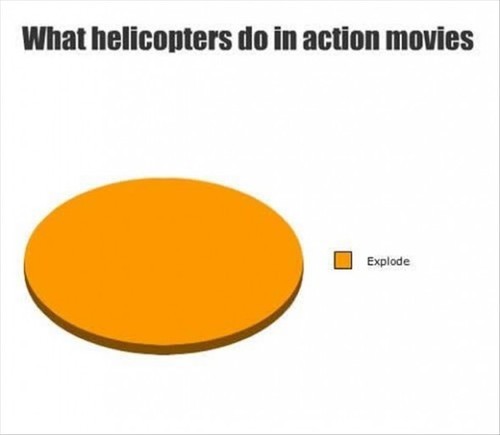
Procrastinating a bit with more I Love Charts:
Of course, if this was real life, the pie's biggest slice would not be explode but broken.
International Relations, Ethnic Conflict, Civil-Military Relations, Academia, Politics in General, Selected Silliness
Tuesday, June 4, 2013
Pondering my Argument
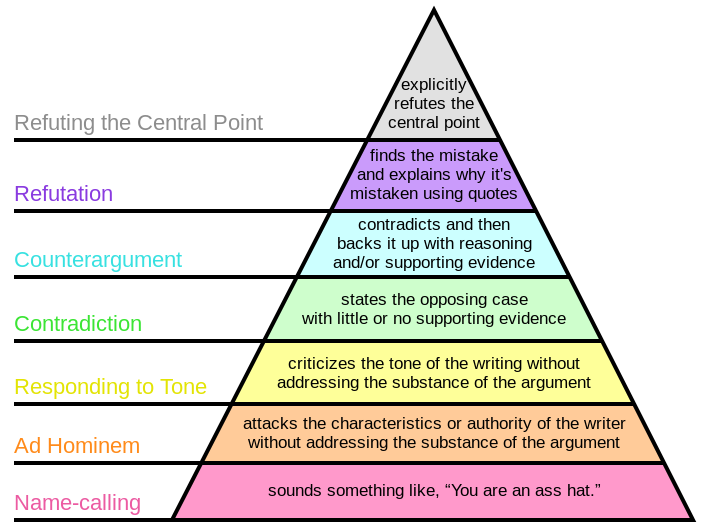
I had a pretty healthy rant in the direction of a Canadian columnist. The question is where does it fit on this handy chart:
From I love Charts: http://ilovecharts.tumblr.com/page/2/.
Almost certainly a mix, as I accused him of generational thinking (thanks Roland), so that would be Responding to Tone. But did I climb higher in the pyramid? I don't know. I do know the commenters on the piece include many ass hats.
From I love Charts: http://ilovecharts.tumblr.com/page/2/.
Almost certainly a mix, as I accused him of generational thinking (thanks Roland), so that would be Responding to Tone. But did I climb higher in the pyramid? I don't know. I do know the commenters on the piece include many ass hats.
Art Imitating Life Backwards: Reverse Corruption
I had lunch today with a woman who spent heaps of time in Afghanistan
doing development work. I mentioned one of my favorite questions:
"which forms of corruption can we tolerate and which ones must we
fight?) and she pointed me to this site.
The video, Payback, has a fake cop stopping Afghan cars at a checkpoint
and then offering them a bribe. That's right, rather than shaking down
the people, the "cop" is apologizing and offering to pay back a bit.
See here for the news story that explain it all.
So, we have an artist making some very solid points about the corruption problem. Unless you speak Dari or Pashto (probably the latter, but I have no idea), you may not understand what they are saying but you can see several people rejecting the "bribe." Interesting place.
Fiddling While Rome is Burning? Sure
I was not thrilled to read a particularly uninformed column in a Canadian newspaper this morning that argued that Canada's political scientists are silent about Canada's woes. I mean, doesn't the guy read my stuff? Well, maybe not, but here is my response. I probably would have been more aggressive had I noticed the line towards the end about wads of time we academics have. Maybe we would if we did not respond to time sucks like this.
Monday, June 3, 2013
Best Tweet about Last Night's Game of Thrones (spoiler)
Why doesn't George R.R. Martin use twitter? Because he killed all 140 characters. #gameofthronesGRRM has proven that he is far nastier than JK Rowling. Her body count only accelerated at the end. JK waited until the end of the fourth book to kill a relatively marginal character, the end of the fifth book to kill a key character who did not appear until the third book, and only at the end of the six book to kill Dumbledore. GRRM killed his Dumbledore, if you will, in his first book in the series. But we are only halfway through the third of many really think GRRM books.
— Carlos Adrianzen (@ingloriousClos) June 3, 2013
The internet outrage by fans of the TV show indicates that they were not paying much attention to the first 2.8 seasons, as the portents were pretty clear. The show was a bit different in what happened to Robb's wife, but, otherwise, pretty consistent indeed.
Update:
Oh, and how did people react?
h/t to CNNSI's hot clicks
Why Federalism is Superior to Confederation
Yesterday, over beers with some keen observers of Canadian politics, I learned something that altered how I viewed Canada's confederation vs. American federalism. Apparently, one not supposed to sell beer across provincial lines, which explains why the appearance of Granville Island Beer is sporadic in Ontario and Quebec beers are not so accessible. Still, beer does cross these boundaries, so I don't know how this works at all. All I do know is that this is not an issue in the U.S.--the interstate commerce clause and all that.
So, on the beer issue, it is pretty clear which system is better. And isn't that all that really matters?*
* Another reason federalism > confederation: approximately 112% of Canadian politics research is on federalism. Yuck.
Sunday, June 2, 2013
Insert Title Here
It is fun when various streams converge (not the Ghostbuster kind that can cause the end of the world). So, on twitter and on poli sci rumor today, there are threads related to titles of theses and articles and books.
The International Consequences of Ethnic Politics" is not a bad start.
I probably go for alliteration too much:
My plays on words and classic phrases have been pretty good, I think:
I had a running fight with my co-author and editor over: "NATO and Afghanistan: Fighting Together, Fighting Alone" as I wanted the subtitle to be the title and lost. Easier to people to find NATO and Afghanistan, but I like the other part more.
I must say that the lousiest titles have been tended be those that editors required, such as
Intra-State Conflict, Governments and Security: Dilemmas of Deterrence and Assurance. The second half is mine, the first half? Yuck.
I can trace every bad decision and misstep in my life back to not going for the punny thesis title. Côte d'Ivoire humor gets 'em every time.I have always taken perhaps undeserved pride in the titles for my stuff, but also have some regrets. My dissertation did not have the snappiest title but was descriptive as hell and did not "Bring Back" anything in or "Problematize" so "Supporting Secession or Maintaining Boundaries:
— Julia Berman (@juliaaberman) June 2, 2013
The International Consequences of Ethnic Politics" is not a bad start.
I probably go for alliteration too much:
- "The Dual Dynamics of Disintegration"
- "Inconsistent Irredentism"
- "Overlooking the Obvious"
- "Dilemmas of Divorce"
- "Comparing Caveats"
My plays on words and classic phrases have been pretty good, I think:
- "Is Pandora’s Box Half-Empty or Half-Full?"
- "Laissez Fear" which combines Laissez Faire economic policy with ethnic insecurity.
- The Ties That Divide instead of the ties that bind, which not only illustrated the concept of the book, that ethnic ties can lead to support for secession, but also a cover that did a great job of illustrating the concept. The subtitle divides the title! Not my idea. But great graphic design.
- For Kin or Country instead of "For King or Country."
- The book I am working on now on Canada and Afghanistan. Not saying now, but not a maple or moose reference.
I had a running fight with my co-author and editor over: "NATO and Afghanistan: Fighting Together, Fighting Alone" as I wanted the subtitle to be the title and lost. Easier to people to find NATO and Afghanistan, but I like the other part more.
I must say that the lousiest titles have been tended be those that editors required, such as
Intra-State Conflict, Governments and Security: Dilemmas of Deterrence and Assurance. The second half is mine, the first half? Yuck.
Sunday Silliness: Why I Stopped Collecting Comic Books
I was a comic fan long before it was cool to be un-cool. I hid my ID as a comic book collector as it felt too geeky as a teen to make public. I tended to collect the mainstream stuff, though, with a focus on Spidey and X-Men. I quit collecting in 1996. I remember this because that was when I had a new expense that crowded out the comic books--diapers. But that was not the real reason I stopped.
I stopped for two basic reasons, but could have been a third.
First, cross-over disease. Marvel and, apparently, DC (I didn't collect DC much) got in the habit of developing special "short series" where characters crossed over into other books or new mini-series were developed. This, was of course, to maximize sales, but it maximized my frustration. I was reminded of this today by a tweet (h/t to Jacob Levy) that pointed out a fun cracked article that highlighted a key X-Men issue (Wolvie gets Colossus good and drunk and then beaten up) that was a result of one of these series:
Second, clone disease. I quit when Spider-man was apparently not the real Peter Parker. Ug. I hate clones, as they are almost always a dodging plot device that leads to bad stuff (no accident that Clones are mentioned in Star Wars but only rear their ugly heads in the prequels). I almost stopped reading the series of Star Wars books that took place after Return of the Jedi since clones were featured.
If I had stuck around for a while longer, I would have then quit due to re-boot pandemics. Yep, the editors let the writers of comic books write themselves into a box. When they realized that they were trapped, they re-booted the character or the entire series or the entire universe. Why should I care about anything in this universe if it can be re-set any time they feel like. Well, a new universe with the old characters re-set means that I have nothing at stake anymore so good-bye.
This, of course, also occurs with the movies: two sets of Spidey's, three sets of Batman (if we include Adam West's version), three sets of Superman with the new one in a few weeks, three sets of Hulks (including the Avengers' version which is, thankfully, superior), and so on. Much of this is driven by the need to keep the rights to the character (Spidey), but it diminishes the value.... unless they do it really, really well. I was not happy with a new Spidey series, but Emma Stone and, oh yeah, Andrew Garfield made it work. The new Superman is probably better than the most recent one, but will still probably fall short of Christopher Reeve's. Then again, I watched all three Superman non-animated TV series (the original, Lois and Clark, Smallville). Well, the second one had a lot more to do with Teri Hatcher, but anyway.
I guess I tolerate the TV/movie reboots because there is a chance that the new version is as good or better than the old. My completely half-assed take on comic books is that never happens. More importantly, if you follow a comic book, you have years and years and dozens and dozens of issues invested, so a new version rips out all that investment. I hate that. Do you?
I stopped for two basic reasons, but could have been a third.
First, cross-over disease. Marvel and, apparently, DC (I didn't collect DC much) got in the habit of developing special "short series" where characters crossed over into other books or new mini-series were developed. This, was of course, to maximize sales, but it maximized my frustration. I was reminded of this today by a tweet (h/t to Jacob Levy) that pointed out a fun cracked article that highlighted a key X-Men issue (Wolvie gets Colossus good and drunk and then beaten up) that was a result of one of these series:
It has its roots in Secret Wars, and while most people remember that as the crossover where Spider-Man got a new costume that wanted to fuck him so bad, it became the most popular villain of the '90s, that was far from the only notable event. The whole idea was that there would be a big change for every book, so everyone reading Marvel Comics would have to pick up Secret Wars in order to find out what the hell was actually going on. This is basically the formula that modern superhero comics are built on, which makes it the most diabolical and successful supervillain plot of all time.Indeed. This led to a proliferation of comic books, which increased the $ spent, and I got tired of having to buy many books to follow one character.
Second, clone disease. I quit when Spider-man was apparently not the real Peter Parker. Ug. I hate clones, as they are almost always a dodging plot device that leads to bad stuff (no accident that Clones are mentioned in Star Wars but only rear their ugly heads in the prequels). I almost stopped reading the series of Star Wars books that took place after Return of the Jedi since clones were featured.
If I had stuck around for a while longer, I would have then quit due to re-boot pandemics. Yep, the editors let the writers of comic books write themselves into a box. When they realized that they were trapped, they re-booted the character or the entire series or the entire universe. Why should I care about anything in this universe if it can be re-set any time they feel like. Well, a new universe with the old characters re-set means that I have nothing at stake anymore so good-bye.
This, of course, also occurs with the movies: two sets of Spidey's, three sets of Batman (if we include Adam West's version), three sets of Superman with the new one in a few weeks, three sets of Hulks (including the Avengers' version which is, thankfully, superior), and so on. Much of this is driven by the need to keep the rights to the character (Spidey), but it diminishes the value.... unless they do it really, really well. I was not happy with a new Spidey series, but Emma Stone and, oh yeah, Andrew Garfield made it work. The new Superman is probably better than the most recent one, but will still probably fall short of Christopher Reeve's. Then again, I watched all three Superman non-animated TV series (the original, Lois and Clark, Smallville). Well, the second one had a lot more to do with Teri Hatcher, but anyway.
I guess I tolerate the TV/movie reboots because there is a chance that the new version is as good or better than the old. My completely half-assed take on comic books is that never happens. More importantly, if you follow a comic book, you have years and years and dozens and dozens of issues invested, so a new version rips out all that investment. I hate that. Do you?
Saturday, June 1, 2013
What's Up With Hizbullah?
One of the advantages of supervising students who do work far afield from one's research is that you can lean on them when you have a question. I have been puzzled by Hizbullah's recent behavior in/towards Syria, so I asked my former student, Ora Szekely of Clark University, for a guest post. I hope to exploit invite more of my students to share their perspectives here.
Ora says:
Ora says:
Last week, Hasan Nasrullah openly
declared Hizbullah’s support for the Asad regime in Syria, referring to its
fight as Hizbullah’s fight and explicitly calling out the “takfiri” (radical
Salafist) influence as a threat to both Lebanon and Syria. In some ways, this is nothing new – it’s been
clear since the onset of the Syrian uprising that Hizbullah is committed to
backing the Asad regime. There are a number of reasons for this:
- Most obviously, Hizbullah badly needs both the arms Syria provides directly and the corridor for Iranian arms it provides indirectly. The former means it doesn’t want the regime to fall in general, and the latter that it doesn’t want it to lose control of territory in the border region in specific, which is why the battle for Qusayr is so critical.
- Syria has historically exercised a great deal of influence in Lebanese politics, and its backing has benefited Hizbullah, in some ways, some of the time, though not in all ways and not all of the time.
- More broadly, being embedded in the “axis of resistance” is far better for Hizbullah than going it alone, for both practical and symbolic reasons. Until recently, the major members of this alliance were Hamas, Hizbullah, Iran and Syria. But Hamas jumped ship last year, leaving the coalition without a significant Palestinian member. (Reports this week of Palestinian refugees burning Hizbullah aid packages are probably a little exaggerated but are still lousy press for Hizbullah.) The fall of the Syrian government would leave Iran and Hizbullah isolated and deepen the sense of both as Shi’ite outsiders in the Arab world.
- In some ways, this is simply politics as usual in Lebanon. There is a long tradition of Lebanese factions seeking military and political support from outside parties, be it the PLO, Syria, Iran, Saudi Arabia, Israel, the United States, France, or whoever else seems sympathetic. Hizbullah is not the only party in Lebanon taking sides in Syria. Driving around the Sunni neighborhood of Bab al Tabbaneh in Tripoli last summer, I saw FSA flags on every available surface, often paired with a poster of a local sheikh. Some Sunni politicians are clearly attempting to link their political fortunes to the popularity of the FSA as a way of improving their own position vis a vis their rivals within the Sunni community.
Friday, May 31, 2013
Steve's Guide to Conference Proposals
A twitter friend of mine was trying to figure out how to put together his proposal for the International Studies Association's Annual Meeting. The ISA has gotten into a nasty habit of having a really early deadline. So, folks are thinking about it today since the deadline is tomorrow. I have had a fair amount of experience on the other end, organizing the program for the Foreign Policy section of the APSA about a decade ago, doing the Ethnicity, Nationalism and Migration section of the ISA [ENMISA] a few years back, and then this masochism year of the Foreign Policy Analysis section of the ISA this past spring and the International Security section (with Idean Salehyan) of the APSA for the meeting in September. So, I have opinions (no surprise to anyone):
To be sure, my opinions are not universally shared so take what I say with a big grain of salt. With that caveat (I love saying caveat these days), here are my basic rules of conference proposals:
- If you can organize an entire panel, complete with chair and discussant, do so, as it will save the program organizer work. Plus the panel will be more coherent. Not all panel submissions are accepted but I am pretty sure the rate of success is higher than for lone paper submissions.
- If organizing a panel, have a mix of people--not all grad students from the same department. This actually gives you an excuse to network and meet new people. Identify who does work that is related to what you are doing, and invite them to the panel. Don't be afraid to invite junior AND senior faculty from other places. Many will thank you for taking the lead, saving them from doing the work or risking a lone submission. Ask your adviser or friends for suggestions and even help in getting a discussant (usually cannot be and should not be a graduate student). The bigger the name, the more likely the panel will be accepted.* People like to get a big name to be chair but I never understand that--the chair just keeps the panel running on time (or not).
- If you are on an organized panel, do not also submit the paper individually. You can submit a different paper but do not do the same one twice--more work for everyone.
* Why? Because panel allocations for future years tend to be driven by attendance (ISA is revising its allocation policy this year so this may be less true), and people tend to go to the panels with the bigger names. The bigger names are not always smarter but they tend to be more articulate, which makes for a better panel. Some folks are know to be excellent discussants, which are a rare commodity. They may or may not have big names. Another reason is that program organizers may be more anxious about rejecting a big name.
- Whether you put together a panel or just submit a paper, you have to provide a description of the panel. Try to keep it short and clear. Some program organizers get hundreds of submissions (FPA gets around 500 papers and I forget how many panels). If you have an overly long abstract, it sends a signal that your paper might be very long (I have been a discussant for papers over fifty pages on a few occasions--not fun), and that your presentation may go long.
- So, keep it simple: what is the question, why is it important, what is your answer, how do you propose to test it (that might just be four sentences!).
- The paper is not going to be written until many months from now so you don't have to go into great detail. If you look at articles in journals, notice the abstracts--150-200 words that explain what the paper is. That is the goal (again, this is for poli sci/international studies, I have no clue about history or sociology or econ or whatever else).
- Aim for a title that is clear about the topic but not incredibly boring.
- Some people get really into linking the paper to the grand theme of the conference. For APSA and ISA (I cannot say about other ones), you don't have to match the big theme to get on the program. It can help but pay a bit more attention to the call for the papers that the particular section posts (if they do). Even then, it is better to have a coherent, interesting paper idea than one that is a mess because you tried to tie it to some broader theme that does not fit.
- Do make sure you send it to the right two sections (other associations may have one or three options), with the preferred section first. Do not just submit it to one.
The Internet is a Strange Place
The internet is just a heap of fun. Check out this Sam Jackson story. Yet more fun is when we can do some comparative analysis. This list of the ten top controversial wikipedia posts by language has gotten some play, so I thought I would ponder it a bit.
You can read the paper. I will get to that eventually, but I thought it would be fun to point out some stuff anyway.
![]() |
| Source: http://arxiv.org/ftp/arxiv/papers/1305/1305.5566.pdf |
Thursday, May 30, 2013
False Fears and Harsh Realities
For some reason, folks seem to fear being falsely accused of sexual harassment, that careers are destroyed when kindness is misinterpreted. Sure, I keep my office door open, especially when a student wants it closed to discuss a plagiarized paper. But the reality I have seen through my nearly twenty years (!) in the business is that the problem is not the false accusations but the relative impunity that the predators have.
Those who harass students, as far as I have observed, either do not get punished at all or are so lightly punished that it appears that they get off scot free. Indeed, at one stop along my travels, I was told "they let us screw the students" as it were a perk. And at that place, a predator was given special treatment by the blind senior faculty, creating such a poisoned environment that one had a hard time cracking down on academic offenses.
So, when I see folks worrying about false accusations (poli sci rumor sites), I am flummoxed--how can the ranks of the falsely accused be so large that neither my friends nor I have met any of these folks?*
This mythology is not only disturbing but destructive. That women (it always seems to be about women who make false accusations according to the fearful) are excluded from meals or drinks because they might "get the wrong idea" is harmful to their careers. They don't get to participate in as much networking because of the fear of fearful men who worry about false accusations (I do fear that some folks use this fear to justify excluding women). There is a relatively easy solution--if one is that worried, invite more than one student to join you for lunch or for a beer at a conference.
I really have never worried about my grad students accusing me of anything. I treat them with respect, and they thus respect me. Working with undergrads can be a bit more complicated so I would drink with larger groups of them at the end of a term. Again, no problems--respect breeds respect. Fear, on the other hand, leads to anger and all that the little green guy asserted.
Those who harass students, as far as I have observed, either do not get punished at all or are so lightly punished that it appears that they get off scot free. Indeed, at one stop along my travels, I was told "they let us screw the students" as it were a perk. And at that place, a predator was given special treatment by the blind senior faculty, creating such a poisoned environment that one had a hard time cracking down on academic offenses.
So, when I see folks worrying about false accusations (poli sci rumor sites), I am flummoxed--how can the ranks of the falsely accused be so large that neither my friends nor I have met any of these folks?*
* Sure, it can happen, but not with great frequency.
This mythology is not only disturbing but destructive. That women (it always seems to be about women who make false accusations according to the fearful) are excluded from meals or drinks because they might "get the wrong idea" is harmful to their careers. They don't get to participate in as much networking because of the fear of fearful men who worry about false accusations (I do fear that some folks use this fear to justify excluding women). There is a relatively easy solution--if one is that worried, invite more than one student to join you for lunch or for a beer at a conference.
I really have never worried about my grad students accusing me of anything. I treat them with respect, and they thus respect me. Working with undergrads can be a bit more complicated so I would drink with larger groups of them at the end of a term. Again, no problems--respect breeds respect. Fear, on the other hand, leads to anger and all that the little green guy asserted.
When People Are Like Cars
The classic dynamic is for one's car to make a noise everywhere except when it is at the mechanic's. Well, this dynamic has led to some ambivalence. I suddenly got some back pain the other day, and I am in the strange position of almost hoping that it sticks around for my doctor's appointment tomorrow. If not, then it will be hard to discuss it and figure out what to do. Other than, do not bend. And yes, of course, I have been dropping more crap the past two days than usual, so more bending.
The good news is that I am enjoying some over the counter back med, which should mean that the fourth chapter of my next book should be more fun to read.
Good times!
The good news is that I am enjoying some over the counter back med, which should mean that the fourth chapter of my next book should be more fun to read.
Good times!
Wednesday, May 29, 2013
Coming Out of the IR Theory Closet
I am a constructivist. There, I said it. Ok, not in my work, but in my thinking about the profession. Huh?
I have always had a bit of an identity crisis as an IR scholar (some would think of me as a comparativist, but that is wrong and beside the point): Liberal IR theory as enunciated by Andrew Moravcsik seemed to fit me best: I focused on patterns of interests.* But as many critics have suggested, that is pretty damned broad. At the TRIP workshop last week, I realized something that I always kind of knew: my work fits into the non-paradigmatic box. Nearly all of my work is focused on understanding particular questions and problems and then figuring how how domestic institutions/dynamics are likely to shape how countries react to such problems. I take seriously IR theories and try to apply them, butusually always find that the domestic dynamics matter more. During the presentations, I dug through the TRIP Journal Article dataset and found my stuff coded as non-paradigmatic.
So, how am I a constructivist? Well, when it comes to the profession, I think that much of what we face is intersubjective--that the realities we face are social ones, that norms, expectations, that which we value are shaped by the social system in which we inhabit and that our actions reproduce and reinforce this social system. The social system can change as we change what we value and how we act.
What does this mean? Well, for instance, when one engages in peer review of a manuscript for a journal or press, it hardly ever comes with any kind of explicit instructions. The idea is to give one's assessment of the article/book based on one's idea of "good work" and what belongs in the press or journal. The first part is what you more or less get in grad school. The second part? Damned if I know where it comes from. People (by which I mean me) use different standards for an article submitted to International Organization versus Bob's Journal of IR. While one may use roughly the same criteria for methodology (or not), one is likely to focus on the contribution, the uniqueness, the heft of a piece for IO than for BJIR (Bob's Journal of IR).
While we may quibble about which journals/presses are ranked the highest, we largely share an understanding of what "belongs" in each journal. This guides our submissions--it may not be that APSR rejects heaps of case study work but that people who write cases submit elsewhere due to expectations. It also guides how we review stuff.
While I spend a heap of time here dismissing rankings, the reality is that our perceptions of what is good (journals, presses, universities, grad programs, whatever) is socially constructed. We do not really spend heaps of time taking seriously objective metrics (those who complain about citation counts have not spent that much time in hiring and tenure/promotion meetings), but go with our beliefs about the various hierarchies. What makes Harvard the number one school in the world in various programs? Mostly our shared perception. Is it the best place to get a PhD in Poli Sci? Depends on what best means, as the label really helps people get hired elsewhere, but best set of profs in every subfield of political science? Probably not. But as long as many people share this belief, Harvard will have a position in the social structure that gives it more heft, more influence, more resources so that it does have the impact of being number one. Which then reinforces everyone's views (ok, nearly everyone).
Is anarchy what we make of it, as Wendt claims? I am not so sure. Is the IR profession what we make of it? Absolutely. I will be revising my TRIP paper as it needs much work (thanks to the comments of peers), but the constructivist view of the profession will remain.
I have always had a bit of an identity crisis as an IR scholar (some would think of me as a comparativist, but that is wrong and beside the point): Liberal IR theory as enunciated by Andrew Moravcsik seemed to fit me best: I focused on patterns of interests.* But as many critics have suggested, that is pretty damned broad. At the TRIP workshop last week, I realized something that I always kind of knew: my work fits into the non-paradigmatic box. Nearly all of my work is focused on understanding particular questions and problems and then figuring how how domestic institutions/dynamics are likely to shape how countries react to such problems. I take seriously IR theories and try to apply them, but
* To be clear, I am also a Realist in the sense that I think that power often determines outcomes (but not interests). Ken Waltz did much to shape my view of the world, but structural realism is so indeterminate there is plenty of room for folks like me to operate. Indeed, my students, grad and undergrad, have often been confused about where I stand (and that is probably a good thing in my case).
So, how am I a constructivist? Well, when it comes to the profession, I think that much of what we face is intersubjective--that the realities we face are social ones, that norms, expectations, that which we value are shaped by the social system in which we inhabit and that our actions reproduce and reinforce this social system. The social system can change as we change what we value and how we act.
What does this mean? Well, for instance, when one engages in peer review of a manuscript for a journal or press, it hardly ever comes with any kind of explicit instructions. The idea is to give one's assessment of the article/book based on one's idea of "good work" and what belongs in the press or journal. The first part is what you more or less get in grad school. The second part? Damned if I know where it comes from. People (by which I mean me) use different standards for an article submitted to International Organization versus Bob's Journal of IR. While one may use roughly the same criteria for methodology (or not), one is likely to focus on the contribution, the uniqueness, the heft of a piece for IO than for BJIR (Bob's Journal of IR).
While we may quibble about which journals/presses are ranked the highest, we largely share an understanding of what "belongs" in each journal. This guides our submissions--it may not be that APSR rejects heaps of case study work but that people who write cases submit elsewhere due to expectations. It also guides how we review stuff.
While I spend a heap of time here dismissing rankings, the reality is that our perceptions of what is good (journals, presses, universities, grad programs, whatever) is socially constructed. We do not really spend heaps of time taking seriously objective metrics (those who complain about citation counts have not spent that much time in hiring and tenure/promotion meetings), but go with our beliefs about the various hierarchies. What makes Harvard the number one school in the world in various programs? Mostly our shared perception. Is it the best place to get a PhD in Poli Sci? Depends on what best means, as the label really helps people get hired elsewhere, but best set of profs in every subfield of political science? Probably not. But as long as many people share this belief, Harvard will have a position in the social structure that gives it more heft, more influence, more resources so that it does have the impact of being number one. Which then reinforces everyone's views (ok, nearly everyone).
Is anarchy what we make of it, as Wendt claims? I am not so sure. Is the IR profession what we make of it? Absolutely. I will be revising my TRIP paper as it needs much work (thanks to the comments of peers), but the constructivist view of the profession will remain.
Tuesday, May 28, 2013
Being Pro Military is Not Always Pro-Military
My latest at CIC where I argue that the Harper government's compulsion to appear to be pro-military (keeping the force the same size, buying the equipment they promised to buy) is going to hurt the Canadian Forces due to deeper than needed cuts in operations, training and maintenance. Hollow? Hollooooow? Hollooooow? That would be me suggesting that echo sound of a hollow military, but the funny thing is that the American concern about hollowing out a military does not seem to travel north.
Monday, May 27, 2013
Draft a New Draft
Today is Memorial Day in this U.S., which leads to all kinds of silly
debates about whether this holiday celebrates just the dead killed in
America's wars or the Veterans as well since there is Veteran's Day in
November (which is Armistice Day everywhere else).
The other silly debate that seems to occur around this time is about the draft. Karl Eikenberry (former US general and then Ambassador to Afghanistan) and David Kennedy (retired history prof) wrote a NYT op-ed about the state of US civ-mil and what to do about it, including ... bring back the draft. Oy.
First, to be clear, there are, always have been and always will be civil-military tensions, and these tensions can be productive but sometimes destructive. The civilians and military have always distinct beliefs about the other, leading to misperceptions, complaints, and such. It is natural although I wonder if it is not that different from how ordinary police or FBI folks view their civilian masters.
Anyhow, the piece talks about the widening gap between the civilian and military worlds, starting with the end of the draft. Of course, this raises a question--was there a gap or were there tensions before 1973 when the draft ended? Given how Jack Kennedy felt after the Bay of Pigs and how LBJ felt as the Vietnam war progressed, um, yes. Of course, the really interesting Cold War moment of civ-mil tensions is when Eisenhower spoke out against the military-industrial complex, but what kind of military experience did Ike have? If that is not sufficient to remind folks of the enduring gap-ness (draft or no draft), read Amy Zegart's book on the politics surrounding the creation of American national security institutions in the aftermath of WWII. It is chock full of very conflictual dynamics between the civilians (many of whom fought in WWII) and the branches of the military as they fought among, between and within over the institutions that would make national security policy.
The point is this: the end of the draft may matter significantly, but let us not over-rate it. A couple of other draft-related points:
The only good part in this piece is the idea of forcing the government to pay for wars as they have them--raise taxes to send troops abroad into combat and you might just find less troops being sent into harm's way. This gets to one of the basic ideas of the democratic peace stuff--if the population pays for war, less war. But again, hard to get this kind of thing to be enacted without providing escape clauses.
This is a good day to ruminate about how to improve the US military and its relationship with the American people and with the government. Unfortunately, this op-ed does not really enhance the conversation.
The other silly debate that seems to occur around this time is about the draft. Karl Eikenberry (former US general and then Ambassador to Afghanistan) and David Kennedy (retired history prof) wrote a NYT op-ed about the state of US civ-mil and what to do about it, including ... bring back the draft. Oy.
First, to be clear, there are, always have been and always will be civil-military tensions, and these tensions can be productive but sometimes destructive. The civilians and military have always distinct beliefs about the other, leading to misperceptions, complaints, and such. It is natural although I wonder if it is not that different from how ordinary police or FBI folks view their civilian masters.
Anyhow, the piece talks about the widening gap between the civilian and military worlds, starting with the end of the draft. Of course, this raises a question--was there a gap or were there tensions before 1973 when the draft ended? Given how Jack Kennedy felt after the Bay of Pigs and how LBJ felt as the Vietnam war progressed, um, yes. Of course, the really interesting Cold War moment of civ-mil tensions is when Eisenhower spoke out against the military-industrial complex, but what kind of military experience did Ike have? If that is not sufficient to remind folks of the enduring gap-ness (draft or no draft), read Amy Zegart's book on the politics surrounding the creation of American national security institutions in the aftermath of WWII. It is chock full of very conflictual dynamics between the civilians (many of whom fought in WWII) and the branches of the military as they fought among, between and within over the institutions that would make national security policy.
The point is this: the end of the draft may matter significantly, but let us not over-rate it. A couple of other draft-related points:
- to get enough Americans through the military to raise the rate of participation of the society, one would either need to expand the military significantly or have a large hunk of the armed forces open up spots for draftees, meaning less professionals at work. The problem with this is that in the increasingly high tech military the US has got, expertise kind of matters. Sure, draftees are good for infantry (although that is more high tech now and expertise is still valued), but for many of the other occupations? For a one to three year term? Hmmm.
- it would save money (which might be a hidden agenda) if the US did not have to spend so much money recruiting and retaining people.
- it ain't gonna happen. Good luck getting enough Congress-people to vote for a draft. Unless there is a real danger, like Mexico or Canada becomes an enemy of the US, it is hard to imagine a scenario where the American people will let their kids be subject to the draft again. Ignoring the politics of the draft is pretty much required by anyone who advocates it. But ignorance is not bliss.
- the military as a means to get out of poverty is seen as a bad thing here. Um, why? The reality has been that the infantry is not where the poor folks tend to go--this article relies on outdated beliefs from Vietnam. Update: see here for some basic stats of who is in the military.
* I am reading the third book in Rick Atkinson's trilogy about the US in the European theater of WWII, and fog of war is a pretty accurate term, given the confusion of much stuff by all side, even in this most conventional of wars.I am confused about the part about the military doing too much beyond the battlefield. The COIN/development stuff means that the military is working more and more with the civilians (whole of government and all that). Does that not lead to a smaller gap?
The only good part in this piece is the idea of forcing the government to pay for wars as they have them--raise taxes to send troops abroad into combat and you might just find less troops being sent into harm's way. This gets to one of the basic ideas of the democratic peace stuff--if the population pays for war, less war. But again, hard to get this kind of thing to be enacted without providing escape clauses.
This is a good day to ruminate about how to improve the US military and its relationship with the American people and with the government. Unfortunately, this op-ed does not really enhance the conversation.
Saturday, May 25, 2013
First-est!
I spent today, the day after a two day conference in Williamsburg, checking out Jamestown where America began. I could not help but think of a few things while going through both the Jamestown Settlement Museum which has re-creations of the first colony and the actual site of Jamestown which has much archaeology going on:
I was surprised to see how well the museums addressed the origins of slavery in the U.S., just a bit over a decade after Jamestown was founded. English privateers were able to capture some Africans and then sell them to the colony, so America's original sin was earlier than I remembered.
I was also surprised to learn that another American stain was partly responsible for the success of the colony: tobacco. That the colony was not a profitable enterprise for anyone until they figured out how to grow tobacco, and that led to folks getting rich pretty quickly (1620s).
One last surprise--that the archaeology and forensics going on today seem to be relatively new. I would have expected bodies to have been dug up long before recent times. But the archaelogical effort is going on now, with the recent discovery of cannibalism: Jane.
Oh, and it was pretty damn cold. I had the chance to buy some fleece jackets or a rain jacket at a nearby outlet shopping center, but did not. So, I have been pretty cold the past couple of days. I don't remember ever being this cold in late May in the middle of the East Coast.
Still, I had a great time at the workshop (with lessons learned to be reported tomorrow), and hanging out with some old friends from grad school. I guess with Jamestown and Yorktown (after the book workshop here 1.5 years ago), the next place I must visit is .... Gettysburg, right?
- Not much has changed. There was many conflict among the settlers that threatened the colony's survival, making today's politics seem a bit less toxic. Ok, almost.
- Lost has enduring relevance. Jamestown was located on the shore amidst a swamp, which made clean water really challenging to get. Not unlike the first season of Lost where Jack discovered fresh water but most folks wanted to stay on the beach. Maybe Lost is really Jamestown, complete with conflict and then cooperation and then conflict with the Others--the Indians.
I was surprised to see how well the museums addressed the origins of slavery in the U.S., just a bit over a decade after Jamestown was founded. English privateers were able to capture some Africans and then sell them to the colony, so America's original sin was earlier than I remembered.
I was also surprised to learn that another American stain was partly responsible for the success of the colony: tobacco. That the colony was not a profitable enterprise for anyone until they figured out how to grow tobacco, and that led to folks getting rich pretty quickly (1620s).
One last surprise--that the archaeology and forensics going on today seem to be relatively new. I would have expected bodies to have been dug up long before recent times. But the archaelogical effort is going on now, with the recent discovery of cannibalism: Jane.
Oh, and it was pretty damn cold. I had the chance to buy some fleece jackets or a rain jacket at a nearby outlet shopping center, but did not. So, I have been pretty cold the past couple of days. I don't remember ever being this cold in late May in the middle of the East Coast.
Still, I had a great time at the workshop (with lessons learned to be reported tomorrow), and hanging out with some old friends from grad school. I guess with Jamestown and Yorktown (after the book workshop here 1.5 years ago), the next place I must visit is .... Gettysburg, right?
Friday, May 24, 2013
TRIP Workshop, Day 2: Electric Bugaloo
Second and final day of the TRIP workshop. I posted yesterday a series of live tweets, so I am doing that again for today's panels. Since I presented first, I didn't live tweet mine and my attention to my iPad and twitter was a bit sporadic. oops.
Overall, I learned a great deal not just about the profession but how people vary in what they see, what kinds of questions they ask when the look at the same data as myself, and about the next generation of scholars. I was not the oldest person in the room but I was closer to that than to the youngest folks. And the young ones are sharp, as sharp as kniiiiiiives. Several were former William and Mary students that were turned onto IR by Mike Tierney, Sue Peterson and others at W&M. This is the kind of place I wanted to teach when I got my PhD, and while I am quite happy with my career, I cannot help but be jealous of Mike and the W&M faculty.
I am presenting a paper on testing Grand theory vs hypothesis testing today at #TRIPworkshop. very rough draft dl.dropboxusercontent.com/u/7252748/Appa…
— Stephen Saideman (@smsaideman) May 24, 2013
Back to #TRIPworkshop, my paper got hit for using some broad indicators, need to go back and unpack. Was I fair to M&W? Not sure.
— Stephen Saideman (@smsaideman) May 24, 2013
Quan Li presented fun paper asking whether quant dominates or not and why not (when it should).Most striking is 1/2 #TRIPworkshop
— Stephen Saideman (@smsaideman) May 24, 2013
Is the concentration of quant articles in only hardful of depts,about 70% of depts have only produced 0-1 quant IR pieces #TRIPworkshop
— Stephen Saideman (@smsaideman) May 24, 2013
Last paper of #TRIPworkshop focused on how generations of different IR scholars vary in terms of what they do, value etc.Fun, fun paper
— Stephen Saideman (@smsaideman) May 24, 2013
Overall, I learned a great deal not just about the profession but how people vary in what they see, what kinds of questions they ask when the look at the same data as myself, and about the next generation of scholars. I was not the oldest person in the room but I was closer to that than to the youngest folks. And the young ones are sharp, as sharp as kniiiiiiives. Several were former William and Mary students that were turned onto IR by Mike Tierney, Sue Peterson and others at W&M. This is the kind of place I wanted to teach when I got my PhD, and while I am quite happy with my career, I cannot help but be jealous of Mike and the W&M faculty.
Ironies of Presentations
Today, I am presenting a paper that tests the assertions in the famous Mearsheimer and Walt paper that laments, among other things, the apparent demise of Grand Theory. My findings: Twain is damn smart. You can check out a very rough draft with heaps of figures and tables.
Comments, suggestions, reactions would be most welcome.
Subscribe to:
Posts (Atom)

