Sunday, January 30, 2022

When Far Right Extremism Show Up On Your Doorstep

 This weekend has been a very angering one here in Canada and especially in Ottawa.  A mass of protesters, upset at vaccine and mask mandates, have clogged downtown, honked endlessly disturbing residential neighborhoods, and have threatened (but not committed thus far) violence.  
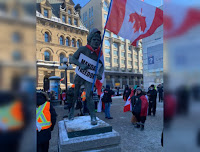
These folks have done their best to identify who they really are and to antagonize almost all Canadians.  They have carried swastikas, they have carried signs and worn shirts calling for the Prime Minister to be hung, they have bullied restaurants, hotels, and the one mall as they sought to violate the mask mandates, they parked and later danced on the Tomb of the Unknown Soldier, and they temporarily defaced a statue of Terry Fox.  

The claim is that these are patriotic truckers who can't cross the border now as the government is enforcing a vaccine mandate.  Their demands are, well, ignorant and crazed as they have called for the governor general and the Senate (?) to remove the current government and all mask and vax mandates.  The Canadian Truckers Association has disassociated itself with these people.  Most Canadians, and, yes, most truckers are vaccinated.  The organizers are mostly associated with far right groups, and there are legitimate questions about how much of this is an attempt to grift. A significant percentage of Canadian truckers are not white, but the protesters were very white.  So, yeah, there is more than a smidge of white supremacy at work (swatiskas and confederate flags tell the tale).  

I asked twitter which was more offensive--parking on the War Memorial (this was before people danced on it), hanging signs and upside down flag on Terry Fox (a national hero who walked across Canada to raise money for cancer as it was killing him), or the swastikas.

The swastikas trumped the other two, but I saw many people on twitter appalled at the other two.  

Indeed, the day's events led to a bit of a question about Canadian civil-military relations.  The head of the Canadian armed forces, General Wayne Eyre, tweeted his shock and horror regarding the dancing on the Tomb of the Unknown Soldier:

Is it appropriate for Eyre to speak about a political protest?  Depends on where you fit on various debates in civil-military relations.  Some think that the military should always stay out of politics, others think that the military is inherently a political actor that should stay out of partisan fights.  I am with the latter.  Given that the Tomb and the National War Memorial are very much focused on the military and its history, it is not surprising that Eyre was offended and wanted to share his offense.  The question may depend on whether one sees the protesters as legitimate partisans in ordinary Canadian politics.

And that is where the Conservative Party of Canada fits in--providing cover and legitimacy for these far right extremists.  The CPC leader, Erin O'Toole, met with the truckers as they headed to Ottawa, as he has tried to balance between appealing to mainstream Canada while not offending the far right folks who might flee to the People's Party.  In the last election, not that long ago, O'Toole tried to take the stance that it was good to get vaccinated, but that people should not be compelled by public policy to do so--no vax mandates.  And his party lost, perhaps partly because of this stance.  79% of the country is fully vaccinated, 85% has had one dose, and a significant chunk of the remaining are kids (no shots for those younger than 5 and the 5-11 vaccinations are still pretty new).  So, most of Canada is not that peeved about vax mandates (some fully vaxxed say they are bothered by it, but not sure they amount to many folks).  So, not a winning political position.  
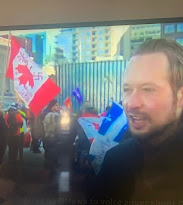
Yet, we see pandering to the far right.  Not just O'Toole.  One CPC member of parliament was stupid enough to be speaking in support of the protest when a person holding a defaced Canadian flag complete with swastika was standing behind him.  A politician, Pierre Poilievre, from the riding (district) next to mine and on my summer bike route was tweeting his support for the convey.  O'Toole issued a series of tweets many hours after the events at the War Memorial issuing his condemnation.  Of course, he had been warned and criticized in the lead up to this event, but now he has some shame.  We shall see how long that lasts. The guy in this picture has issued a statement saying he had no idea this flag was behind him.  So, political malpractice or just not so plausible deniability?  You make the call. Poilievre hasn't deleted his tweets as he wants to be on the far right of his party.  I doubt he will reach the level of temporary and weak regret that Ted Cruz did last year.

Speaking of the far right, it is notable that there were no arrests, that the cops of Ottawa were able to navigate this event without arresting anyone.  Impressive policing or biased enforcement?  The police of Canada have shown far less ability to de-escalate when the protesters are Indigenous.  

I live far from downtown (Barrhaven is often called Farhaven for being 25 minutes from the city core), but I have friends who live downtown.  I worried about them, but they seem to be ok despite the thugs that were in the streets all day and into the night.  

You can tell a lot about a group by what they say, what they do, and who their allies are (Trump?).  Anyone claiming this was anything but a far right group seeking to shake things up is fooling themselves.  Yes, these assholes have a right to protest, but they violated more than a few laws along the way while inciting hate and violence.  No, there was not much violence yesterday, but this is not over.  And politicians bending over to them and trying to avoid offending the fringes of their base will just encourage this assholes.  

Canada has an extremism problem, not a polarization problem, as it is on one side of the spectrum.  The sooner the Conservatives realize that these folks are poison, the sooner their party will find their way out of the wilderness and into power.  As it stands now, this weekend just reminded Canadians that the Conservatives are not a viable option for the middle of the political spectrum. 


 VdDiO_t-Bf_EjVXSoHs_Qttps://twitter.com/PierrePoilievre/status/1487546518085197825?s=20&t=RVdDiO_t-Bf_EjVXSoHs_Q

Saturday, January 22, 2022

When Transparency Meets Partisanship, Transparency Dies?

 This tweet touched a nerve apparently.

The tl:dr of this whole thing is that there is a real problem that democracies face--how to have transparency and accountability while keeping bad guys (foreign and domestic enemies) from knowing stuff that they should not know--that Canada is poorly armed to handle this challenge, and that the primary reform that managed to finesse some of this is now being crapped on by the Conservatives because ... it is better to score points than to help the country be both democratic and accountable.  

What is the longer version of this?  When I was interviewing politicians about the mission in Afghanistan in 2007, I was stunned to learn that members of the House of Commons Defence Committee lacked security clearances.  I said "how can you do oversight if you don't have access to the secret stuff?"  The response: "we don't do oversight,* we hold the Minister to account."  How can they do that if the Minister (in this case of Defence) has all the info and the members of parliament (MPs) have none?  "We get leaks," and their primary concern was agenda control of the committee, not info.  Why?  Mostly because they would prefer to talk aloud about stuff that they don't know much about than know more via security clearances but not be able to use that stuff in question period or other public fora.  As I framed it, better to be an ignorant critic than informed overseer.  The editor of the journal where Phil and I published the piece softened the title.  

This was not just a theoretical issue for us social scientists (although it did inspire the current book project and trips to many democracies) but also a major political issue.  During the Afghanistan war, one of the major points of contention (the most debated issue in Parliament--my book has handy figures on this) was the plight of Afghans detained by the Canadian Armed Forces--whether they were beaten after being turned over to the Afghan authorities.  The opposition wanted the info on this, the government said they couldn't, but since it was a minority government, the opposition was able to compel the government to produce documents under a very limited process.  The opposition leaders were able to go to a room where the documents were, sans recorders and notepads, and look through the documents, and then ask a judge or judges to declassify stuff. This effectively buried the issue, but it raised questions about how to provide accountability when there is not a minority government or when the opposition does not have consensus about pushing things.

NSICOP--National Security and Intelligence Committee of Parliamentarians--is an innovation that is about five years old.  The idea here is that there is a committee of parliamentarians and senators who have security clearances and can get access to the secret stuff so that they can access the strengths and weaknesses of Canada's national security stuff.  The focus is mostly on intel agencies, but defence and other stuff gets reviewed as well.  The trick about this committee that causes much controversy is that it is not a parliamentary committee because it reports to the Prime Minister.  Mostly, this has not be a problem as they have issued unclassified reports that have been extensive and informative reviews (my colleagues who do intel stuff track this more closely than I do).  This process does mean that the committee does not serve at the whim of the Parliament, and the PM can limit what is produced.

This became a hot issue this past year as the Conservatives have wanted all the classified documents relating to a biohazard lab in Winnipegs.  They find NSICOP to be insufficiently focused on this, and have undermined it by not sending MPs to join it in the current session.  What do they want?  Damned if I know.  

Erin O'Toole has been grandstanding on this issue in ways that may undermine NSICOP and pour gas on the conspiracy theories out there.  My basic take, having not seen any of the secret stuff, is that the Winnipeg lab thing is an excuse to accuse the government of conspiring to be soft on China.  There is plenty of other stuff out there that can come in handy that way--this particular axis of effort is destructive to that good governance and order Canadians are supposed to care about.  Because O'Toole is killing the one thing parties could agree to that would provide some oversight* over the intel folks in Canada.  

The funny thing is that my tweet above, I think, was the reason I got a call from Mark Holland, the Liberal who is "Leader of the Government in the House of Commons."  He focused on the problem of redactions--that there had been materials that had been declassified but some stuff had been redacted.  The Conservatives think the redactions are problematic and that Parliament should be able to see everything and decide what can be shared with the public.  Holland's alternative is to take the Afghanistan detainee scandal process and make it more of a lasting thing: that some MPs could see the documents in their entirety subject to the usual security clearance laws, and that if they think some stuff should be released unredacted, then a committee of jurists should decide.  This would take the matter out of the hands of the government, and it would also mean that the opposition could not release stuff willy-nilly.  

Again, I am not the expert on this stuff, but this seems like a good compromise that gets at the heart of this--if the opposition cares about the issue itself.  They get access to the info, and then being able to talk about some of it if a panel of judges consent.  I haven't seen yet what O'Toole would say is wrong with this.  It seems quite reasonable.

What is my preference?  That Canada has committees that have security clearances.  This would not be sufficient, of course, because these committees have little heft--they can't change budgets, they have no influence on promotions, etc [the US Congress and German Bundestag are relevant actors not just because their defence committees can get the info but they also have power to use it--to shape budgets].  So, we'd have to innovate to give them a bit more heft so that their increased knowledge would have some relevance.  

But that ain't happening. The MPs don't have an incentive to know more--their incentives all point towards talking more, scoring points, not really focused at all on improving governance. So, this compromise, like NSICOP, is the best we can do. The alternative that O'Toole seems to want--for Parliament to have the power to release whatever it wants--seems problematic especially when at least one party seems to be more focused on spinning up conspiracy theories.  When people say that Canada's politics are immature and its politicians can't be responsible, this is what they (or I) have in mind.

* Oh, and about oversight, this is something where I get into fights with my colleagues.  For some reason, in Canada, oversight in the intel sphere has a different meaning than I have understood it anywhere else.  To me, oversight is about actors getting more information to know what other actors have been doing.  It can be and is usually retrospective (my friends suggest that it is more directive--that oversight is telling the actors what to do--that it is controlling, I think).  Parliamentarians don't need to know what Special Operators are doing right now in the field, but they should know what they did last summer.  Why is this important?  For many reasons, such as democracy requiring transparency (Colaresi has a great book on the contradictions between democracy and secrecy), but for my principal-agent-informed outlook, oversight is important because those who are delegated responsibility for doing something (spying, breaking codes, running special ops missions, whatever) will know more than those who give them those jobs about what actually happens.  One way to insure that those doing the work do the work as they are supposed to do it is make them feel as if they are being watched.  Oversight best works when those who are overseen anticipate that they will be caught if they behave in undesired ways, which then leads them to behave in the desired ways.  

Why can't we just leave this to the government of the day and civilian servants?  Why does civilian control of the military (or of the intel folks) have to involve other elected officials?  Because those in government may be tempted to hide stuff if revelations might hurt them politically.  Civil servants are not accountable to the public, so if you leave it in their hands, things tend to disappear.  There has been talk, for instance, of having the Privy Council Office supervise the various independent agencies that might get responsibility for overseeing the military (Ombudspeople, Inspector General, whatever), but that would be a black hole, not transparency.  

Anyhow, that's a lot for a Saturday morning post explaining a tweet.  Glad I provided the tl;dr up top.


Sunday, January 16, 2022

Distressed, Depressed, and Down: Where To From Here?

Despite being relentlessly critical of stuff, I have always tended to focus on the arc of progress--that things will get better even amid the bumps of today.  This weekend?  Damn.  An entire country mostly disappears beneath a volcano (any idea of how the Tongans are doing?), the Supreme Court continues to reveal itself to be not just partisan but enthusiastically so, gutting reasonable policies and putting much of the progress of the past fifty years in doubt, a "good" hostage crisis causing us to experience relief or just more anxiety, Trump amping the white supremacy with insufficient outrage aimed against him, stories of African-American voters unlikely to turnout since Sinema/Manchin have blocked any progress on voting rights, the likelihood that the GOP's bet to ally with the pandemic so that Biden would pay for the continued pandemic will pay off, etc.  

I can go on.  This is definitely the winter of my discontent.  I was hoping pre-omicron that we'd have a bit of return to normalcy--return to classes, in-person events, more skiing, actually going to an ISA conference after missing the last two of those.  And now all we have is uncertainty.  I haven't felt like blogging because I didn't want to just whine and complain, but I also wanted to mark, as I indicated in my first quarantine post way back when, my descent into madness.  And I am just so mad these days.  So much so that I am crapping on the joy to my friends that is wordle.

It is definitely getting in the way of my work as I so easily distracted these days.  I tend not to get depressed, but I kind of feel that way now.  I am one of the lucky ones--I haven't lost any immediate relatives to COVID, my relatives have managed through this economically ok, the next generation is mostly in pretty good shape even though most of them have had covid (LA Spew continues to dodge the disease better than I can dodge a wrench).  And damn, not must my younger relatives but all the folks I meet in my classes and I see out in the world are so impressive.  I hate that we are giving them a shitty present and a very uncertain future, but I have more faith in them, in their tolerance, in their creativity, than I do in those that came before us.  I guess that is the reed upon which I am placing my hope these days.  

That and endless tv/movies streamed to my house help keep me from descending too far.  I hope you can find ways to get through this awful time.  As they say, the only way out is through.


Monday, January 10, 2022

Where's Spenser When We Need Him?

 I have long been a fan of mysteries, especially those featuring snarky detectives.  Robert B. Parker's Spenser will always stand out.  I remember discovering Spenser when friends were reading aloud one of his books during a break during my college years, and the dialogue was so much fun.  Anyhow, ever since then, I would tend to find one or two writers and just read all of their stuff: Sue Grafton (I gave up around M or N), Sara Paretsky, Dianne Mott Davidson (one of my wife's editing clients).  I fell into John Sandford when he was writing under a pseudonym--John Camp.  Lee Child's books were less mysteries and more thrillers, but very addictive.  

More recently, I started reading the Bosch books by Michael Connelly.  Bosch started out as a weary, abrasive detective in the LAPD.  The TV show has been something that all of my siblings and mother watch--our tastes usually don't align so well.  So, I got the latest book, where Bosch and a younger female detective, Renée Ballard, work together after Bosch's retirement from the LAPD.  The book takes place more or less in the present--people are wearing masks (or not) and there is much discussion of the state of LAPD.  A theme that gets repeated several times (and I am not that far into it) is that LAPD is now facing deep budget constraints because the protests have cost so much money that programs are being defunded even if the department is not receiving less money. Oh, and the cops are wary of doing anything because they don't want to face a hostile public. 

Anyhow, mostly because of the way Connelly keeps referring to the position the cops have been put into by the protests, I am offput.  It is distracting and angering because LAPD has behaved awfully before, during, and after the protests.  I would know this even if I didn't have a relative engaged in some of the protests as LAPD and LA Sheriffs have made it abundantly clear that they are above and beyond the law.  I guess in the past I either read books that didn't feature cops or I was able to compartmentalize so that I didn't really think of how bad the cops were in reality when I read about the hero cops in the various books.

Spenser was a fallen cop--he had left because he didn't get along with authority.  Maybe some subtext I might be injecting into the series, he was far more liberal or tolerant or whatever than the cops.  Maybe not.  But now I am thinking that as I give up on Connelly, as I gave up on some other folks whose political leanings got to be too annoying (Tom Clancy is the classic case as his racism completely soured me), I need to find mystery authors whose protagonists are not cops again.  Where is the next Spenser, V.I. Warshawski, Kinsey Millhone, or Goldy Schulz?  The good news is that they are out there.  I just need a detective to help find them for me. 

Saturday, January 8, 2022

Quarantine 2: Electric Bugaloo

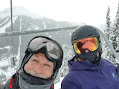
JC & me, Lake Louise
The Civ-Mil crew in Copenhagen
I stopped doing quarantine reports last summer after Mrs. Spew and I had two shots plus two weeks.  Shortly afterwards, we drove to Philly to see my mother and the rest of my family.  I went to a movie when we got back, and we would occasionally go to restaurants (almost always outdoors).  I went to Copenhagen for a conference, we held a hybrid event (the Year Ahead 2022), I gave a talk in Calgary and, yes, went skiing afterwards, I had a fun poker game with folks who were in town for another conference, and, then we get super anxious about going to see my in-laws over the holidays.

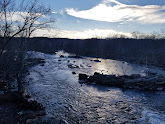
Great Falls park
It was not the usual winterfest, as we only went to one restaurant and very reluctantly so.  Otherwise, it was take-out.  No metro trip to the Mall.  Instead, my daughter (Hollywood Spew) and I went to see a river and a canal.  We worried much about whether we would get our PCR tests back in time for us--before we were to cross the border back to Canada.  And we got them while we were driving back north.  We also worried much about whether my daughter could get back to LA as her first flight was cancelled, but she persevered and got a flight back.  She went back sooner than planned because she was unable to stay over with her besties from college as they were all exposed to covid and some tested positive. 

And then we returned to old habits with modifications.  I only leave the house now for groceries and to rehab my knee (I mentioned above I went skiing, right?).  No dining out.  I did make one exception--I went to see the new Spidey movie just before provincial regulations changed to close the movie theaters.  I haven't started the winter exercise ritual of last year--snowshoeing and cross-country skiing as we don't have enough snow yet (unlike my pals to the south).  

Instead of shopping for funky looking masks, I focus on the monthly Costco trip, hoping they have KN-95s.  And when I went this week, I bought three boxes, which felt very much like hoarding.  But I did so anyway because I have no idea if there will be any next month.  I haven't put away my cloth masks that Omicron has made obsolete.  Maybe the next variant will be less transmissible?

Which gets to the feelings of the moment--exhaustion and frustration.  It may be the most "mild" of variants, but its greater transmissiblity has had a huge impact.  Carleton has pushed the first three weeks (and probably more) online.  Which is not a huge deal to me as I am teaching a course that has online components from last year--so I checked and the material is quite recyclable.  But damn, when I said that online, the parents of kids were most upset that I was not as angry as they were.  I am angry and frustrated, but my stakes are much smaller than theirs.  There is no good way to deal with this new wave for schools as McSweeney's illustrated quite nicely.  One thing that has remained most consistent has been the Ontario government screwing this up.  The plans for the winter are being upended.  The big anniversary trip to Morocco Spain Hawaii Vancouver next month is now in doubt.  The CDSN Capstone Seminar and Civ-Mil Workshop were going to be in Calgary in the beginning of March, but that is now uncertain.  ISA in Nashville at the end of March?  ¯\(°_o)/¯  

Despite being vaxxed and boosted, we are anxious as we quarantine.  I don't worry about getting seriously sick (although Mrs. Spew does), but I do worry about becoming a vector that endangers someone else.  Once again, we thought we saw the light at the end of the tunnel, and then found out that this thing is going on and on.  I think that, along with the fact that we all know far more people with COVID this time around (we are up to four nieces and one nephew since this thing started, with only two nieces and one daughter still dodging covid successfully), has worn us down, frazzled our nerves, and genearted much fear, which ain't good:

We, alas, are not in this together.  As I keep saying, COVID does to societies and political systems what it does to the human body: reveal and exacerbate pre-existing conditions. The politics of this is making all of this costlier, more stressful, and just worse all the way around.  

I am placing a lot of hope on two things: that mild really means mild and that the bending of the curve is going to be fast, like it has been in South Africa.  I know that rebellions are built on hope.  I am hoping that recoveries are, too. 


Monday, January 3, 2022

There Is Still Magic

The past few years have been very frustrating, angering, saddening times for many Harry Potter fans as JK Rowling has allied herself with the dark forces in the world (including Johnny Depp).  Her anti-trans attitudes seems to me to be a betrayal of what her books tried to convey.  I have been stewing about this for quite some time, and I haven't re-read or re-watched the HP stuff in a few years, breaking my usual winterfest habits.  I finally sought to express my feelings on this as I watched the 20th anniversary special.  Seeing all the folks who made the movies (well, almost as we have lost several along the way) and seeing the scenes of the making of the movies made very sad but also reminded me of the magic in the books and the movies.*

(* Ok, the first 8.5 movies as the first Fantastic Beasts movie had some magic, the second had much less, especially with Depp playing such a big role).  

To be clear, the books and movies are imperfect.  They do not represent well, they tend to rely on stereotypes (JK's borrowing of Tolkein's take on goblins is still anti-semitic, for instance), that Dumbledore is not explicitly gay in the text, but she retconned that later, and so on.  But the larger themes are of love and tolerance and choice are so central. That the bad guys don't get it--they can't exhibit remorse, they don't have friends, they have contempt for those who love, that they don't really have something to fight for, and the good folks win precisely because they are willing to love, to forgive, to trust.  

Early in the special, the words come across the screen that it is not what family you are born into (although, of course, there are contradictions--the discussion of Draco as a product of Lucius) but what you choose to do that matters.  In the books, this is one of the strongest and consistent themes--that is the choices you make that matter.  And this plays in two ways now--that JK is making the worst choices and she is, of course, judging how others live their lives, that she is judging people who identify as their true selves.   

So, how do I see it now?  Watching the actors and directors talk about the stuff, how much it meant to them (and to the fans), the bonds they have with each other, the themes that they tried to convey helped feed my confirmation bias and my compartmentalization.  That there is such good stuff in the books and the movies that I will focus on that--the magic of friendship, of love, and, yes, of tolerance--and only occasionally grapple with the darkness in the books and in JK.  She has chosen to be awful.  The actors (statements by Radcliffe and Watson) do a nice job of distinguishing her stances from what the books and movies were trying to say.  And I will side with them.  

It is, after all, the choices we make that matter. 

Friday, December 31, 2021

Year 2 of Pandemic in Review: the Dizziest Rollercoaster

The first year of the pandemic started well with several cool trips (researching in Germany, chaperoning in Japan, skiing out west) and some great CDSN events (the first Capstone) and then the pandemic hit and everything went south.  The second year of the pandemic was much ... wavier.  The rollout of the vaccines created much anxiety as the eligibility kept changing, and the most widely available one in Canada got pulled ... after I got it.  Things looked bright until Delta came along, but then we reached high levels of vaccinations and things started opening up and then Omicron came along.  On this last day of the year, I look back, mostly so that in later years I can distinguish between years one, two, and three of the this pandemic.

On the bright side, year two had much less death among my immediate friends and family even as the US had far more death in 2021 (Delta was/is so very nasty).  I lost friends the previous year due to heart attacks that were not apparently covid-related.  This year, we lost Bob, our very old cat.  He spent his last year being far more cuddly with me than this previous seventeen or eighteen.  He was an important part of our pandemic routine, especially for Mrs. Spew who got to see the veterinarians on an increasingly regular basis until it was very much time to say goodbye.  We also lost my father's best friend, who became known to us as Uncle Stanley.  He was very influential in my early life, and I am pretty sure I owe much of my sense of humor to him.  I wish I had talked with him more before he declined.  Alas, there was much death among those who taught at UCSD during my time there--John Ruggie, Frances McCall Rosenbluth, Mat McCubbins all passed away in 2021.  I only took one class from John, but interacted with both France and Mat on many occasions.  Of the three, McCubbins has had the greatest impact on my work as I succumbed to principal-agency theory half-way through my career.  Their losses were felt hard by not just their students but by the profession.  Robert Jervis also passed away.  He didn't teach at UCSD, but he helped me get there by sucking me into IR via some of the first stuff I read. 

Professionally, it was a mixed kind of year.  The CDSN did quite well--we had our long-awaited Summer Institute, entirely online, and it went wellThe Year Ahead was a hybrid event that happened in that window in between waves, and it was great to see people and have a great day of insights and varied perspectives.  The Capstone was online but remained a very special event. The podcasts continued to be a biweekly boon to my spirits, and it was fun to get a call from the Chief of the Defence Staff (the highest ranking officer in the Canadian military) who wanted to talk about something I said in the podcast.  This was a few months after we had him and the Deputy Minister on our podcast.  In the last months of the year, I got to consult with the new Minister of National Defence as well as a former Supreme Court justice who is reviewing the Canadian Armed Forces as part of the effort to address the sexual misconduct/abuse of power crisis.  That crisis also led to a couple of op-eds where I called for the firing of the previous Minister of National Defence (not much of an influencer if it happens eight or so months later) and previous Chief of Defence Staff (ditto).  Between stuff in the US and in Canada, it was a busy year for those who do civil-military relations. So, a peak year for engagement with the policy world.  

While the engagement was great, the publications ... were not so great.  I had a record year, I think, in contributions to edited volumes.  But as anyone in my biz will tell you, those don't count as much as refereed articles in top journals, and, well, it was mostly a year of rejection on that front.  My various co-authors and I reached for the top and found the top to be a pretty competitive place.  That and our work needed much reviews.  A good number of the reviews we received were most helpful in telling us how to improve our work.  I expect those pieces to do better in 2022.  Dave, Phil, and I didn't make as much progress on the big book project--the end is in sight, but it didn't get much closer.  I expect us to finish in the first half of the new year.  Frustrating not to get it done, but I hope to get a burst of new energy to do what it takes to push it over the goal line.  On the bright side, 2021 demonstrated both the importance of civilian control of the military, and the variation that exists among the world's democracies in the roles played by legislatures.  Canada proved yet again why it belongs on the weak end of the spectrum.

Teaching was entirely online.  Students continued to adapt, so that the seminars via zoom went pretty well.  I supervised a variety of projects from MA papers to more dissertations.  The dissertation proposal class continued to expose me to a great variety of topics, mostly way outside my expertise, and the course worked--students made progress and many got through their proposal defenses.  My PhD students are making progress through their projects despite the challenges of doing research during a pandemic.

US politics occupied much of my mind.  The insurrection n January 6th was a dismal way to start the year.  Fending off those who thought I didn't think it was serious because I argued it was not a coup attempt was not so much fun.  Biden's inauguration created some joy, which Manchin and Sinema destroyed through their obstinacy.  The anti-vaxxers did their best to undermine the miracles of the vaccines, causing much unnecessary misery.  They started threatening doctors and scientists, which would have been awful even if those folks were not at their limits due tot he pandemic itself.  And, yes, those folks infected Canada, as my friend JC Boucher found in his scraping of social media--that the vectors of anti-vax stuff in Canada originate not in Russia or China but in the US.  It didn't take long for outbidding to develop in the US among GOP and their media--that they had to double and triple down on the big lie about the election.

In Canada, three political processes dominated the year.  The hashtag for the pandemic became #IncompetentMurderClowns as the premiers of the provinces (governors) tended to be slow to close, fast to open up, and opted for the less effective policies.  I will always be struck by a pre-delta press conference where a journalist asked the health officers of Ontario "Am I missing something here, or is this presentation predicting a disaster?" and the doctors, who were discussing the opening up of stuff just as Delta was on its way, said "I don't think you are missing anything."  The year ended with not enough tests, a confusing rollout of the boosters after all of the health authorities had delayed on that, and with no clarity about how the new school year would go.  I have always felt bad for the parents during this crisis, and the past week took that to new heights/depths.  Ontario is pushing back the start of schools by two days.  What will that do?  Damned if I know.

The second process was an election that the Liberals called because they thought they could win a majority even as Delta was spiking and as vax hestitancy in the Prairies (Manitoba, Saskatchewan, and Alberta) was going to kill any victory parade.  Oh, and Afghanistan's collapse also got the Liberals off message.  So, we have more or less the same government (finally some much needed cabinet shuffling) and more media for anti-vax folks ... and much frustration. 

The third focused on something that gets only episodic attention--the past and continuing plight of Canada's Indigenous peoples.  The finding of 215 graves at a residential school in Kamloops reminded everyone that Canada's government engaged in truly awful policies that have been determined to be genocidal.  The government talked a good game of reconciliation, but a bunch of policies and problems continue that make these seem like pie crust promises--easily made, easily broken.

The big IR event of the year was the collapse of the government the US and NATO had been fighting for in Afghanistan.  I was never an expert on Afghanistan itself, having focused entirely on the dynamics of the countries intervening there.  It was and is a great tragedy for the Afghans who have always been in the middle of this conflict, and it was, of course, also traumatic for those who expended so much there.  I did reflect on my work and how to think about it now that not just the NATO mission ended but so did the target of that mission

The personal highlights for me were the breaks in the quarantine.  Going to Philly for the summer family vacation was more than just a bit restorative--it was so very necessary.  We didn't do that much tourism, but we spent a heap of time with family and even some old friends over steak sandwiches.  I got to go to Copenhagen for a civil-military relations conference where I got to hang with some of my friends in the business and watch civ-mil tensions up close (the Danish military types didn't like to be told that militaries are sometimes unreliable agents that need close oversight).  A conference by our partner networ--RAS--meant a heap of fun people in town for the only in-person poker game of the year--it was a blast!  The online poker games were fun, too, but not the same.  I gave two talks in the last few months--"at" the U of Chicago where I got great feedback on the Steve/Dave/Phil project and actually at Calgary, which then was followed by skiiing with JC.  I survived the skiing with 1.5 knees intact.  The last trip of the year, to see my in-laws, was much needed as I missed them all very much, and they needed to see Mrs. Spew in person.  Also, I got to make the big meal including several pies.

The baking of year one continued into year two of the pandemic with lots of cookies made for distribution before we fled south for the holidays.  The second year was more of a balance of new and old recipes. Will I bake that much in year three of the pandemic? Probably despite a resolution to eat a bit healthier.  I hope I keep up the snowshoeing and cross-country skiing that I did last year, but that depends as much on the weather as it does on my will power.  And, yes, I will continue to enjoy heaps of tv.  I only made it to the movie theaters three times in 2021--for three Marvel movies (Black Widow, Shang-Chi, and  ... Spidey in less than two hours).  

As I kept saying and posting, to get through this, we have to do whatever it takes.


Thursday, December 30, 2021

More Than Bad Faith: A Party of Autocracy, Hate, and Death

 I have taken to calling the Republicans the Party of Bad Faith because so much of what their leaders and members say they don't believe and will flip on a dime if the identities of the relevant actors are switched.  The party of family values elected and supported a serial philanderer who lusted after his daughter while being caught on tape bragging about sexual assault.  The party that says that you can't select a supreme court justice months before an election did so days before one.  Anyhow, a friend said this:

And this is quite fair.  The GOP is not just a party of bad faith.  It is a party of autocracy, hate, and death.  Just a quick bit on each:

  • Democracy requires the acceptance of losing, not gaming the rules to prevent losing.  Long before January 6th of 2021, the GOP had been engaged in a sustained effort not just to suppress the vote but change the powers of governors when they lost those positions.  The entire big lie about Biden's victory may be motivated by cowardice--fear of their most rabid supporters and fear of Trump and fear of Fox and other far right media--but whatever the motivation, their support of the big lie is poison to American democracy.  The tragedy here is that the GOP has proven it can win Latino votes, so there is not really a need to suppress the vote--they can try to win elections the democratic way--by getting more votes.  But that is not the path the party and its members and its media friends have chosen. They have chosen to burn down American democracy.
  • The GOP is also a party of hate.  They have long used racist appeals (the Southern strategy, Willie Horton, etc), but they are now openly the party of white supremacy.  Tucker Carlson spews it all the time.  The discussion of "Real America" and all that crap, the embrace of replacement theory, etc is a toxic brew of hate that has been killing people.  Wherever Trump rallied, hate crimes were sure to follow.  In this pandemic, the GOP were not too fussed when the casualties were urban people of color.  And all this has bred more violence.  Trump won by ethnic outbidding--being the best white supremacist in the GOP in 2016--and he fed that for years.  Remember that his least worst Attorney General was once considered to racist to be a Federal judge.  
  • And now the GOP is the party of death.  That Trump delayed on confronting the pandemic because he didn't want the stock market to tank.  That they gave Kushner the job of figuring out the tests, which was as sure a path to failure as one could possibly imagine.  That they politicized mask wearing and then the vaccines even though the vaccines were developed when Trump was president.  Most recently, Trump has faced much friction from his own party for talking up booster shots.  The policies of governors like Abbott and DeSantis have been so reckless with so little concern for the lives of their constituents.  And as I was typing this, the GOP House Judiciary account tweeted its support for covid.

I could go on, but this covers the essentials.  The GOP is more than the Party of Bad Faith--they are not just without values, not just hyprocrites, but they are allies of a deadly virus, not just friends to autocrats but wannabe dictators, and they are stoking hate.  The problem of our day is not polarization, which suggests that two parties are moving from the middle. The problem is that one of the two major parties does not believe in democracy and does not even care about the health of their own constituents.  

Even if the Democrats can hold the Presidency in two years and maybe a house or two, the erosion of American democracy will continue as democracy requires winners and losers to treat each other as fellow citizens in the non-violent competition for office and governing for all, not just the winners.  In short, the US is truly fucked.


Saturday, December 18, 2021

Defend the Review

One of the notable absences in the Mandate Letter that the Prime Minister gave to Minister of National Defence Anand is any mention of a new defence review.  Instead, her mandate is to keep implementing the Strong, Secure, Engaged document produced by the 2017 defence review.  The 2017 review was a lot of work, as the DND folks consulted widely--at least ten meetings across the country with four senior folks (former CDS, former Supreme Court justice, former MinDef, and former DepSec of Cabinet), lots of submissions, etc, etc.  It is understandable that at a time where there is already a review concerning the culture of the CAF and DND by the aforementioned retired Supreme Court justice that the focus would be on just getting that stuff straight.  

But after talking with a friend, I am more convinced that a new defence review is something that should happen sooner than later.  Why?

  • These reviews should be a regular event, perhaps every four years, like they do it in the US and elsewhere.  The world changes and priorities evolve.  It is good to do a lessons learned process and figure out what went well and wrong with the previous review.  Indeed, this would give the Minister a much needed oversight tool as one of the core challenges now but actually always is civilian control of the armed forces and of those who oversee the armed forces.  And DND would develop a skill set that would be sharpened as it gets used over and over.
  • There is more than just the DND/CAF culture to review.  Do the priorities set forth in the last review make sense now?  I will continue to harp on the idea that listing a bunch of priorities is not really prioritizing and that listing aid to civilian authorities (domestic emergency operations) as one of a few top priorities isn't sufficient. The pace of domestic operations is increasing and has increased much over the past four years thanks to climate change.  So, it is time to seriously think what that means for the other priorities (domestic emergencies shouldn't just be seen as something to get right so that it does not impact readiness), how the CAF might be realigned so that domestic operations are seen as the day job of the CAF as much as stuff abroad, and so on.  
  • There should be a review of the procurement stuff listed in the SSE.  Where are we at in terms of the stuff that was proposed to be procured?  What worked, what did not work?  How have we adapted to improve procurement?  
  • What is the threat picture?  I should have started with this (it definitely should not go last).  Is the CAF set up well for attacks short of war?  What progress has been made on reducing vulnerability to cyberattacks and developing cyberoffensive capabilities?  How can Canada prepare if either Trump returns or the US succumbs to greater civil strife?  How does climate change, now that it is here, threaten Canada and the CAF?
  • Maybe this time make some hard choices.  The 2017 review ended up being a list that gave lots of different constituencies pretty much everything they wanted.  Which is probably not sustainable.  So, maybe make some difficult decisions at a time where the military is not in a great position to fight back.  
  • The personnel file is, yes, a part of the Arbour review, but there is probably more to it than what she is looking at.  Plus after she does her review, the Minister and DND will have to figure out how to implement her recommendations, and, yes, which ones to implement (simply agreeing to do everything she says is an abdication of responsibility--Arbour may not be right about everything).

The SSE set the agenda for the past four years.  It served as a signpost for pretty much everything although, of course, the previous CDS (ok, one before the one before the current one) interpreted it as he saw fit as he didn't do stuff that he found inconvenient.  So, this review should not only serve as an exercise in civilian control of the military, but provide an opportunity to measure and improve that exercise.  Once the review is done, the question then becomes how much is implemented in the ways imagined by the Minister of National Defence and the Prime Minister.  We need a new marker, a new baseline, as the new minister definitely has a different idea of what her job is than her predecessor.  

In short, the new Minister needs to do a review so that she inflicts her will upon the CAF and on DND, and that we all can see what the priorities are.  With that, she and the rest can be held accountable for whatever progress is or is not made.

Thursday, December 16, 2021

New Defence Mandate Letters: Are All the Priorities Prioritized?

 Today, PMJT released his mandate letters that provide each minister with their marching orders.  I am most interested, of course, in the defence letter to the new Minister of National Defence.  

  • The first item I noticed is fealty to the existing and increasingly outdated Strong, Secure, Engaged [SSE] defence review document.  As I will write in the next day or two that we are in need of a new review and that those reviews should happen on a regular basis, this letter pretty much screams "no new review anytime soon."  I understand that the Minister and her policy staff are busy trying to improve the sexual misconduct/abuse of power crisis so that they might not want to be distracted by another review.  However, just as intelligence should drive policy, policy needs to drive everything else and we need to think about whether the policies developed four or so years ago need to be revised.
  • There is much discussion of transforming the culture of the CAF as it should be.  That the Arbour recommendations should be implemented, but since we don't know what they are, we can't really say what this will involve.  Related to this are both "eliminating all sources of ..." all kinds of bias including white supremacy.  I am glad to see that, as these biases are as much an "existential threat" to the CAF as the abuse of power/sexual misconduct crisis.  There is also appropriate attention paid to the military justice system and the Fish report.  
  • It is striking that the mandate mentions continued CAF support to Canada's COVID efforts but no real mention, as far as I can tell, of making domestic emergency operations of a higher priority.  Sure, it is always listed as one of the four main priorities, but it is also always seen as an inconvenience that gets in the way of the CAF's day job.  This needs to change, but this mandate letter does not provide a basis for making that change (maybe a defence review would?).  
  • "Undertake ambitious efforts to improve the diversity of the CAF...."  My favorite proposal for this one would be to have serving in the CAF as a pathway to citizenship.  But this is "too hard" so I doubt it will happen.  
  • Expanding Canada's long and short-range strategic airlift capability?  Hmmm, this would mean buying more planes, which are not, as far as I can recall, costed in the SSE.
  • Speaking of planes, no mention of the fighter replacement effort, which could mean that they don't plan to replace the fighters, that they already have decided what they are doing, or that they don't want to raise the salience of this controversial issue.  
  • Modernizing NORAD gets much play.  This was not in the SSE, but has been something discussed quite a bit in Ottawa including events semi-orchestrated by the government before the pandemic.  This stuff is super-expensive, but the defence challenges are getting very complicated and require new tech.  I am not surprised to see it here, given the conversations I have heard the last few years, but it stands out with the stuff that hasn't been mentioned (fighter replacement, domestic ops).
  • There is no clear mandate here to do heaps more peacekeeping.
  • The focus of Climate Security stuff here is on establishing a new NATO Centre of Excellence on Climate and Security, which is good for us as our current grant bid focuses on that element of climate change.  On the down side, maybe the CC priorities of DND should be on reducing CAF's carbon footprint and, oh yeah, more effort on the domestic operations front.
  • I didn't know Communications Security Establishment, Canada's NSA, is under the Minister of National Defence.  What is striking here is the focus on a "renewed Cyber Security Strategy" and "National Cyber Security Action Plan."
  • Shipbuilding, alas, gets mentioned not just for getting the ships but "advance the shipbuilding industry and create middle class jobs."  Notice the play to Quebec with the "add a third Canadian shipyard."
  • Supporting the Minister of Foreign Affairs in developing an Indo-Pacific Strategy is interesting given that, well, MFA does not do strategy or reviews, so good luck with that.

Minister of National Defence Anand has a very, very full agenda with both that which is mentioned here and that which is not.  Domestic operations, for instance, are going to play a greater role thanks to Climate Change as well as Pandemics.  There is not enough research, understanding, or policy on this stuff, which, yes, the CDSN hopes to examine over the next several years.   

The good news is that Anand's prior experience as Minister of Procurement will help her here.  That and she understands that civilian control of the military requires .... civilians exerting control.  I expect lots of complaints about micromanagement in the years ahead, but given that the CAF has not managed itself well, there will not be much support for these complaints.  Management is much needed.  I guess that is a recurring theme in this letter, and it probably could not be more explicit.  

Any thoughts from y'all?

Monday, December 13, 2021

DND/CAF/Govt Apology for Sexual Misconduct, Past and Present

 Today, the leadership of the Canadian Defence Team apologized for decades of sexual assault, harassment, and discrimination.  This was required by the settlement of a class action suit that had around 19,000 individuals who filed claims.  It was also required by the realities of the past year.  While harassment and assault have been part of the military and defence experience for decades, the past year has seen senior leadership be revealed as abusers of their powers and violators of the trust given to them by the public and by their subordinates.  

I was glad to see Minister of National Defence Anita Anand include abuse of power in her statement, apologizing on behalf of the government.  Each government, not just this one, has failed its people.  She noted that the governments failed their duty to protect them, to provide justice and accountability.  This is not just an historical grievance as recently keeping around a Minister who so badly failed for far too long is part of this record of failure.  Anand has started making decisions that suggest a break with the previous Minister.  The mission she faces is a difficult one with many challenging tradeoffs and complicated situations, and she will face much resistance.  She will have to change the basic pattern of Canadian civil-military relations--she will have to reduce the autonomy the CAF has had for generations.  The military has proven that they can't handle this stuff on their own, and, indeed, its leaders have often demonstrated that they can't be trusted to be left to their own devices.

Chief of Defence Staff General Wayne Eyre went second.  The statement he read was quite a good one.  "We have betrayed that trust.... it breaks my heart."  "On behalf of an institution that failed you, I apologize." "“I am sorry. We sincerely apologize for the trauma that you have experienced. To those who suffered in silence, we are sorry. To those who shouted until you could shout no more at great personal risk only to have no one listen to you, we are sorry.”  "Do I have the moral authority to apologize?"  He addressed that the harm continued under his watch.  Once again, he referred to this crisis as existential. The question is whether the folks at lower levels see this the same way.  I am not so sure.  I did like that Eyre noted that the reforms will not always work, that they will make mistakes.  The path forward is not obvious.

 Deputy Jody Thomas went last.  It was important to recognize that the problem is not just within the CAF but also in DND.  It is also important to note that DND didn't do its job to protect those in the CAF.  I still don't understand how the DND/CAF relationship has worked over the years.  Thomas said on our podcast that Vance pushed DND out of implementing the Deschamp Report, but that contradicts what I had heard about how CAF and DND shared the personnel file. 

To address both the sexual misconduct crisis and the larger pattern of abuse of power, the Minister of National Defence is going to have to engage in multiple axes of effort:

  • fundamentally re-shape the pattern of civil-military relations so that civilian management of much stuff is normal;
  • civilian oversight is also normalized, engaged, and expected;
  • institutions governing recruitment, retention, and promotion are changed;
  • educational and training systems are revised to remove the sense of entitlement and impunity that certain pathways tend to produce;
  • focus more on domestic operations and less on special operations as the model for service;
  • military justice should be reformed at least as far as the Fish report recommends and probably further than that;
Well, that's a start.  There is obviously more to do.  This much is going to be very hard, but it needs to be a strong, consistent effort that is not just seen as a blip but a transformation of how the Minister, DND, and the CAF relate to other and how they do their jobs.  Anything short of that will make today's apologies somewhere between a bit and entirely hollow depending on how far the reforms go.  The apologies are important, but they require follow up--changes in how business is done.  


Saturday, December 4, 2021

The Year Ahead 2022: Hybrid Success

 Yesterday, the CDSN and CSIDS held the Year Ahead, which is an annual conference in Ottawa (and beyond).  The idea is to address some of the challenges likely to arise in the next year.  We consult our various partners in and out of government to get a sense of what those challenges are.*  We built a program focusing on:

  • Grey zone warfare--attacks from the usual suspects short of conventional war--cyber, disinformation, etc  Our two panels focused on the legal dynamics (do the various actors have authority or not) and what our allies are doing.  Leah West, my colleague at NPSIA, organized the first.  I corralled the second panel and had Rachel Babins of the new organization Emerging Leaders in Canadian Security moderate the second.  Key insights here:
    • international law is not as much of an obstacle to reacting to this stuff as some think.
    • that maybe the Russians and Chinese are worse off now as they have alienated much of the planet; 
  • Our fireside chat focused this year on Islamophobia and National Security, and was organized by a new group--Women of Color Advancing Peace and Security-Canada
    •  That Muslims are less likely to turn to the government if they fear that the government will destroy their sons.
    • That creating a crime focused on terrorism mostly put a target on the backs of Muslims even as far right white folks hurt more Canadians.  Indeed, Muslims have been victims of terrorism more so perhaps than any other group in Canada [except, I am guessing, women]
    • the government seems super fast when it imposes new policies and laws that are harmful to Muslims, but slow to introduce reforms, such as getting innocent kids off of no-fly lists.
  • Changing the culture of organizations.  Our directors of the CDSN Personnel Theme, Irina Goldenberg and Stéfanie von Hlatky, organized this panel, which consisted of experts in and out of government.
    • culture is a verb as well as a noun
  • Our final panel focused on nature-triggered emergency operations in Canada.
    • the trend in major emergencies is just astonishing--a very steady increase over time, including six this year.
    • greater clarity about why militaries seem to be the go-to: timeliness, competence, efficiency, and so on.

We will be issuing a report on the event in the new year--our research assistants took better notes than I did as I was focused on the event and the various complications.  We were not used to doing a hybrid event so we didn't have a way to tell the moderators that time was running out, for instance.   You can check it out for yourself:  here are the English and French videos of the entire event.

It was definitely worth it ** to hold the event as a hybrid.  We were able to get participants from other parts of the world via teleconference, and we had more people watching online than in person.  The in-person component was quite valuable as there were plenty of conversations in between the sessions, and we squeezed a lot into the day that we could not have if we were doing it online.  So, the best of both worlds, I think.

I am very, very grateful to our CDSN team for making this work so well.  Kaha, Melissa, Paxton, Racheal, Rose, and Gabriel were terrific.  And having others organize and moderate the panels worked out great.  


*  This post is being written on the road so I am not going to post pictures (they are on another device or the names of everyone) 

** Of course, if people end up catching COVID due to our event, then the costs/benefits calculation shifts....

Thursday, November 25, 2021

Giving Much Thanks In Hard Times

 I keep losing track of the pandemic--it really is year 2 with year 3 on the horizon.  I am thankful that no one in my immediate family has paid the highest price although we have one long hauler among us.  I am grateful that my family and friends have embraced the vaccines, with only us Canadians un-boosted.  I am so very thankful my friends can finally have their kids 5 and up vaxxed.  I am thankful that I have been able to travel to see my family twice now--in August and now for Thanksgiving.  I am very much looking forward to finally seeing the other side of my family over winterfest as it has been way too long--two years. I am very thankful that I can travel for work again, albeit at a lower pace.  

I am very thankful for my co-authors who have carried much of the work this year.  Although we got a series of rejections lately, I am grateful for the serious and constructive reviews we received.  Hopefully, 2022 will see the completion of several projects and the start of the next big one.

I am very, very grateful for the entire Canadian Defence and Security Network.  The staff at the HQ have done most of the heavy lifting in often challenging circumstances so thanks to Melissa, Kaha, Paxton, and Racheal. The co-directors have given much time and effort for the greater good.  The students involved in our efforts have been creative, constructive, and injected us with their energy.  Our partners have provided many great ideas and initiatives.  The grant gods were most generous this week, so much thanks to them.  And the semi-weekly chats with Stéfanie von Hlatky for the podcast are highlights of my, um, battle rhythm.  The Summer Institute was a great experience even if it had to be online. 

The basic idea of the CDSN was to build connections among the various subcommunities in our business, and we are getting there. I am thankful that the media has relied on so many of our experts in the CDSN as they have covered the various trials and tribulations facing the Canadian Armed Forces and the Department of National Defence.  These scholars and defence scientists have provided much clarity and keen analyses as the government has struggled with this crisis.

Carleton has managed the pandemic better than most, including providing me with two flu shots and one covid shot.  Our students have managed the online experience better than one could have expected.  It was great to see some of them in person last month.  I look forward to next year when my MA class will be in person.

My family has navigated the past year quite well, all things considered.  We had one case of breakthrough but it was short and the niece who had it recovered quickly.  While the next generation may not all have the jobs they want, they are all employed.  My daughter changed jobs moving from the talent management side of Hollywood to the creative side, working in a small production company tied to a pretty terrific actor.  Mrs. Spew has spent the year helping to keep the local gardening club alive and thriving.  And I am grateful for the stand mixer that has gotten far more use than I expected thanks to discovering easy pita recipes.  The next round of winterfest cookie baking is nearly upon us, and I plan to go even more overboard than last year.

Finally, I want to thank those that gave us much before they left us.  Three amazing professors who taught at UCSD during my time in grad school passed away this year.  I only took classes from one but benefited from what the other two taught.  John, Mat, and Frances will be missed.  I was lucky to cross paths with them at key point in my life.  They were very, very different people, but each was not just smart but passionate about the stuff and so supportive of their students.  

I hope you and yours have much to be thankful for in this challenging time.  Gobble, gobble!


Saturday, November 20, 2021

An Agenda For Canada’s New Defence Minister

I wrote the following for an outlet that is now going through some editorial turnover, so I decided to put it here instead.  

The Canadian Armed Forces and the Department of National Defence have always been a mostly thankless responsibility for ministers of national defence. While Anita Anand’s experiences as a law professor with expertise in corporate governance and as minister of procurement has prepared her better than perhaps any other potential candidate for the position, this doesn’t change the magnitude of her task. Anand is tackling the most challenging job in Justin Trudeau’s government. It is not just that a sexual misconduct problem has tainted more than a few senior officers. There is also an abuse of power crisis fed by the military’s belief that civilians should have little role in managing the Canadian Armed Forces.

General Jon Vance’s behavior, both personal and professional, revealed contempt for civilian control of the armed forces.  He engaged in a decades-long affair while hitting on even more junior subordinates.  Operation Honour, which was supposed to address the sexual misconduct crisis in the CAF, actually contradicted key recommendations of the Deschamps Report, which the civilian leadership had promised to implement.  Notably, Vance put into the Chief of Personnel position an office, Vice Admiral Hadyn Edmundson, who had been credibly accused of rape.  Deputy Minister Jody Thomas reported in a podcast last spring that Vance told her to stay out of the way when it came to dealing with the military’s sexual misconduct file.

Strengthening civilian control of the armed forces is job one for Anand.  While the crisis in the CAF can’t be solved by replacing a few people here and there, some important personnel decisions will not just set the tone but be an important first step in reinforcing civilian control of the military.  Admiral Art McDonald, on leave from his position as chief of the defence staff, needs to be gone yesterday. McDonald stepped aside in February when news of an investigation into his alleged sexual misconduct was made public. In August, the Canadian Forces Provost Marshal said the investigation “did not reveal evidence to support the laying of charges under either the Code of Service Discipline or the Criminal Code of Canada.” McDonald’s subsequent letter to top military officials claiming exoneration and arguing for his immediate return to duty was insubordinate to the government whose job it is to make such decisions. By forcing McDonald to retire, Anand would be reminding the Canadian Armed Forces that no one is entitled to a senior post and that civilians are supreme in the chain of command. 

The next decision is whether to make General Wayne Eyre chief of the defence staff, removing the “acting” from his title, or moving on from him. That decision depends on the relationship Anand is developing with Eyre and whether there is a better candidate ready to serve in this position. Again, this decision is not just about one person but setting the tone for Canadian civil-military dynamics.

Harder decisions await Anand. The Deschamps and Fish reports [Explain what these were, and link if possible] argued there need to be more independent processes to adjudicate accusations of sexual misconduct. The former was in response to stories about sexual misconduct in the CAF; the latter is part of a regular review of the military justice system. The problem is that no organization can be completely independent, as it must report to someone.  Should these “independent” actors report to Parliament? Probably not, since parliamentarians do not think their job is to oversee the armed forces.[1] We might have more faith in the minister of the national defence to monitor such agencies if the last one, Harjit Sajjan, now minister of international development, hadn’t made such a hash of managing the sexual misconduct scandal these past few years. Perhaps the answer is to build  review agencies like those responsible for the intelligence community: the National Security and Intelligence Review Agency [NSIRA] and National Security and Intelligence Committee of Parliamentarians [NSICOP].

Changing the culture of the Department of National Defence and the Canadian Armed Forces is going to be tougher than figuring out how to connect some independent agencies to accountability mechanisms. In most advanced democracies, military officials tend to believe they are the sole experts on the management of violence and should therefore enjoy significant autonomy. Civilian intervention is seen as micromanagement. This mindset must be challenged. Members of the Canadian Armed Forces cannot simply say they are the professionals who can get the job done after failing so badly to address their sexual misconduct/abuse of power crisis.

Changing this mindset will require changing military education at all of levels from cadets to the Royal Military College to the Canadian Forces College. Ultimately, the new Professional Conduct and Culture Command, set up by General Eyre to change the culture of the CAF, will need to reform what it means to be a professional military officer, reinforcing subordination to civilian control, increasing transparency, and reducing entitlement. 

On the bright side, the hardest component of the job for most ministers of national defence is usually procurement, and this is an area in which Anand is already quite experienced. Her previous job as minister of procurement puts her in a strong position to deal with this troublesome part of the portfolio. Her handling of the vaccinate procurement has gotten many raves with Canada leading most of its peers in first and second doses.  Because she has experience with high stakes, controversial procurement projects, she is in a better position than most ministers of national defence when it comes to making decisions like those about fighter jets.  The remaining part of the job — making big decisions about military deployments — will probably not be so difficult in the near future, as it is unlikely the armed forces will be asked to do another Kandahar. Instead, the focus will mostly be on maintaining the current set of missions — leading the NATO battlegroup in Latvia, training in Iraq and Ukraine, domestic emergency operations.

Minister of National Defence Anand has the most challenging portfolio of any minister today. That military leadership has thoroughly discredited itself should give her some room to maneuver but she will no doubt encounter tough headwinds all the same. She must push through them. The credibility of the Canadian military and the sanctity of civilian control over it depends on her success.


[1] I am finishing a research project where I have interviewed several members of parliament and senators, and they repeatedly say that their job is to hold the Minister of National Defence to account, not to oversee the CAF.