Wednesday, June 19, 2013

Super Over-Reach

Joe Queenan criticizes Hollywood for the proliferation of Superhero movies.  While there are some decent points buried in the piece, the article is pretty contradictory and also overlooks some key points. 

Are there too many superhero movies today?  Probably.  The studios realized that this stuff sells worldwide (the Chinese like 'em), and they realized they needed to keep putting out movies to keep the rights (hence the reboots of Spider-man and Superman).  But the lamentation here reminds me of the old "Star Wars" killed the movie industry stuff.  Yes, there is a desire to gamble on the big profits of an Avengers rather than spend less money on a mid-budget complex tale of some kind.  But independent movies still exist, and Hollywood is always swinging to the latest trend like a web-slinger, so I am not so worried.  Of course, the funny thing is that the biggest franchise over the past decade is not based on comic books but book books--Harry Potter.

Anyhow, it is the case that movies get played out--that the first second series of Batman movies with Michael Keaton started to suck.  Oops.  The new Dark Knight peaked with the second movie, as Heath Ledger's Joker distracted folks from the tremendous plot holes better than Bane did in the third movie.  The first Spider-man series peaked again with the second and then the third was not so good.

But sometimes there is progress, as the Hulk movies were not very good, but the Hulk in Avengers was pretty terrific.  Queenan is wrong about Captain America and the Avengers--both movies were fun and interesting and pretty darned coherent, unlike his post, which travels all over the place.  And then he gets, um, stupid:

"All superheroes are Republicans" he says.  Really?  Are the X-Men Republicans?  Given that the comic books and the movies contain heaps of parables/metaphors/parallels to gay rights struggles, fights against racism and pleas for tolerance, they don't appear that Republican.  Tony Stark is a defense contractor that realizes his sins and develops remorse.

Yes, superhero movies have problems with women.  And that does come from the comic books. The problem is not comic book buyers "may not even be interested in girls. They are certainly not interested in girls with superpowers."  Have you seen the comic book art?   I was trying to find a picture of Jean Grey as the Phoenix the other day, but it was difficult as nearly all of the pics emphasize her breasts to the point of being nearly porn (see to the right).  But there are also positive female role
models in the comic books and in some of the movies: Storm, Kitty Pryde and Rogue in the X-Men books (and a bit less so in the movies), Black Widow in the movies and heaps of women in the Avengers books...  The real problem is that people have been messing up the making of a Wonder Woman movie that would help ameliorate the bias, and that does speak to Hollywood's problems.  But we can now sell movies in the world with super female protagonists: Lara Croft to name the most obvious case.  Hunger Games is also pretty successful.

"Superhero movies are made for a society that has basically given up."  Really?  X-Men and Spider-man (the first series) started before 9/11 and before the financial crash.  Many of these movies were made in the boom times before 2008, so the timing is just a bit strange.

Queenan contradicts himself towards the end:
it would be a mistake to say that all superhero movies are the same. The Dark Knight movies are dark. The Iron Man movies are funny. The Hulk movies are goofy. The X-Men movies are complicated. Captain America was camp, Thor a bit silly, The Avengers sillier still. The Spider-Man movies are closest to conventional movies, placing ordinary people in difficult situations. The Spider-Man movies also feature a romance that seems quite believable, unlike Iron Man.

 Exactly.  Trying to impose a meta-narrative on this is just as silly as the costumes these folks wear (remember George Clooney's Bat-nipples?).  The real meta-narrative is this: action movies sell well around the world as the action does not need dubbing/translation.  Superheroes are bigger action movies, so blame the Chinese for buying the stuff and for Hollywood focusing on ... trying to make money.  The joy of the 21st century is that people can make their own movies and disseminate them without spending hundreds of millions of dollars.  The internet does have a magic way of helping quality get out there.  And that gets to a second reason why the big action movies will be with us for a while--they work best on the big screens.  Other kinds of movies can be downloaded and watched at home.  My family tends to save its movie money for those movies that look best on the big screens and now find alternatives to Blockbuster to catch the smaller ones.

I agree that we can and should over-intellectualize the movies--my blog is chock full of playing with the ideas in these movies and seeing what they say about our concepts and vice versa.  I just don't want to impose a false view that all of the stuff is the same.  Just like any era in the movies, there is good stuff and bad stuff, and some of the good stuff does not sell and some of the bad stuff does.

And, yes, I was interviewed yesterday for a CBC show that will be on today about my reactions to this article.  My guess is that my appearance will be far shorter than this blog post.

Tuesday, June 18, 2013

Confused by Transition

Today is apparently the day that the transition of Afghanistan's security is, um, complete.   I did not realize what transition means apparently in practice--that NATO troops are only backing up the Afghan National Army if they are in super-serious trouble.  Ambushes?  Nah, that's ok.  Why?  Because we don't want to build up dependency.  We are kind of late on that, aren't we?  I get weaning these guys off, but there are a few questions this raises.

How much bleeding is the ANA prepared for, given that they are not even getting medevac?  I get the idea of reducing support, but this seems to be a bit much.  Given that we want this to go well, that we don't want the ANA to be gun-shy or to have more of an "attrition" problem--folks going AWOL, we might want to ease the transition just a bit.

How much of NATO is required to stick around?  If the status quo right now is that the ANA is doing all of the fighting with no partners fighting along side, it is not clear why NATO needs 97k troops on the ground.  Most of these folks are not training anybody, and these numbers are pretty close to those that existed for quite some time when NATO was doing all of the combat (well, those within NATO that engaged in combat). 

So, the funny thing is that on the rush to the exits, NATO seems to have stopped its mission significantly before it gets out the door.  So, what will the NATO troops be doing?  The funny thing about being the "in extremis" relief force is that "in extremis" can be read in a variety of ways--to do very, very little or to be actively engaged whenever any trouble appears or in between.  The NYT piece suggests that it is on the "do nothing" end of the "in extremis" help spectrum.

Given that much of the "information ops" about transition over the past few years has been less than accurate, we have to take this story with a grain of salt.

Monday, June 17, 2013

GoT Montage

I love a good montage.  There were some awesome ones in This is the End.  Since I cannot post those, here is a fun Game of Thrones one set to the 1980s Rocky style.

Retirement Delayed, Deferred, Dodged, Dismayed, Denigrated

Inside Higher Ed has a piece about a survey of  profs about when the boomers are likely to retire.  Given that my generation of profs have been hearing that the old profs were going to retire ever since we got started, pardon my lack of surprise.  In my last job, a solid hunk (more than 40%) of the full professors were at or above 65, with one closer to 90 than to 85.  Why retire when one can hang out with sharp young minds?  Can you retire, given the bumps in the markets?

Obviously, this can be extremely problematic.  I snarked on twitter thusly:
That is, the boomers have been selfish in pretty much everything they have done (the original me generation that ironically hypocritically criticizes the millenials for being narcissists, just as they said the same about gen X).  Given that they have consumed pretty much everything else, why should we be surprised by the boomers not gracefully stepping aside. 

Who Can Save Us? Superheroes and Today's Crises

I got a strange invite last week--to be on CBC radio (rebroadcast on NPR apparently) to participate on a panel discussion about superheroes and who could be helpful in various world crises.  Really!  Here is the proof.  The other panelist runs a comic book shop, so he was far more up to date on the various trends in the books, such as Tony Stark as futurist (I remember him as an alcoholic). 

The choices were Superman, Wolverine, and Iron Man due to the particular movies coming out this summer, and the host set it up with Superman being UN-ish, Wolvie as black ops, and Iron Man as defense contractor.   The three issues/crises that we discussed were North Korea, Syria, and Al Qaeda/Taliban. 

Given that structure, it made sense to suggest Superman for NK.  Why?  Not because of his UN-ish-ness, as I reminded the host that Superman is from Kansas so he would not look all that diplomatic from a North Korean perspective.  Instead, given the multiplicity of military threats (artillery, missiles, nukes) that NK presents, only someone who can move superfast and can fly and has multiple weapons (fists, laser eyes, super breath) could do with it.

For Taliban/AQ, well, that is a dark war, and Wolvie's favorite phrase is: "I am the best at what I do, but what I do is not very nice."  Um, yeah.

For Syria, well, we had to use Iron Man since Superman was busy elsewhere plus Stark knows the weaknesses of the military technology.  Plus if Superman is an agent of the UN these days (I have no idea, I don't read the books but he did apparently renounce his American citizenship), then he would be stymied by the Russian veto.

Who did both of us recommend if not these three?  Wonder Woman.  The comic book shop owner cited her ambassadorial qualities, but I focused on the general set of findings that empowering women is associated with all kinds of good stuff--less war, less civil war, more economic growth, more democracy, etc.

Anyhow, what I would really recommend for these big crises: either the X-Men or the Avengers or perhaps the Fantastic Four.  Most of the big problems in the world are multidimensional, and teams are far better than individuals for handling such stuff.  And I know where folks can go if they need to figure out how teams/alliances operate in 21st century conflicts.

Sunday, June 16, 2013

Easy Pickings: What Americans Will Tolerate For Security

Recent American politics is like all American politics: the organized minority can dominate the unorganized majority.

Brian MacFadden, NYT

The gun lobby has long been organized to stop and push back any and all efforts to manage guns.  The narrow interests of some gun producers plus a well-oiled organizational machine plus a handy set of popular but almost entirely false beliefs produce complete paralysis. 

The contrast is that phone users, internet users and the like are such very big groups of people and, thus far, few big industries in their corner, so that organization/lobbying is pretty much impossible.  McFadden may be right in that the Americans do not mind, but I think it is also that it is hard to organize a group such as "all consumers."  This is why the sugar industry can set up barriers to foreign sugar, which drives up the price of our cheezy puffs, as all of us face the costs of higher cheezy puffs but only a few companies sell sugar.  A lot easier to get the latter in a room than the former.

The only place where this battle between more security/less liberty has really been a fight?  Flying.  Because there are groups representing travelers and there are corporations that are hurt by too much intrusive security stuff.  Still, the security theater at the airports goes on, but efforts to do more have faced pushback.  The best example?  The Secret Service wanted to close permanently Washington National Airport after 9/11, but this would inconvenience Congresspeople and Senators who need to get home regularly (including avoiding NSA briefings to do so). 

Anyhow, the cartoon is interesting, but I have a different causal story than MacFadden's. It is less about tolerance and more about the politics of large groups versus the politics of small groups.

Saturday, June 15, 2013

Public Outreach and Tenure Decisions

A recent tenure denial at Georgetown has gotten heaps of attention, in part because the candidate and the coverage seems surprised that appearing in the media did not help the guy get tenure.  While there are a variety of flaws in the piece (Georgetown is hardly a narrow-minded environment where only rational choice and quantitative work are accepted as worthy), I want to focus on the strange belief that media work would be expected to matter that much, arguing that it should not matter that much.  

Perhaps we should not be surprised at such expectations.  My mother thought my media stuff (not quite 600 appearances but over 200, I think) would help me get promoted/hired elsewhere a few years ago.  So, the reporter is not alone.  However, I would expect more from a reporter covering academia.

The reality is that media appearances does fit somewhere in the holy trinity of tenure applications: publishing, teaching and service--into that last category.  While formal rules might suggest some sort of equality, the reality is that at most places service is generally considered to be a minor part of the tenure evaluation.  We don't expect assistant professors to spend that much of their time to contributing to their department, university, community or profession, as developing a publishing record and teaching well takes priority (especially the former).  We expect those who are more senior to carry more of the load.  So, doing heaps of service before tenure is a bonus but not going to tip the case except when things are very, very close.  Doing absolutely no service, shirking all responsibilities, might hurt someone (hence no need for a collegiality clause).  So, doing heaps of media can only help improve one's service standing, which might matter just a bit.

But should media stuff matter more?  As someone who does a fair amount of it (television, radio, op-eds, interviews for newspapers/magazines), I don't think it should matter much.  Why?  Because the dark secret is there may not be much of a connection between media appearances and quality.  One gets contacted by the media because it happens to be that one's issue is hot and one happens to be ... around.  Yep, being around and then being willing to do it is pretty much all it takes.  Now, getting on Colbert as the candidate in question did is pretty special, but says more about luck and connections than about the value of the ideas presented.  Once one does do some media, one does get more and more opportunities because journalists/editors are ... lazy.  Once they have a reliable person who can talk in quick bursts clearly (still working on that) or being able to write in 750 words or less, one that can be reasonably articulate, they go back to the well again and again.  Oh, and one other factor--is the person going to say something that will support the reporter's preferred narrative?  My most embarrassing media experience was one of my first, where I went along with the narrative.  Oy.  Anyhow, media appearances are a matter of luck, opportunity and some willingness.  These are things that should not matter that much in making decisions about lifetime employment.  Yes, getting stuff published in the better journals and presses is partly about luck, it also has to do with the quality of research, the contribution to knowledge.

So, why should academics do media stuff, if not for getting tenure and promotion?  I have an urge to yell: that is what the money is for!  Grant money these days require dissemination.  I do think that we are obligated as scholars who "generate" knowledge to then share it.  But not everyone can or should do it.  Some people have work and expertise that does not relate to the events of the day or week or whatever.  Others are shy or nervous about being subject to the slings and arrows of outrageous editors, and I get that.  When one writes an article or book, one gets last cut, the last edit so that the words are yours.  When one does anything but live tv or radio, the news organization can cut, quote and present in ways that change the message, and that is problematic.  To me, given the controversies over the past few years (NSF funding, for example), it is imperative for some of us to do the media stuff to show that political scientists/scholars of IR can provide some insights, have value for society.  I also do it because I want to correct the misperceptions and misunderstandings out there even though I know that confirmation bias and other forces mean that people may not change their beliefs that much.

In short, do not expect media stuff or other service to carry the day for tenure/promotion. It is about the publications more than anything else (publish or perish is not a myth but a reality), that teaching can matter more or less depending on the place (one should could care about teaching well because it is a defining part of the job), and that service matters only at the very, very margins.  Be a good citizen both because it is right and because being a bad one might hurt, but don't expect it to matter that much for tenure.  You will have plenty of opportunities to do service when one is tenured.


Friday, June 14, 2013

Good Story, Bad Story, Great Story

Kid (Sebastien De La Cruz) sings national anthem, racists post crap because the boy is Latino, kid responds with class, team/city respond with class.


The San Antonio Spurs even had Sebastien perform a second night to give a nice finger to the haters and give support to the boy.  Sure, an easy call in a majority Latino city, but the right thing anyway.  Another reason to root for the Spurs. 

So, it was a good story that turned into a great story thanks to positive responses to the xenophobes.


The Collegiality Clause

This piece does a good job of discussing the challenge of having collegiality as part of the criteria for tenure/promotion in universities.  The stakes are, of course, very high, since tenuring a person who is pretty hostile/obnoxious means living with them for about twenty or forty years.  On the other hand, as the piece notes, coming up with criteria for good or bad collegiality is pretty hard, even harder than measuring research contributions or teaching quality. 

In my first tenure-track job, it was one of the tenure criteria, but given that the senior faculty were stacked with exceptionally un-collegial folks, the criteria could only be applied in ways that perpetuated hostilities.  So, that is clearly a danger.  The reality in tenure/promotion decisions is  that even without collegiality clauses, the standards can be bent enough that a committee can recommend those that they want to recommend and reject those that they do not want to recommend.  Not all tenure/promotion committees act that way, but it can happen [did it happen to me? um, sort of].  It is up to the rest of the university (and outside letters) to make sure that department committees do not bend the standards in this way.  The collegiality standard will always be hardest to correct by those up the chain as the teaching and publication and service records can be reviewed.  But assertions of asshole-ness? Unprovable and the folks up the chain may not correct for it as they defer to the folks closer to the candidate who know better.

On the other hand, I can see why folks would want not to tenure someone who is not collegial.  Stuck for life.  Lovely.  On the third hand, folks may hide their true nature until after tenure, so their lack of collegiality only becomes obvious after tenure. 

My general position here is that collegiality can be a tool to reject people who otherwise meet the criteria, and this tool is more likely to be abused than applied carefully and appropriately.  So, I would prefer that this clause not exist.  In my current and most recent jobs, it does not seem to be part of the standards, and that is a good thing. 

Making Fun of the Haters

The original Cheerios commercial was fine and sweet.  This is super sweet:


Suck it, haters.

Thursday, June 13, 2013

Are We There Yet? Ambition, Ego, Careerism are the Dark Side

When listening to General (ret.) Walt Natynczyk's talk yesterday, I was most struck by the part where he talked about the greatest threats were ambition, egoism, careerism.  That is, he was talking about how important trust is to the military as it is the foundation of relationships (always fun when  warriors sound like self-help authors).  And this makes sense especially if one wants to follow a philosophy of mission command where the higher ups delegate a great deal of discretion to the folks down the chain of command, trusting them to do what is best, rather than restricting them out of fear of what they might do.

Anyhow, the point was that officers focused on their own careers are corrosive to trust and relationships.  Natynczyck's recommendation: declare success and move on.  That is, become comfortable with where you are at and focus on the job and not on where one stands.  He mentioned how there were two and three star generals/admirals who viewed not getting that next star as a failure, which he found laughable.

This really struck home as I have been thinking lately about career stuff, perhaps because I am happy with my job, or perhaps because I am now a Full Professor, which means there is no more promotions to be had.  So Natynczyk's question rang in my head: when can an academic declare success?  The most likely responses, I would guess, are:
  • When one completes their PhD.
  • When they get their first publication.
  • When they get their first tenure track job.
  • When their work is cited for the first time.
  • When they get they get tenure.
I do concur with the general that focusing on one's own success at the expense of others can be pretty destructive.  I have known of colleagues to deliberately or less than deliberately prove to be unreliable as advisers and/or as contributors to department service because of their career pursuits.  I know that I became unreliable in my last job in terms of department service because the department was not abetting my career and was hurting my ego.  Was that a mature response that was productive for the organization?  Um, no.  On the other hand, I did keep up on the responsibilities I had to my students (grad and undergrad), so my egoism was not that harmful (see, I can still rationalize).

But I have reached the point where I think I can declare victory/success, and focus on doing what is fun and right and good and not so much on what is necessary for the next job/promotion/ambition.  I wish I reached that point earlier--my last years at McGill would have been far more enjoyable.  Hell, my time at Texas Tech would have been more enjoyable as well, as my pursuit of my career did sometimes impact what I was doing. 

Anyhow, I do like the idea of declaring success so that one can focus on doing what is good instead of doing what is good for one's career.  Of course, it is easy to say and hard to do when one is stuck in a spot where one does not want to be.

Ethical Warriors Down Under

Australia seems to have the same problem as the US--harassment and degradation are apparently not uncommon.  So, their chief of the army has this message:


Powerful stuff.  "If that does not suit you, then get out!"  "Show moral courage and take a stand against it."  "The standards you walk past is the standards you accept."

Ethical Warriors and Related Thoughts

I spent the past two days at the Kingston Conference on International Security, which is run by Queen's Center for International and Defence Policy and the CF's Land Force Doctrine and Training System (which is a lousy name for an army's intellectual center).  I am not a scholar of ethics so I got to learn much while my talk had little to do with ethics (see here for how I translated my slides into a CIC column).

What did I learn?  The Just War presentation was a good refresher as it was Just War 101, more or less.  Stephanie Belanger of the Royal Military College presented a very interesting study, using discourse analysis, of how Francophone and Anglophone soldiers used different words to describe themselves and their relationship to the CF.  They have essentially different identities.  It was fun to hear a German scholar talk about the Afghanistan mission after I had used his country as an example in my presentation.  Oops. 

I tended not to be drawn into the ethics presentations as much as the ones on the social science of ethics.  Deanna Messervey of the Canadian Director General Military Personnel Research and Analysis had an interesting discussion of when people are more and less likely to engage in ethical behavior, given that stress causes people to process and decide automatically rather than reflectively.  Olenda Johnson of the Naval War College showed how backward the US Navy's leadership training effort has been and the current initiative of the NWC to revise how the Navy does leadership development.  Most surprising? That the current naval leadership has gotten behind this effort, even though they are a product of the old system. 

These are just some of the highlights.  The most impressive talk was given by the former Chief of the Defence Staff--Walt Natyncyzk.  It was the most dynamic, captivating talk.  I guess getting to four stars requires some ability, eh?  The funny thing is that his rep is being soft spoken.  Perhaps compared to his predecessor, but otherwise?  Not so much.  The talk was funny, moving, and provocative.  I am not sure what I can say about it since he looked up and pointed at me twice, saying that I could not write about what he was saying at that moment.  It was really funny, and the officers around me were highly amused. 
Anyhow, some of the interesting things he said that I think I can quote are:
  • He preferred being responsible to being accountable.  An interesting distinction.
  • That he was ready to quit after his tour in Iraq (he was on exchange with III corps when it went to Iraq, and he went with it.*
  • He said he didn't want to be CDS because it was a glasshouse, it was really hard with incoming fire from all directions but was also the best job because he can make a contribution.
  • Rather than asking a female officer her age, he said "what is your story" which is a really nice opening line for a superior to ask a subordinate he does not know.
  • The greatest threats were ambition/ego/careerism which undermine the trust which is the basis of the relationships within the CF and between the CF and the public/government/allies.  "Declare success and remove the yoke of ambition." More on this point in a post later today.
  • He was willing to talk about his own "scandal" which involved flying a government plane when some folks thought he should not have.
  • His recipe for messaging: Go Ugly Early (do not let a mess sit around but confront it fast), Accept Responsiblity, Set the Record Straight respectfully, Focus on the Internal Audience.  
  •  If you face a really tough decision, default to the choice that involves compassion.  
  • He talked about his own post-war stress, diving off the bed during a thunderstorm.  The story he told was funny, but it was to get at the point that people in the Forces need to identify their own problems and ask for help.  To make that easier, the CF must reduce the stigma involved with mental health problems.  
  • He seemed to call for an operational pause and a focus on maintaining the base of the force in the face of austerity and in the aftermath of such high optempo in Afghanistan (some SOF did eight tours).  
  • One of his last references was most interesting.  He mentioned a particular unit of Americans that worked along side the Canadians in Kandahar.  When he met with them, he noticed their regimental colors, which included a ribbon or whatever from their very first victory--burning York in the War of 1812.  Enemies and now best of allies.  Indeed.
* During one of the meals, I was chatting with an officer who turned out to be a pilot who flew over Libya in the first rotation.  He informed me that the American Marine pilot that was embedded in his unit was not allowed to participate in the effort.  This was mighty strange, given the Canadian willingness to have its officers serve in their exchange positions even in wars that Canada avoided (Iraq).  The story indicated that the Americans had no clue about how to respond to this quick new mission.
One of the most interesting bits: that he and the folks of his generation were experiencing the decade of darkness (deep budget cuts) and complaining over beers (the folks in the story were Hillier and Stu Beare, who is currently commander of Canada's Joint Operations Command), and the realization that their near-quitting the force was less about the cuts and more about the failure of their bosses to inspire them.  Given this talk Natyncyzk gave and how he gave it, perhaps there is no shortage of inspiring leadership these days.  I don't think he is perfect, and I wish I had asked a key question about the conflict between being ethical and having to work with a government focused on message management, but the talk was damned impressive.

It was a good couple of days in Kingston, my Canadian home away from Canadian home.  I hope to get invited back again in the future (this was my second KCIS).

Wednesday, June 12, 2013

Camp Nostalgia

I am exhausted from driving back from Kingston after attending the Kingston Conference on International Security.  Rather than discussing that (tomorrow's post), I am going to review this 25 Signs You Went to Sleepaway Camp (I cut down to 20) since I am just about to go into my yearly bout of "I'd be doing x right now at camp." 

So, blue means yep, red not so much. 
  1. You think you’re good with fire because you did rope burn.
  2. Half your clothes still have name tags.
  3. You don't know the real words to any old song. Well, sort of.  I do remember the fake lyrics to songs used in color war singing contests.  Yeah, really.
  4.  Your first kiss was in the dark on a softball field.  Close enough.
  5.  You refer to a frat house as a bunk with alcohol and girls.  No.
  6.  You still get excited whenever you get a package.
  7.  You still have clothes with friends' nametags.  Nope.
  8.  You've posted your camp's zip code as your status.  Huh?
  9.  You used to divide your Buddy list into Home and Camp.  Friend on FB, sure.
  10. Whenever it rains, you wish you could have a Rainy Day schedule.  Meh.
  11.  The highest position of authority you ever held was in Color War.  Actually, I was never a lieutenant in the camp's Olympics, not even when my best friend was a General.  Never a bridesmaid...
  12.  You still refuse to stack your plate.  Huh?
  13.  You want to eat a bagel, you want some chocolate milk.  Sure, but what does that have to do with camp?
  14. Fly tape used to be your best friend.  Nope, occasionally we had horsefly problems, though.
  15.  You know the song "Taps," yet you were never in the military.
  16.  You think the younger you went to camp, the braver you were.  Maybe
  17.  You still refer to doing your laundry as "laundry day."
  18.  You used to laugh at your British counselors on the 4th of July.  Our camp tradition was being woken up on that day to Hendrix's Star Spangled Banner blasted on somebody's huge amplifier.
  19.  You've had numerous run-ins with skunks.  A few.
  20.  You have been involved in a 400 person water fight.  Close enough.
Camp was the best time of my life until college.  Lived about 44 weeks a year to enjoy 8.  All of my favorite memories before 18 took place in the mountains south of Gettysburg and north of DC.

Tuesday, June 11, 2013

Civ-Mil After Afghanistan

Today, I spoke at the Kingston Conference in Security about the state of Civil-Military Relations in the aftermath of Afghanistan.  I posted a piece at CIC that summarizes the talk.  I was more blunt than most of the other folks--not much of a surprise.  So, I got some good reactions afterwards and an amusing one right before. 

Check it out and let me know what you think.

Monday, June 10, 2013

NSA Scandal du Jour

I have not posted about the NSA stuff as I am seriously confused.  I have long had qualms about Obama's domestic justice stuff, but I am not a big fan of leaking and running to Honk Kong.  This stuff is far out of my expertise (that does not usually stop me, of course).  But I am going to sit this one out for now. 

The only thing I can think right now is--holy principal agent problems!  Turtles all the way down indeed.

GoT references

I missed this when it first came out


Heaps of fun.  From this collection.  H/T to https://twitter.com/Allison_Good1  Fun that Parks and Rec leads with multiple mentions.


Sunday, June 9, 2013

Peeping Phones

I really do not know what to believe about all of the NSA phone stuff.  But this comic does amuse me
By Brian MacFadden at NYT, as usual on Sundays.


Saturday, June 8, 2013

Fun with Maps: US/Canadian Borders edition

A friend put this on his FB page and I found it so instructive I am putting it here:


The joy of non-straight lines.  I didn't know that there was a no-touching zone between the US and Canada.  Ah, the joy of google earth and all that.  Once again, we are reminded that path dependence uber alles!  I probably should have posted this next month in between Canada Day and Independence Day, but I have a short memory.

Speaking of short memories, I noticed in today's paper a guide to real estate that included a particular township just west of Kingston (where I will be next week for the Kingston Conference on International Security): named Loyalist.  Yep, Loyalist as in those who preferred the King to the Revolution and fled north.  Looking forward to the conference but not to meeting any Loyalists.


Saturday Silliness: Mocking with Harry Potter

My sister-in-law posted this on my facebook page, demonstrating that she gets me:


The downside of living in a really neighborhoody neighborhood: a few more door to door solicitors than we had in the old place.  Thus far, no snakes but it has been less than a year.

Friday, June 7, 2013

Long Games and Short Games

A variety of twitter conversations and other threads have raised a basic question for academics today (and politicians all of the time): how to balance the imperatives of today with the long term incentives/interests.  The discussion about the NSF and its changes to deal with the Coburn amendment have complicated an already difficult balancing act for scholars

Does one apply for a grant, where the effort can be a huge time suck with small probability of success, but the gains in the long run can be quite significant?

or

Does one forgo the grant writing and instead focus on writing articles and chapters that may get published sooner rather than later?

Obviously, a key part of this calculation is the probability of success as neither grants nor pubs are certain things.  The NSF mess may improve the odds for some for those with more solid claims to work that relates to national security/economic interest and perhaps for anyone who applies as the number of applications may decline as people self-select out.  Same goes for pubs--is a summer spent on a pub a waste of time if the data is not new and cool?  Or a more modest experiment rather than what the grant would provide?  Or secondary research rather than intensive fieldwork?

The obvious answer would be: if you are tenured, focus on the long run.  If not, don't.  But yet that is too easy and could be too wrong.  Sure, tenure allows folks to focus on the long run, but there are plenty of institutional incentives to focus on the short term--yearly criteria for merit increases is the one that stands out.  Yep, one can have one great year when two books are published and a drought in between, and if your university has a merit system that focuses on yearly gains, you might be screwed by having a great year when merit money is low and blah years when merit money is flush.  In my case, I worked on a complicated team grant last fall that pushed aside most of my research for a while, which is problematic when my new new book is on Canada and Afghanistan and the relevance of that conflict for Canadians began diminishing in 2008 2011.  I now have to think about how to re-apply for this grant (didn't get it, didn't get much feedback) without distorting my research as much.  In the long run, this effort will eventually pay off, but it is killing my short term.  So, I may punt for a year until my schedule clears a bit.  Hmmm.

For junior faculty, the problem is obviously more acute, and it depends on a variety of factors.  Is grant success a key condition for tenure?  Some places have increased its relevance as university adminstrators look at grants as free money to help them solve their budget challenges or low rank (twas the latter that caused a heap of emphasis at TTU in the late 90s).  Is the grant necessary to complete the work that would produce a tenurable record?  Oy, I hope not, but I can see how that could be the case. 

Faculty face a similar problem if they are unhappy where they are at: do I go on the market this year, which is a time suck, getting in the way of pubs that might improve my chances of getting out of university x next year or do I publish this year, but perhaps lose a year of possibilities?  

Grad students face similar pressures--do I publish now, but delay finishing the dissertation as the promised funding starts to run out?  Or do I finish the dissertation as fast as possible so that I can get a job and then publish later?  I thought the latter strategy was the right answer in the early 1990s, but I was wrong.  And that strategy is mostly wrong-er today--pubs seem to be a requirement for much job placement success.  On the other hand, my last batch of students got good tenure track positions without finishing their dissertations and with only modest publications.  However, that is not a gamble I would advise anyone in the current market.

[Update: Oh, and I forgot to mention the life stuff: when to have a baby (h/t to http://twitter.com/ClaireAdida for reminding of this)?  For females, in particular, this is a huge challenge. }

All this goes to show that what is true for politicians is true for academics: balancing the short run vs the long run is really hard.  Of course, Keynes was right: in the long run, we are all dead.
 

A Year of Glancing at Violence

Tis the one year anniversary of Political Violence at a Glance.   My posting there has increased as of late.  Was it because there would be awards (what do we get?) for more posts and other categories?  Mayhaps.  I did join last year because I wanted to be associated with their very sharp list of contributors.  I always wanted to be in the cool kids' club.  But I had a bit of a struggle at first, since I had not done much work of late that fit cleanly in a narrow definition of political violence.  My ethnic conflict stuff is mostly in my past with my current diaspora project very much still at the "damn, the data is still a mess" stage.  My NATO/coalitional warfare stuff only occasionally bumped into the topics that were coming up.

But in recent months, I have found myself to be less shy (yes, I can be shy, really, Really!, really?).   I have been shy about posting to Duck of Minerva--only posting what I think is my better and more general stuff.  Bigger audiences mean more opportunities to embarrass myself.  The funny thing about this blog is that I did not expect for anyone to read it that much.  The idea was for me to talk to myself, and, if others paid attention, that would be ok. 

And apparently, depending on the post and how I promote it, some folks do manage to read myself and respond.  My typical non-promoted post only gets a dozen or two hits.  If I post on twitter and facebook, it can get double that or a hundred times that if I am insulting IR trolls.  Hmm, trolling works?

Anyhow, it has been an interesting year at PV@G.  I do think that site is taking off.  If it only has the impact of spurring Will Moore and Christian Davenport to blog and to tweet, then it is a huge victory for anyone interested in political violence.  Of course, it has done more than that, but not a bad start. 

Thursday, June 6, 2013

Best Take (of the day) of Recent Game of Thrones Episode

Do not click if you do not want to be spoiled:


Ah, the perfect combo.

Marking D-Day with Context

Given that today is the 69th anniversary of D-Day, it is fitting that I finished reading Rick Atkinson's The Guns at Last Light yesterday.  It is the third book in his Liberation Trilogy about the American wars in North Africa (first book), Italy (second book), and Western Europe.  I had read a fair amount about WWII before, but these books did a great job of covering the alliance politics from top to bottom, and the warfare at the level of the generals, on the ground and in between.

So, on this D-Day anniversary, I want to highlight a few things I learned from this well-trod ground of WWII history (thanks @ncprime for pointing that out).  First, while we know a great deal about D-Day, Operation Market Garden, and the Battle of the Bulge thanks to movies (I need to re-watch the first part of Saving Private Ryan again), TV (Band of Brothers always deserves a re-watch), non-military historian types know far less about Hürtgen forest, for example, and how tough the fighting was not just to get over the Rhine but to get near it.  I do not mean to underplay D-Day, as it was an amazing collection of acts of bravery, but there was more to this war than that.  Including a lot of bad leadership.  Indeed, reading Atkinson's books makes one realize how much the fog of war really exists and how rare it is to have great leadership at the highest levels.  Having crappy 2-4 star generals is not just a 21st century problem.

Second, not planning for the day after is an old problem apparently.  Just as the US military, thanks to poor civilian leadership and Tommy Franks's limitations didn't plan for the aftermath on Iraq, the Americans and Brits did not plan very well for what happened after landing on the beaches.  That is, I knew that bocage/hedgerow country in France was tough from other stuff I read, but I didn't know that the allies never really prepared at all for it.  The good news is that improvisations by the guys on the ground to create blades that they put on the Sherman tanks and other improvisations made a difference. 

Third, a lot more friendly fire during the WWII than people tend to recall.  I knew of the bombs that fell short in the effort to break out of Normandy, but not the other many examples. 

Fourth, while I had read about Operation Market Garden before, and visited the sights when I was on my way to doing research in the Netherlands, the book does a great job of showing how poorly planned this effort was, and how much intel failure was involved (a recurring theme).  The Polish Commander's comments on the plan "But the Germans, how about the Germans, what about them?" are most instructive.  Worse, this was not the last time paratroopers were thrown into a battle with not so much thinking (see the effort to cross the Rhine).  

Fifth, I wished this book was out before we finished our book on NATO and Afghanistan, as De Gaulle provides us with some great examples of when double hats and national command complicate alliance operations.  Namely, when Ike wanted to pull allied troops back from Strasbourg to solidify the lines, DeGaulle ordered his commanders to disobey Ike "I order you to take matters into your own hands."  While the defeat of France was, of course, a very bad thing, it at least kept France from mucking up planning and operations until France was mostly liberated. 
Beetle Smith, Ike's chief of staff:  Juin said things to me last night, which, if he had been an American, I would have socked him on the jaw."
 The book documents very, very well the bickering between the Americans and the British (Monty, once again, comes off as a dick extraordinaire), but adding De Gaulle and the French just made things worse.  Indeed, I didn't know that the French had their own squabbles as one key general had stayed with Vichy and another had not.  They, of course, didn't get along. 
A great Ike quote: "Next to the weather ..., [The French] have caused me more trouble in this war than any other single factor.  They even rank above landing craft."
The book even goes into the talks at Yalta with more piling on the French, who were not there.  

Oh, and of course, one other non-surprise.  While the book focuses mostly on the American war, it does address the stuff at the leadership level, so we can get glimpses of a recurring pattern: that the British lead the Canadians poorly.  The Canadians did a lot of the tough fighting to free up Antwerp, which should have been Monty's priority as ports were mighty hard to come by (geez, the Germans were great at destroying ports!)  

In the epilogue, Atkinson cites a Churchill quote we use in our book: "There is only one thing worse than fighting with allies, and that is fighting without them." Indeed.  This is not the only big bonus of the books, to document this, but it is one that sticks out to me as I await the proofs for our book.

D-Day was an amazing day with such allied cooperation among the Americans, British, Canadians, Poles and others.  There was a lot of stress and tensions among these folks, but they managed to put enough troops on the beaches so that the Germans could be defeated 338 days later (with, of course, the Soviets doing much more of the killing and dying).  So, this day is very much worth marking.  Reading some really good history is good way to remember what the young men did on that day and the days after.

Wednesday, June 5, 2013

The Star Wars Rule of Political Rhetoric

Do not use empire, imperial or any term related to these unless you are referring to one of the Star Wars movies.

The Greatest

Ultimate is chock full of its own jargon. Some of it varies from place to place (they tend to call a backwards short pass a bail in Ottawa rather than a dump everywhere else I have played).  Some of the lingo is very consistent.  For instance, if one intercepts a pass in the opponent's endzone, it is called a Callahan and counts as a point.  I have managed a few of these over the years.

I have not managed to be on either end of a "Greatest."  A greatest is when a pass goes out of bounds but is caught by a player who has leapt from the field of play, then tossed back into the field before the player lands out of bounds to be caught by a teammate.  Here is the best illustration I have seen of this:

(H/T to Sparta for posting this on her FB page)

Why have I never pulled off this feat?  I can and do dive on a regular basis, but usually a greatest involves a person jumping up and out, and I have never had any "ups" that would allow me sufficient hangtime to pull it off.  This video shows the athleticism needed to pull it off.  Even in my prime, I never had this much athleticism.

Anyhow, what this really shows is that the depth of talent in Montreal ultimate (the teams in the video are two of the best teams in the province/country) is mighty impressive.

American as an Insult

Elizabeth May may be proving why her Green party has such limited support in Canada.  If the best insult she can have for Stephen Harper is ... that he is not Canadian but essentially an American, then she really has little of value to say.  To call someone un-Canadian is just about as stupid and reckless as calling someone un-American.  Does Elizabeth May really want to be in the same club as those who sat on the House Un-American Activities Committee?

It makes May sound much more like those in the GOP who question Obama's citizenship.  Sure, she may not really mean it, but it is cheap, low politics.  One can criticize Harper on many grounds (and I have), but to say he is not Canadian means what exactly?  That he is too American?  Why is that an insult? 

All it does is distract from the real criticisms people can levy at Harper--that his government has over-reached, that it is incompetent, that its promises to be transparent can only be viewed as comedy/farce, and so on.  But if you want to call the folks who voted for Harper traitors to all that which is Canadian, then you may find Harper getting the necessary plurality of votes again in 2015. 

The good news for May is that she can get some attention as the only Green in the Parliament.  So, she say can what she wants, even as it may guarantee that she remains the only Green in the Parliament.

Best Post of the Week: Double Definitions

Noah Smith's post on "What Is Derp?" is genius for two reasons: it explains what derp is (thanks, South Park) and it explains Bayesian probability.  So, it gets at a key, relatively new and popular pop culture term, and it helps clarify a key concept that has become ever more important in the social sciences.  Go read the piece. 
But here's the thing: When those people keep broadcasting their priors [pre-existing beliefs] to the world again and again after every new piece of evidence comes out, it gets very annoying. After every article comes out about a new solar technology breakthrough, or a new cost drop, they'll just repeat "Solar will never be cost-competitive." That is unhelpful and uninformative, since they're just restating their priors over and over. Thus, it is annoying. Guys, we know what you think already.

English has no word for "the constant, repetitive reiteration of strong priors". Yet it is a well-known phenomenon in the world of punditry, debate, and public affairs. On Twitter, we call it "derp".

So, what is your favorite example of derp lately?

Tuesday, June 4, 2013

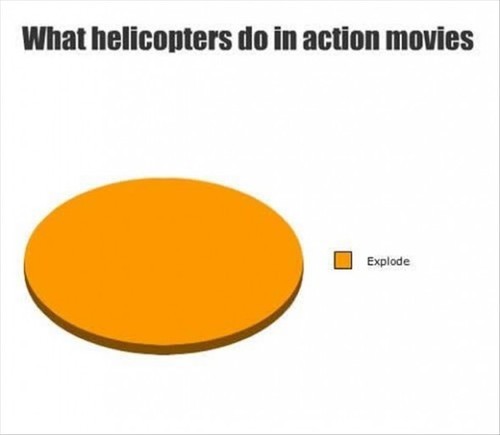
Half Right About Helos

Procrastinating a bit with more I Love Charts:

Of course, if this was real life, the pie's biggest slice would not be explode but broken.

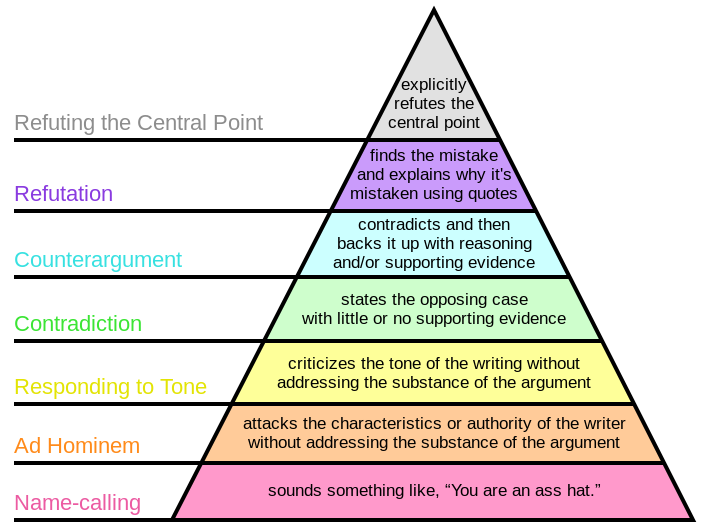
Pondering my Argument

I had a pretty healthy rant in the direction of a Canadian columnist.  The question is where does it fit on this handy chart:
From I love Charts: http://ilovecharts.tumblr.com/page/2/.  

Almost certainly a mix, as I accused him of generational thinking (thanks Roland), so that would be Responding to Tone.  But did I climb higher in the pyramid?  I don't know.  I do know the commenters on the piece include many ass hats.

Art Imitating Life Backwards: Reverse Corruption

I had lunch today with a woman who spent heaps of time in Afghanistan doing development work.  I mentioned one of my favorite questions: "which forms of corruption can we tolerate and which ones must we fight?) and she pointed me to this site.  The video, Payback, has a fake cop stopping Afghan cars at a checkpoint and then offering them a bribe.  That's right, rather than shaking down the people, the "cop" is apologizing and offering to pay back a bit.  See here for the news story that explain it all.

So, we have an artist making some very solid points about the corruption problem.  Unless you speak Dari or Pashto (probably the latter, but I have no idea), you may not understand what they are saying but you can see several people rejecting the "bribe."  Interesting place.

Fiddling While Rome is Burning? Sure

I was not thrilled to read a particularly uninformed column in a Canadian newspaper this morning that argued that Canada's political scientists are silent about Canada's woes.  I mean, doesn't the guy read my stuff?  Well, maybe not, but here is my response.  I probably would have been more aggressive had I noticed the line towards the end about wads of time we academics have.  Maybe we would if we did not respond to time sucks like this.

Monday, June 3, 2013

Best Tweet about Last Night's Game of Thrones (spoiler)

GRRM has proven that he is far nastier than JK Rowling.  Her body count only accelerated at the end.  JK waited until the end of the fourth book to kill a relatively marginal character, the end of the fifth book to kill a key character who did not appear until the third book, and only at the end of the six book to kill Dumbledore.  GRRM killed his Dumbledore, if you will, in his first book in the series.  But we are only halfway through the third of many really think GRRM books.

The internet outrage by fans of the TV show indicates that they were not paying much attention to the first 2.8 seasons, as the portents were pretty clear.  The show was a bit different in what happened to Robb's wife, but, otherwise, pretty consistent indeed.

Update:
Oh, and how did people react?


h/t to CNNSI's hot clicks

Why Federalism is Superior to Confederation

Yesterday, over beers with some keen observers of Canadian politics, I learned something that altered how I viewed Canada's confederation vs. American federalism.  Apparently, one not supposed to sell beer across provincial lines, which explains why the appearance of Granville Island Beer is sporadic in Ontario and Quebec beers are not so accessible.  Still, beer does cross these boundaries, so I don't know how this works at all.  All I do know is that this is not an issue in the U.S.--the interstate commerce clause and all that. 

So, on the beer issue, it is pretty clear which system is better.  And isn't that all that really matters?*
*  Another reason federalism > confederation: approximately 112% of Canadian politics research is on federalism.  Yuck.


Sunday, June 2, 2013

Insert Title Here

It is fun when various streams converge (not the Ghostbuster kind that can cause the end of the world).  So, on twitter and on poli sci rumor today, there are threads related to titles of theses and articles and books. 
I have always taken perhaps undeserved pride in the titles for my stuff, but also have some regrets. My dissertation did not have the snappiest title but was descriptive as hell and did not "Bring Back" anything in or "Problematize" so "Supporting Secession or Maintaining Boundaries:
The International Consequences of Ethnic Politics
" is not a bad start.

I probably go for alliteration too much:
  • "The Dual Dynamics of Disintegration"
  • "Inconsistent Irredentism"
  • "Overlooking the Obvious"
  • "Dilemmas of Divorce"
  • "Comparing Caveats"
I have gotten away with some pop culture references only rarely: "Pie Crust Promises and the Sources of Foreign Policy."  Mary Poppins FTW! The strange thing of that one is the second half--the editors wanted FP in the title, but the journal is Foreign Policy Analysis, so, um, duh!

My plays on words and classic phrases have been pretty good, I think:
  • "Is Pandora’s Box Half-Empty or Half-Full?"  
  • "Laissez Fear" which combines Laissez Faire economic policy with ethnic insecurity.
  • The Ties That Divide instead of the ties that bind, which not only illustrated the concept of the book, that ethnic ties can lead to support for secession, but also a cover that did a great job of illustrating the concept.  The subtitle divides the title!  Not my idea. But great graphic design.
  • For Kin or Country instead of "For King or Country."
  • The book I am working on now on Canada and Afghanistan.  Not saying now, but not a maple or moose reference. 
To be clear, I had some fun ones that editors nixed.  "Determining the Sources of Irredentism" should have been "Reuniting: When Does It Feel So Good" from this song.  I really regret never naming at least a conference paper: "Four out of Five Irredentists Agree."  What a waste of a research project, leaving such a great title unused.

I had a running fight with my co-author and editor over: "NATO and Afghanistan: Fighting Together, Fighting Alone" as I wanted the subtitle to be the title and lost.  Easier to people to find NATO and Afghanistan, but I like the other part more.

I must say that the lousiest titles have been tended be those that editors required, such as
Intra-State Conflict, Governments and Security: Dilemmas of Deterrence and AssuranceThe second half is mine, the first half? Yuck.


Sunday Silliness: Why I Stopped Collecting Comic Books

I was a comic fan long before it was cool to be un-cool.  I hid my ID as a comic book collector as it felt too geeky as a teen to make public.  I tended to collect the mainstream stuff, though, with a focus on Spidey and X-Men.  I quit collecting in 1996.  I remember this because that was when I had a new expense that crowded out the comic books--diapers.  But that was not the real reason I stopped.

I stopped for two basic reasons, but could have been a third. 

First, cross-over disease.  Marvel and, apparently, DC (I didn't collect DC much) got in the habit of developing special "short series" where characters crossed over into other books or new mini-series were developed.  This, was of course, to maximize sales, but it maximized my frustration.  I was reminded of this today by a tweet (h/t to Jacob Levy) that pointed out a fun cracked article that highlighted a key X-Men issue (Wolvie gets Colossus good and drunk and then beaten up) that was a result of one of these series:

It has its roots in Secret Wars, and while most people remember that as the crossover where Spider-Man got a new costume that wanted to fuck him so bad, it became the most popular villain of the '90s, that was far from the only notable event. The whole idea was that there would be a big change for every book, so everyone reading Marvel Comics would have to pick up Secret Wars in order to find out what the hell was actually going on. This is basically the formula that modern superhero comics are built on, which makes it the most diabolical and successful supervillain plot of all time.
Indeed.  This led to a proliferation of comic books, which increased the $ spent, and I got tired of having to buy many books to follow one character.

Second, clone disease.  I quit when Spider-man was apparently not the real Peter Parker.  Ug.  I hate clones, as they are almost always a dodging plot device that leads to bad stuff (no accident that Clones are mentioned in Star Wars but only rear their ugly heads in the prequels).  I almost stopped reading the series of Star Wars books that took place after Return of the Jedi since clones were featured. 

If I had stuck around for a while longer, I would have then quit due to re-boot pandemics.  Yep, the editors let the writers of comic books write themselves into a box.  When they realized that they were trapped, they re-booted the character or the entire series or the entire universe.  Why should I care about anything in this universe if it can be re-set any time they feel like.  Well, a new universe with the old characters re-set means that I have nothing at stake anymore so good-bye. 

This, of course, also occurs with the movies: two sets of Spidey's, three sets of Batman (if we include Adam West's version), three sets of Superman with the new one in a few weeks, three sets of Hulks (including the Avengers' version which is, thankfully, superior), and so on.  Much of this is driven by the need to keep the rights to the character (Spidey), but it diminishes the value.... unless they do it really, really well. I was not happy with a new Spidey series, but Emma Stone and, oh yeah, Andrew Garfield made it work.  The new Superman is probably better than the most recent one, but will still probably fall short of Christopher Reeve's.  Then again, I watched all three Superman non-animated TV series (the original, Lois and Clark, Smallville).  Well, the second one had a lot more to do with Teri Hatcher, but anyway.

I guess I tolerate the TV/movie reboots because there is a chance that the new version is as good or better than the old. My completely half-assed take on comic books is that never happens.  More importantly, if you follow a comic book, you have years and years and dozens and dozens of issues invested, so a new version rips out all that investment.  I hate that.  Do you?


Saturday, June 1, 2013

What's Up With Hizbullah?

One of the advantages of supervising students who do work far afield from one's research is that you can lean on them when you have a question.  I have been puzzled by Hizbullah's recent behavior in/towards Syria, so I asked my former student, Ora Szekely of Clark University, for a guest post.  I hope to exploit invite more of my students to share their perspectives here. 

Ora says:


Last week, Hasan Nasrullah openly declared Hizbullah’s support for the Asad regime in Syria, referring to its fight as Hizbullah’s fight and explicitly calling out the “takfiri” (radical Salafist) influence as a threat to both Lebanon and Syria.   In some ways, this is nothing new – it’s been clear since the onset of the Syrian uprising that Hizbullah is committed to backing the Asad regime. There are a number of reasons for this:  

  • Most obviously, Hizbullah badly needs both the arms Syria provides directly and the corridor for Iranian arms it provides indirectly.  The former means it doesn’t want the regime to fall in general, and the latter that it doesn’t want it to lose control of territory in the border region in specific, which is why the battle for Qusayr is so critical.
  • Syria has historically exercised a great deal of influence in Lebanese politics, and its backing has benefited Hizbullah, in some ways, some of the time, though not in all ways and not all of the time.
  • More broadly, being embedded in the “axis of resistance” is far better for Hizbullah than going it alone, for both practical and symbolic reasons.  Until recently, the major members of this alliance were Hamas, Hizbullah, Iran and Syria.  But Hamas jumped ship last year, leaving the coalition without a significant Palestinian member.  (Reports this week of Palestinian refugees burning Hizbullah aid packages are probably a little exaggerated but are still lousy press for Hizbullah.)  The fall of the Syrian government would leave Iran and Hizbullah isolated and deepen the sense of both as Shi’ite outsiders in the Arab world. 
  • In some ways, this is simply politics as usual in Lebanon.  There is a long tradition of Lebanese factions seeking military and political support from outside parties, be it the PLO, Syria, Iran, Saudi Arabia, Israel, the United States, France, or whoever else seems sympathetic. Hizbullah is not the only party in Lebanon taking sides in Syria.  Driving around the Sunni neighborhood of Bab al Tabbaneh in Tripoli last summer, I saw FSA flags on every available surface, often paired with a poster of a local sheikh.  Some Sunni politicians are clearly attempting to link their political fortunes to the popularity of the FSA as a way of improving their own position vis a vis their rivals within the Sunni community.