Wednesday, July 6, 2011

Why Do We Suck at Nation-Building

Andrew Exum answers his own question thusly (bold/color is mine):
Why do we suck at nation-building? A lot of reasons. Here are just a few:

(1) We are ignorant. We do not know enough about the cultural, political and social contexts of foreign environments to fully appreciate how our interventions will affect those environments. Thus our aid and development spending (and military operations, to be fair), meant to ameliorate drivers of conflict, often exacerbate them. 
(2) We do not provide enough oversight and accountability for the projects we initiate. This is boring but important. We have spent ungodly sums of money in both Iraq and Afghanistan and have not provided enough contracting officers to effectively oversee the money we have spent. How do we just give tens of millions of dollars to agencies and departments in the governments of Iraq and Afghanistan without any oversight? Lack of contracting officers. How are contracts in Afghanistan divided up between shady sub-contractors and sub-sub-contractors, with tax-payer money falling into the hands of the Taliban and warlords? Lack of contracting officers.
(3) We do not have any patience -- and we have limited resources. Nation-building takes time. Where we can nation-build at relatively low-cost over an extended period of time, as in Colombia, we can be successful. But asking Americans to spend massive amounts of money for an extended period of time in Iraq or Afghanistan is a recipe for ... turning your average U.S. tax-payer into an isolationist. 
Cannot really add much to this.  He is on target with all of this.

Second Canada-Afghanistan Rant of the Day

Paul Robinson, a prof at U of Ottawa, has claimed that Afghanistan has upset Canadian values by privileging the military.  There are some decent points in the piece, but I think it is mostly vastly overstated.

Again, as a foreigner who has only lived here for about nine years, I may not be that familiar with Canadian values, but I think that multilateralism, responsibility to protect, and wanting to make a difference in the world are Canadian values.  How can one be responsible if one avoids doing the hard work, which often requires violence to be deployed?

Is Canada more militaristic?  Since Canada has left Afghanistan due to the pressures of party politics and political competition and public opinion, I would say nay.  Yes, the Canadian Forces get more respect, but is that over-compensation for the "decade of darkness" after Somalia or about the right level of respect for one of the truly national institutions?  After all, we have had a series of Quebec-based units fighting and dying for the Canadian effort in Afghanistan, with little controversy despite expectations (including mind to a degree).  What other national institutions get respect in Alberta and Quebec?  The Supreme Court?  Uh, no.  The RCMP, I guess.  Who else?  Exactly.  So, having the CF be viewed positively across the country is almost certainly a net good for Canada.

Robinson claims that the "support the troops" mantra has undermined civilian control of the military.  Yet the civilians did manage to stop the Afghan combat mission.  The opposition has opposed the F-35 and have confronted the government and military on detainees (which I continue to believe is a distraction from more central questions, but that is just me).  There is no real parliamentary oversight over the Canadian military today because this is the way British-style systems work.  The question really is whether the Prime Minister, cabinet, and the civilian side of DND have control over the military?  Civil-military relations are dynamic with power among the actors changing in response to events and personalities.  Harper chose Natynczyk to replace the more outspoken Hillier as Chief of the Defence Staff, when he could have either renewed Hillier or appointed someone else like him.  He did not--exerting civilian control.

Do not blame the military for the demise of DFAIT.  Blame Harper and his series of less than stellar Foreign Ministers. 

Regarding: "The distorting pull of DND is also warping spending priorities elsewhere ...Foreign aid"--that was temporary.  Afghanistan aid dollars are being cut.  CIDA will again return to its long term focus that tries to be as un-tied to Canadian national interests as possible.  Not sure that is a good thing, but CIDA bureaucratic culture will overcome "Canadian mil superiority."

Finally, Robinson and I have a big disagreement.  He likes the myth of the Canadian peacekeeper.  I believe that we need to understand the reality of post-Rwanda peacekeeping: that militaries sent to had to places will have to kill and risk being killed as the rebels/opponents will not meekly obey those in Blue Helmets.  Indeed, being prepared to fight in such situations makes the fight less likely.

End of Combat for Canada: Was It Worth It?

The Canadian Forces have ended their combat role in Afghanistan, as of the past few days.  The Mandate passed in 2008 ends at the end of July, with Canada already starting its new training mission that is "Kabul-centric."  I just had a radio interview on this topic, my first Afghanistan-related media opportunity since December.  It used to be the case that I was talking Afghanistan with Canada's media folks a couple of times a month.  But with that decision in 2008 and with Harper using that decision as a shield from having to think about extension (he could have, he chose not to), the media lost interest.  True, there has been a flurry of stories over the past month, pondering what it all means.  So, here is my first take at this big question.  Or second, since I gave it a shot for the radio interview (See two Canadian academics consider this here).

What is worth it for Canada?  157 soldiers, a couple of aid workers, one diplomat and one member of the media lost their lives and billions of dollars were spent.  If one thinks that there is nothing that is worth the life of a Canadian, then the answer is easy.  It is hard for me to answer this question, as I am not a Canadian although I do pay tax dollars.  I have no relatives and few friends from here who put themselves in harm's way.  Still, as a scholar of International Relations and having researched the NATO mission in Afghanistan (plus my ten days in Afghanistan make me an expert, right?), I have some opinions.


Tuesday, July 5, 2011

Academic Action Figures?

Yes, they exist.  But there is a critical flaw--we do not do "action."  I remember a few times when I had TV crews in my office to interview me, they would seek an action shot.  What would that be?  Me typing.  Woo hoo!?  So, action figures make little sense for folks who mostly stand and talk or sit and type. 

Ironies of Innovation

I focused on American innovativeness the other day when I considered a list of what is great about America--more so than Geico commercials.  This piece, where an American army officer develops an app that allows him to target the enemy quickly and effectively, illustrates that American spirit.
His answer was to create the Tactical Nav app, which troops can download to their smartphones. The Tactical Nav app combines a compass, a map, and a camera
"It combines three components," he said. "A compass, a map, and a camera. It's pretty simple - but obviously it does a little more than that."
He said he's tested his app against everything currently in use in Afghanistan - and claimed it is just as accurate.  The app is designed to give soldiers exact co-ordinates for where enemy fire is coming from.They can then send that information to their command centre, who will decide whether to call in an air strike, or send a rescue helicopter to help wounded troops.
"The first time I tried it for real," he said, "I sighed with relief. "I could have got into trouble - but it worked. "As a fire support officer, I take into battle a compass, binoculars, a map, a protractor, a GPS device - a secondary GPS device in case one fails - and batteries. "What this does is, it combines all these components, and throws it into just the one app," he said.

What is even more American is that the when he faced an unsupportive army bureaucracy, he went out on his own to develop the app and then find some financial support. 

Blame Aplenty

The Dutch have lost a lawsuit--some Bosnian Muslims were suing the Dutch for failing to protect them when the Bosnian Serbs overran the UN safe area of Srebrenica.  The Dutch already blame themselves in a 2002 report that led to the fall of the government for events in 1995.  This is most striking for a variety of reasons.
  1. The Dutch were under UN command at the time, so one could blame the United Nations for failing to give the Dutch the necessary support to defend the sector.  Specifically, the Dutch called for air support, which NATO was willing to provide, but the UN leaders said no.  As a result, the Dutch now always bring their own air support with their own rules so that their troops on the ground never are left with such dire choices.
  2. Ratko Mladic is now at the The Hague for instigating, planning, and leading the attacks and the killings.  So, the timing is interesting and raises questions of who should get the blame: the international community or those who commit the crimes?  The answer apparently is: both.  I would weight more heavily the guilt of the guy driving the car directly into a crowd than the police officer who fails to get the crowd out of the way.  Yes,  a gross simplification, but the Bosnian Serbs led by Mladic are the folks who are most responsible.  But, yes, this was a failure of the international community as well.  But suing the Dutch may only discourage other countries from joining UN operations since they, too, may be left hung out to dry.  
  3. The Canadians deftly escaped responsibility.  They had peacekeepers initially deployed in Srebrenica but re-deployed to another part of Bosnia because they knew the situation was fraught with peril.  The Dutch were in place to face this horrible situation--fight despite having no UN support or surrender the Bosnian Muslims--because the Canadians could see further down the road (or game tree). 
  4. The Canadians were not alone.  Lots of other countries could have done more and acted earlier.  So, should everyone be sued?  Should the Belgians be sued for their failures on Rwanda?
The one striking thing in all of this is that the court did recognize something that the Dave and Steve project on NATO and Afghanistan emphasizes--the key decisions are in the national capitols, not within international organizations.  BUT, to be fair, the Dutch decisions in 1995 were critically constrained by the lack of UN support.  The Dutch could have fought in a hopeless situation rather than essentially surrender to the barbarians.  Might not made much of a difference, except where we point the finger.

Monday, July 4, 2011

Captain Update!

I already mused earlier about the movie folks trying to play down the American part of Captain America the movie.  Well, now it appears that the First Avenger (the non-Captain name for the guy wearing red-white-and-blue with a star) will be Captain America everywhere except..... Russia, Ukraine and South Korea.  South Korea?  Um, given that there are still 20,000 American troops there to help deter the crazy folks from the North, they aren't used to seeing stars and stripes in South Korea?
Though it is common for American blockbusters to feature less US-focused titles in foreign markets, Paramount largely decided against the alterations for Captain America, and instead gave foreign countries  the choice of two titles, Captain America: The First Avenger or The First Avenger.
Interestingly, most international distributors believed the franchise name was so identifiable that not using "Captain America" in the title could risk losing ticket sales.
Well, yeah. So, the South Korean distributor felt First Avenger was better than Captain America?  Um, I think the Koreans (the ones in the South that is) have access to the internet and such.  I think they are already hip to where Captain America is from and that he is not a General or a Lieutenant or a Corporal.

I wonder if countries changed Green Lantern to a less environmentally correct color as one could see the title as a subtle rejection of industrialization.  Ok, that's a reach, but then so was the movie (I'll be here all night).

Seriously, for just a second, if you are willing to show the movie, it seems silly to deny what it is.  Captain America is intrinsically American.  The Hulk can be from anywhere.  The X-men could be gay.  Spider-man does not have to be from New York (although it helps).  Thor has to be from Asgard, and Captain America has to be from, well, the U. S. of frickin' A.

Oh, and for those playing at home, the superhero race still has X-Men in front of Thor and Green Lantern, with Natalie Portman edging out Blake Lively simply because they dressed NP normally while Blake was wearing fancy duds all the time.  Just too much unintentionally comedic wardrobe.  Plus Thor had a better backup cast with Heimdall, the Warriors Three and Sif.  Green Lantern had some CGI friends.  Well, 3599 Green Lantern friends of all shapes and sizes.

And Super-8 still has the lead for best movie of the summer. I will have to watch Harry P from Australia and see how he does with an Aussie accent.

Ritual 4th Post


And, yes, a chilling scene despite the fact that, as Bob Dole would put it, the average American is dead.

Getting Perspective on some Academic Truths

Dan Drezner and his wife have parallel columns in the Chronicle of Higher Education addressing the experience of tenure denial.  It is still shocking to put Dan into that category of a tenure denial-ee, as he has been consistently one of the most productive, influential, and, indeed, successful political scientists of his generation.  But his experience (and that of another excellent scholar rejected by the tenured folks at Chicago that year) reflects an enduring reality in the academic world: you will get tenured and promoted if the tenured folks want to do so, and you will not if they do not. 

That is, merit sometimes has something to do with it, but often not.  Departments will grant tenure and/or promote someone even if they fall short of contemporary standards if they want that person tenured and/promoted  And departments will ignore contemporary standards and deny tenure/promotion if they don't want to give it.  Dan's take on his past and his wife's reflections do a great job of showing how one deals with such a career reversal.  I have friends who have been through worse experiences as Dan landed on his feet immediately.  Given the investment of time and effort to hit a wall after five or six years in a place is just very tough, especially when the job market is particularly bad.  Smart departments will hire such folks.  My old place was smart enough to do that on at least one occasion, and my current department took advantage of another bad decision made by Chicago that year. 

But the feelings do linger.  Is Dan still bitter?  Just a bit.  Am I bitter for him?  Sure.  Do I understand what he has been through?  Just a bit.  Someday I will blog more directly about flawed promotion processes.  Just not today.  Dan has ably taken the floor, only to be out-classed by his wife.  Do take a look and see what they have to say.

How the Declaration of Independence is Like The Bible or Clausewitz?

It is read selectively, of course.  The Tea Party folks and more extreme actors out there use key clauses to justify themselves, especially: "-That whenever any Form of Government becomes destructive of these ends, it is the Right of the People to alter or to abolish it, and to institute new Government."

They, of course, forget the next lines: "Prudence, indeed, will dictate that Governments long established should not be changed for light and transient causes; and accordingly all experience hath shewn, that mankind are more disposed to suffer, while evils are sufferable, than to right themselves by abolishing the forms to which they are accustomed."

While we live in a time where institutions seem so frozen that government cannot operate, with the threat of filibusters and now divided government, the reality is that changes to the existing order can still be made within the system.  If the Democrats had the courage of their convictions, they could have overcome the filibuster threats.  When they did act, things did happen--a compromised health care bill.  The debt crisis we now face is something that can be managed, but there are games to be played still.

This Independence Day I ponder not the sacrifices made by soldiers on battlefields around the world (Memorial Day and Veteran's Day foster such reflections) but rather the state of the union and what it means to be an American.  Are we over-consumed with decline?  Can we bounce back from the current situation?  What has happened to the American dream?

I don't think the US will ever return to its dominance of the planet in the 1950's and 1960's for the simple reason that we will not have another war that decimates all of the other great powers while leaving the US barely touched.  Iraq did heaps of damage to American leadership not just through over-extension but also through a loss in legitimacy.  It is one thing to go it alone essentially, and another to go alone based on lies.  I remember being asked by the Montreal media in early 2003: what if there are no WMD's in Iraq?  And I remember being stymied by the question.  I didn't think WMD programs justified the war, but I had expected something, anything, to get turned up.  But no, the intel was pre-cooked, and then the country that could go to the moon proved that it could do everything wrong in a post-war phase that just created more war.

Still, the Libyan effort shows that American leadership is still necessary.  Yes, Obama now has US forces playing a supporting role, but it took the US to get NATO to agree to the effort, and it continues to take US assets to make the effort sustainable--refueling, intel, reconnaissance, etc.  I don't think too many folks are looking forward to Chinese leadership, not even the Chinese.  So, yes, the US is declining relatively, but it still possesses a fuller portfolio of power than anyone else: conventional power projection, nuclear weapons, a large albeit semi-broken economy, a large population, an appealing set of ideas (back to that Declaration and Constitution), and so on.  While some datasets have China having more power than the US because of the role of population in the calculation, we need to remember that power is relational.  To get others to do what they would otherwise not do.  While China is good at gobbling up resources around the world, the US still manages to get others to do stuff they would otherwise not do, like fly over Libya or contribute to Afghanistan. 

I will ponder the state of the union and the American dream some other time as this post is getting long and I have some work to do on this non-Canadian holiday.  To preview, I still think that Americans, even in this relatively dark time in our history, are dreamers and innovators.  If we can recover from the Civil War and from the combination of Vietnam and Watergate, I think we can bounce back from the financial crisis and from the Bush Administration.

Sunday, July 3, 2011

Evaluating American Assets

CNN Money has a list of the top 100 great things about the US.  I guess we cannot blame them for their patriotic pontification given that tomorrow is the 4th of July and, aside from the Bin Laden raid, Americans have not had that much to cheer about lately.  Anyhow, the list ranges from on target to pure padding (should have come up with a top 10 or 25).  So, just to have fun with it, I am going to assess the list.

  1. Opportunity.  Yep, the US remains the land of opportunity although wages by most of the country have stagnated.  Still, immigrants continue to come to the US, do well, and improve things for their kids.
  2. Interstate highway.  Um, don't other folks have good highway systems (the autobahn?)?   Sure, there is some great history there, but not that super-special.
  3. Sears Tower.  Um, ok.  Tall building, but great?  
  4. Wal-Mart Employees saving lives in Joplin?  Ok. We do have bundles of stories of Americans doing great things in times of great hardship.
  5. Navy Seals.  Sure. All of the Special Operators are quite, ahem, Special.
  6. ESPN?  Um, I do like some elements of it (Bill Simmons and the new Grantland are pretty cool), but isn't the network also responsible for some of the worst elements in sports, like the focus on ego gratification and big hits, rather than good team play.
  7. Fedex.  The Canadian postal service and their ox-carts certainly make Fedex look good.  Too bad it led to what's-his-face owning the Washington football team.
  8. Steve Jobs.  Sure, as a PC user, I can respect what Mac has done, and I do like my Ipod.  This goes to larger hunk of what makes America great--a good environment for innovation.  Perhaps not as unique as it used to be, but still we have some of the most successful college drop-outs.
  9. Whole Foods.  If you say so.
  10. Microsoft Word.  I am not sure there is a consensus on this one, especially as every new update causes people to get upset at the new formats.  
  11. Ford F-150.  Bestselling pickup.  11?  Really.
  12. Rockerfeller Family?  heaps of good works apparently.
  13. Caterpillar construction machinery.  Whatever happened to Tonka?
  14. Detroit.  I guess buying low, right?
  15. Kindle?  Too soon to say.  
  16. Duct tape.  You mean, this is an American thing.  What do the Germans and Japanese do with their ducts?  And their kidnap victims?
  17. Bill of Rights.  Um, #17?  These should be at the very top.  This land o opportunity would not be such without freedom of speech, assembly, from religion (yes, I am putting it like this to antagonize folks) etc.
  18. Wall Street Bull.  Given the past several years, nothing on Wall Street should be on this list, but this is CNN Money's list. What else can you expect?
  19. Carlos Santana.  Sure, first immigrant listed.  
  20. Pappy Van Winkle Bourbon.  A beverage that is really hard to find and drunk by a few?  I would go with Coke here or Microbrew beers.
  21. LinkedIn.  You have to be kidding me.  Thus far, an annoyance with not so much merit.  Down the road?  We shall see, but not the best social networking hunk of internet around. 
  22. Colin Powell.  Nice immigrant story, sure.  But he enabled the Bush Administration and was the face of the US when it was lying to itself and the world.  Heaps of demerits here.  
  23. Bill and Melina Gates.  Microsoft and now macro-good-doing.
  24. Geico commercials.  Um, is that the best we got?  Mad Men before Geico.
  25. Mississippi.  Yep, cool river, big, and all of that.

Saturday, July 2, 2011

Al Qaeda and Spinal Tap

The intel treasure trove from the Bin Laden raid has revealed that the folks in AQ, especially its #3, are aware that they have much in common with Spinal Tap drummers:


One of bin Laden’s principal correspondents was Atiyah abd al-Rahman, who served as No. 3 in al-Qaeda before bin Laden’s death. A 2010 message from Rahman expressed frustration with the CIA drone campaign, a source of particular concern because many of his predecessors in the third-ranking slot had been killed in strikes by the unmanned aircraft.
“He was saying in the letter that their guys were getting killed faster than they could be replaced,” the U.S. counterterrorism official said.
Um, so there is one vote against the on-going US drone campaign.  

One thought on the reports about these documents--it just might be the case that there is some selectivity in what is being released so that the stories end up supporting US policies.  Just a thought.

Joint Staff Rocks Again

Check out this interesting post by a "Feminist in the Pentagon."  Like me, she was surprised at how welcoming the folks on the Joint Staff were.  And then she enumerates why they are so swell:
  1. They work as a team.
  2. They encourage professional development.
  3. They are smart.
  4. They reward good work.
  5. They don't bullshit.
  6. They hold diverse views.
I pretty much entirely agree.  They welcome diverse views, but they were not that diverse.  At least, not in my one year of experience in the Balkan moshpit. 

But I wholeheartedly agree with this line: "The serious content of our work, juxtaposed with the camaraderie and humor of our office, strikes a great balance."

Of course, this woman is generalizing about the military.  It may be the case that the Joint Staff is the best part of the military--that is what they always told me.  We have examples of other places in the military where team means the boss tells you to just do what he thinks is right, that they are not that bright, and where they do not hold diverse views--CENTCOM under Tommy Franks, for instance.

Still nice to see that my experience was not unique and that today's Joint Staff is not that different from the one I enjoyed ten years ago.

Xenophobia, Italian Style

I was pleased to see that Russian racism might be serving to cool down enthusiasm for adventures in the Caucuses, but my joy for the counter-intuitive dynamic does not blind me to the reality that intolerance can, of course, also produce inhuman policies.  I mentioned earlier that France was developing policies that were undermining the EU in repsonse to the Libyan crisis

This piece shows that Italy is acting in ways that directly challenge the raison d'intervention--responsibility to protect--by denying refuge to the folks fleeing the violence.  It is not surprising, but still appalling.  Yes, the economies of these refugee-recipients are not doing well, but refugees usually flee to countries that are much, much worse off.  Italy can afford these folks much better than Congo, Pakistan, etc. 

Italy is clearly looking to end this conflict any way it can, changing its line on supporting the bombing campaign from refusing to strike, to participating in the strikes, to now calling for a ceasefire.  Looks pretty desperate to me.  Again, since Italy is in far better shape economically than your average third world country, it must have something to do with the perceived fragility of the Italian political scene.  I am not an expert on Italy, and the refusal of the Italian diplomats in Canada to meet with me means that I have not done that much research on the politics of Italy's deployment in Afghanistan.  So, I can only speculate.

What Italy's fecklessness does verify?  That xenophobia is a weak reed upon which to hang a humanitarian intervention.

Friday, July 1, 2011

Celebrating a Better SecDef

Secretary of Defense Robert Gates has retired.  My man-crush for him continues.  He was not a perfect SecDef, and we might err in over-loving the guy since his predecessor was so very, very bad at his jobThis piece suggests that one of the most important things he managed to do was to prevent a war with Iran.  I had a running battle/bet* with a friend of mine about a war with Iran, as I didn't think we could be so stupid as to start another conflict in the Persian Gulf.  My friend turned out to be right about how motivated the supporters were, but I turned out to be right about Gates and the military. 

Gates did a lot of things right.  He developed a good, transparent relationship with the military while not being its puppet.  He cut stuff that elements of the military wanted and forced them to invest in things that mattered for the current war like drones and more IED-resistant vehicles (MRAPs).  Gates should get some credit for the mission to take out Osama.  He consistently presented arguments that made him a voice of reason (the Juliet Johnson of the US administration), including his take on wikikeaks.  Gates may have moved more slowly than folks would have liked on Don't Ask, Don't Tell, but his backing made it possible to remove this blight.  He handled the firing of McChrystal as well as one can. 

What these two SecDefs remind us is that individuals and personalities do matter, even as we political scientists focus more attention on international pressures and domestic structures.  The folks manning (personning?) the machines matter a great deal.  At a key point in time, we had a special person running the most dangerous machines.  If only he had been SecDef in 2003-6.  Alas.

Gates earned his accolades, doing a tough job that had plenty of potential to alienate most folks.  Leon Panetta would be wise to keep Gates on the speed-dial.

Happy Canada Day!

While I bitch and moan about life in Canada, I would be remiss not to appreciate all that rocks in Canada.  The people have been very welcoming to my family despite our strange ways (like not using "u" hither and thither) and our insults to Montreal bagels.  Canada has been a big boon to my research as I have had great access to the Canadian military (and some of the civilians--the agency that has been least helpful knows who it is), and they have taken to remote places like Kabul, Kandahar and Bagotville.  And the ultimate here has been fantastic. 

So, today, I will hoist my Alexander Keith's white beer (the big beer companies are so much better than the American big beer companies) and toast all that is Maple, all that is Maple-Leafed (I still get a kick that a general's rank is denoted in the number of leaves on his/her shoulders), and all that is cold, eh?

Thanks again to the Canadians for having a great sense of humor/humour.

Iceland Backfill Memories

I keep coming back to this story from my Joint Staff days: that a list was handed down from Rumsfeld of American commitments around the world he wanted to end.  Supposedly to save money and stress on the troops, but mostly due to an ideological commitment that the US should not spend money on allies/multilateral commitments.

Anyhow, I have mentioned this before.  What brings this up yet again is that Rummy has a piece in the Wall Street Journal where he specifically cites the money saved from finally ending this commitment: $225 million dollars.  Perhaps the list of commitments to end (like four guys or so in a UN mission to East Timor) was really about the money, but the funny thing here is this: closing the USAF base in Iceland was not his idea.  It was something the Air Force wanted to do, not to save money (nor was the concern about the four fighter planes) but so that they could re-position the long-range search and rescue helos and planes.  How do I know this?  I was the one handling the list, and the original response memo went up the line without the Iceland commitment listed until it hit a two general in my chain of command* who was an Air Force officer.  Then, the list came back to me with a request to consider Iceland.
*  All those who know me can now giggle at the thought of me being in anyone's chain of command.

There were some difficult tradeoffs as Iceland saw this as the US/NATO commitment to its defense and essentially held the US anti-submarine warfare facilities (featured in Tom Clancy's Red Storm Rising) hostage.  The new deal, as I have mentioned, has NATO sending occasional rotations to represent the NATO commitment (and I believe a similar operation applies to the Baltics--occasional tours of NATO fighter planes).

The point here is that Rummy is now taking credit for cutting a "wasteful" expense when it was really not his idea at all.  Just good old bureaucratic politics.  Rummy did cut some expensive programs (the Crusader artillery system--good thing we never had it around to deploy to a Muslim country, right?), but giving credit where it is due has never been a Rumsfeld hallmark.  Steven Metz has been reading Rummy's memoir and tweeting about it (so that the rest of us can be spared, I think), and he has noted that all of the problems in Iraq where some other dude's fault (Bremer), forgetting that he,Rummy, had demanded the responsibility for the post-war phase until it got too messy.

The other point is: why are we paying any attention to the Worst Secretary of Defense in American History?  Oh yeah, nostalgia.

Thursday, June 30, 2011

Wuffle's Law

One of the recurring themes both in my blog and at the Poli Sci Job Rumor site is that of rankings.  See here, here, and here for a start of my fixation.

Anyhow, I am always reminded of a simple fact when I see any poli sci ranking of journals, presses, departments whatever: that whenever a ranking is suggested or revised, it is always suggested by someone who benefits from the new ranking.  Nobody ever proposes a ranking that puts their department lower.  So, Godwin's Law is that the longer any internet discussion, the probability of Hitler/Nazis/Holocaust being mentioned approaches one.

What would we name the following law: Any ranking of any aspect of the academic enterprise will produce revised rankings that improve the standing of the folks who produce the revised rankings? In honor of a semi-anonymous person who published amusing pieces at PS (see here for an example if you can--gated), so how about Wuffle's Law?

Russia Fits!!!

In my book with Bill Ayres (again, the non-terrorist one or perhaps just the secretly terrorist one), we argued that Russia was one of the cases of the silent dog that did not bark--that Russia did not engage in irredentism, despite being voted most likely to engage in such activities at its prom in 1991.   We contended (daringly, I say, as non-specialists) that Russia's identity crisis (what does it mean to be Russian sans Ukraine et al.) was poor grounds for any significant effort to annex neighboring territories inhabited by Russians even with 25 million Russians left outside of Russia when the Soviet Union fell apart.

But then Russia has been playing around with supporting separatists in Georgia--the Abkhaz and the South Ossetians, even issuing some of these folks passports.  Yet Russia did not annex these territories or really threaten to do so.  Plus Russia still has not been so enthused about Belarus returning to the fold even though this most dysfunctional ex-Soviet ex-Republic has occasionally expressed interest.

So, we were never convinced that the interventions with Georgia really were irredentism since it was never about identification with kin and never really about a Greater Russia.  Now we have a bit more evidence to our central thesis--xenophobia can serve as a brake on foreign adventures and even encourage retrenchment:
“In Russian public opinion for both subjective and objective reasons there has gradually been the adoption of a view that Russia has more to profit by distancing itself from the Caucasus and its problems, though formally maintaining territorial integrity.”  (Italics in the original, red not so much).
The piece concludes with this:
Russia’s new nationalism is a mixed blessing for Europe. The chances of an expansionary ‘Weimar Russia,’ feared during the Georgia War are minimised – but the danger of a Russia that is more racist and at risk of a bloody divorce in the North Caucasus should keep Europe awake at night.
I don't know--if I were the Poles, Baltics, and especially the Georgians, I would be happy for some retrenchment rather than adventurism, even if it meant a more racist Russia.  Yes, there are tradeoffs as more xenophobia is not more happiness--it has mixed effects.  As we raise in the book, you get less irredentism but more discrimination at home.  I know how the neighbors would vote, just as I am pretty sure that there are significant folks within Russia that find this rising xenophobia to be less than appealing.

But, since this is my blog, it is all about me.  And these trends suggest that Bill and I were on target.  If Russia fits, our theory acquits?  Um, never mind.

PS  I think this post sets my non-Olympic record for number of parenthetical expressions in one post.

PPS That Russia is critical of France for arming the Libyan rebels makes me giggle.  Russia has hardly been restrained from arming folks it wants to arm.

Where's Wallace? Rocking on FNL

While I am miffed at the bridge situation (see previous post), one of the advantages of living here is that I am getting the last few episodes of Friday Night Lights nine days before the Americans who rely on NBC (and about six months behind the folks who got it with DirectTV).  And it is ending so very well.

Spoilers lurk below, but consider this before you jump: is there any city or state/province in North America that sounds like an alien species better than when you refer to somebody from Calgary as a Calgarian?

Because You Have No Credibility

The title is the answer to the following question: Why would Montrealers, including the local newspaper, really need to see the inspection reports for the Mercier bridge?  Sam Hamad, the head of the relevant agency, basically told the newspaper to screw off.  Just because everything that we have been told for the past few years seems to have been a pack o' lies and/or omissions, why should we have any need to see the reports?

Oh, because we would only understand half?  Perhaps the newspaper might have some experts that they could interview.  Oops.

The good news is not all of the bridges connecting Montreal to the surrounding areas are on the verge of collapse.  Just two of the four major connections to the South Shore--the big suburbs on that side of the river but also the shortest route to the US.  The Champlain bridge apparently has more traffic on it than any other bridge in Canada or close to it, and it was designed so badly it only has a fifty year life span. And getting a new one built requires heaps of federal-provincial wrangling.  The Mercier Bridge is half-closed with a crater in the open half.  Double oops.  And repairing that is complicated since it lands on the south shore on the lands of the Kahnawake, who understand only too well how much leverage this gives this First Nations tribe. 

The bridge folks, like the folks running the city of Montreal (who have managed to take the new innovative bike rental business, Bixi, and turn into a money-losing, law-violating, heart-breaking venture), have simply no credibility.  So, when they deny access to reports, people suspect that they might be hiding something.  And they can deny the Canadian equivalent of Freedom of Information requests, Access to Information, by saying that the material contains opinions or recommendations, that the recommendations have not been acted upon, or that it would affect bidding.  So, damn, the Access of Information Act is actually a wonderful shield for the bridge people and any other government officials that are running their cities or province into the ground (or the water, as the case may be). 

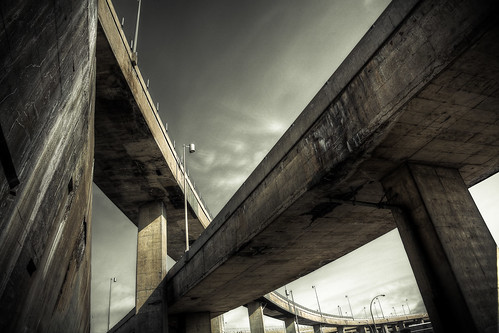
I am now pondering how my family will get to New York for our summer vacation--will we dare to try to cross one of these broken bridges or will we go West to go East and add an hour or so to the trip?  I have already changed my Ultimate habits--I no longer play regularly in the summer leagues as they require a commitment to travel anywhere in the Greater Montreal area during rush hour to get to a game.  Instead, I will sub for a team that thinks it needs me if the game is on the western half of the Island of Montreal--I will not cross bridges or drive through the Turcot interchange (which is also falling apart--hence the nets under the overpasses--see the pic) even though I love to play ultimate.

But I guess we should trust the bridge folks, right?

Wednesday, June 29, 2011

Blog Burnout Day: Let's Re-Hash NATO

I had a surprising hard time writing a piece for Current Intelligence on Afghanistan and the Obama announcement.  Should have been easy.  I am hitting some serious writer's block, so I am posting today an op-ed that didn't make it.  On NATO.  Not a surprise that newspapers did not find it seductive enough (how come I still think of Debbie Harry when I hear or use the word seductive?  Oh, never mind).


Is NATO’s Cup Empty?
Stephen M. Saideman, McGill University

Secretary of Defense Robert Gates has gotten much attention for his speech blasting NATO and pondering its relevance.  The speech should not be that surprising since such critiques are a grand tradition.  Not only did Gates’s predecessor, Donald Rumsfeld, say similar things, but even the ordinarily polite Canadians expressed much frustration at the restrictions limiting what other countries were doing in Afghanistan.  Gates is getting much attention because he is viewed as being far more deliberate and discreet than Rumsfeld and far more aware of the tradeoffs that come with the realities of military deployments.  Opponents of NATO and of the Afghanistan and Libya missions will take this speech and assert that NATO is a dying organization.  The reality is a bit more complex as NATO is indeed constrained, but still has consistently provided significant contributions since the end of the cold war. 
            It is clear that the members of the alliance do not contribute equally nor have they ever.  During the 1980’s, the burden-sharing debate was focused on whether countries spent enough of their gross domestic product on defense.  During the 1990’s, countries varied in their participation in the NATO stabilization efforts in Bosnia and Kosovo AND there was much frustration at the intra-alliance bargaining over how to bomb Serbia.  During the 2000’s, the debate over burden-sharing became far more real as some countries paid a far higher price for their operations in Afghanistan.  The Danes and Canadians led in terms of killed in action per capita while the Germans, Italians and Spaniards faced much criticism for being restricted from engaging in combat in the South and East of Afghanistan.  These restrictions, known as caveats, were the subject of multiple NATO summits and are likely to be of increased relevance over the next few years as the transition plan for the NATO mission in Afghanistan implies moving troops around the country.
            The ability of individual countries to opt out of specific operations or entire missions is integral to NATO’s existence and to any of its efforts.  Why?  Because decisions are made by consensus, and we are simply not going to get all twenty-eight countries to agree to a decision if they are obligated to do whatever is commanded.  Indeed, Article V, which is the focal point of the organization, “an attack upon one is considered an attack upon all” provides an exit option, as each country is responsible for responding to such an attack “as it deems necessary.”  One cannot fix the caveat problem since it is foundational to the organization.
            Even with these handcuffs, NATO has made an impact, if not efficiently, in Bosnia, Kosovo, Afghanistan and now Libya.  The difference between the UN force and the NATO effort in Bosnia 1995-1996 was one of night and day, as the latter had far more robust rules and could successfully deter attacks by any of the sides against each other.  We overlook the reality that there has been no significant violence in Bosnia since the entry of NATO, which sharply contrasts with the years of UN failure.  NATO, despite significant disagreement within the organization and despite a very visible lack of commitment by its members with promises of no ground forces, was able to compel Serbia into essentially giving up a politically, culturally, and historically significant piece of territory.  Yes, it took about eighty days, but it is a pretty impressive effort, given how little the NATO countries, including the US, were willing to risk.
            The allied troops vary in how efficient they are in Afghanistan, but they have been providing much added value to the effort.  While the US was distracted with Iraq, the Canadians were preventing Kandahar from falling to the Taliban and the British and Danes were keeping the insurgents at bay in Helmand.  The Germans, much criticized, were at least keeping a NATO presence in a less dangerous area.  If NATO fails in Afghanistan, it will not be entirely due to the caveats and other restrictions on the troops in the country.  We have the three P’s that are more responsible: poppies, Pakistan and President Karzai. 
            Libya is far from over, and the NATO effort is borne very unevenly with the US, the French, the British, the Canadians, the Danes and the Norwegians doing nearly all of the work.  So, why bother with NATO?  Why not just do it alone or with coalitions of the willing.  Well, Iraq teaches us a couple of things.  First, countries that participate in coalitions of the willing may still have caveats, as the Spaniards, Australians and others proved in Iraq.  Second, NATO provides a multilateral gloss that provides greater legitimacy so that other international organizations are more likely to help out.  Third, a NATO effort is seen as less imperial to international audiences and those in the country that is the object of the intervention than a solo American one.  Fourth, it is very hard to get significant contributions from other countries if NATO is not involved.  In the domestic debates over deploying to Afghanistan and Libya, less enthusiastic political parties had to consider whether opposing a NATO mission would impact whether they were perceived as serious parties.  While the UK and France were willing to participate in the Libyan operation without a NATO cover, the other countries now participating in the effort would faced far more difficulties at home and Italy might not have provided bases for the effort.
            NATO is not a perfect organization by any means, and it is not known for efficiency.  But no other multilateral security organization comes close and coalitions of the willing have similar problems while not providing any of the legitimacy.  The US has all kinds of reasons for not wanting to go it alone, and its allies would very much prefer that the US does not go solo into these kinds of efforts.  The reality is that NATO will be around for quite a while to come as it can and does provide meaningful contributions to the important problems of the day.

Tuesday, June 28, 2011

Sports Media Gripe of the Week

The National Football League and those who cover it have conspired to make news by releasing a list of the top 100 players in the league.  Since there is no real way to measure the value of a particular wide receiver versus a linebacker versus a right guard, this just provides heaps of fodder for endless and meaningless debates.  It is hard enough comparing two quarterbacks since they belong to different systems with different personnel.  Sure, there are stats out there that can help, although one should beware of stats in team sports.

This might all be a fun diversion from the NFL lockout, but I will not fall for it.  I choose not to read any of the posts online about the magic list of 100.  That should reduce my online time waste-age by 3.47%.

Funny-Looking or Funny Ha-Ha

Tim Goodman recently articulated something that I had been mildly displeased with for years--that the comedy category of the Emmys tends to focus on stuff that is not at all comedic.  That is, not funny. 


Other folks have taken Tim's challenge and ranked shows by how funny they are.  The list is not a bad effort, but I do have some suggested revisions, focusing solely on the shows that I have watched more than once recently.


This is their list, edited down.
43. "Mad Love"
42. "Episodes"
29. "Chuck"
12. "The Big Bang Theory"
10. "The Office"
6. "How I Met Your Mother"
3. "Community"
2. "Modern Family"
1. "Parks and Recreation"

My list would be from most funny to least:
  1. Community
  2. Parks and Rec
  3. South Park (where is it in the established list--is it not a sitcom?)
  4. Chuck (always some good laughs with some interesting drama and heaps of Yvonne S.)
  5. Modern Family (some of the humor is just too painful for me to watch--I hate embarrassment gags)
  6. Big Bang Theory
  7. How I Met Your Mother
  8. The Office
  9. Episodes
  10. Mad Love
I would also put Shameless in the middle of this list as it is often very, very funny.   And yes, my recommendations for Emmys for Best Comedy would be the top five here.  The Showtime "comedies, except for Shameless, don't amuse me, except the old years of Weeds.  And I do not get the TBS/TNT/FX comedies reliably thanks to the vagaries of Canadian programming.

Monday, June 27, 2011

Fussing with Our Pool

It looks like anyone who had June or before is going to lose in the Qaddafi pool o' regime change.  Pundits are now pondering whether the involvement of the International Criminal Court will lead to an earlier or later resolution, including the NYT's Nicholas Kristof who tweeted:
Int'l Criminal Court Issues Arrest Warrant for Qaddafi An office pool for date he's arrested?
As followers of my blog now, we already have a pool, but it is a broader one of regime change.  Qaddafi may or may not be arrested and sent to The Hague.  That is one possible outcome that one could wager on in my on-going pool.  The relevance of the arrest warrant is whether it will speed up or slow down Qaddafi's departure from his Iron Throne (or whatever they call it).  Roland Paris in his new blog at the Canadian International Council, R2P v. ICC?, suggests that there might be a bit of a tradeoff between doing what is right (indicting) and doing what is best (getting the bastard out of power). 

However, as others have tweeted, Qaddafi has never seemed likely to walk away, so it is not clear that the threat of an arrest if he steps aside changes things much.  There has been talk of negotiations but not clear that they can go anywhere.  Still, the war goes on.  Oops, the conflict short of hostilities goes on.

The old pool has these options left:
June 20th to July 3rd--things start to get too hot for Qaddafi, jail cell in cool Hague sounds good.
July 4th--if it is good enough for Will Smith, it is good enough for Qaddafi.
July 5th-28th--Qaddafi wants to give a gift to me or my many relatives who have a birthday in this period.
July 29th-August 30th--Qaddafi wants to sneak out while most of Europe is on vacation.
August 31st-Sept 4th--Big events seem to happen during the annual meeting of the American Political Science Association (Katrina), so Qaddafi will quit while most of the American experts are otherwise indisposed.
Sept 5th to the end of the year--slow but steady wins the race?
Last possible choice: Qaddafi lasts as long as the world (if the world ends on Jan 1st 2012).  This is the choice for the NATO doubters--that the effort fails and Qaddafi sticks around.
Matt Eckel has most of July,Stephanie Carvin has APSA, and Chris C. has August.   Thus, we still have until July 3rd, July 4th, the rest of the year, and next year and beyond open.  

Oh, the stakes are: winner gets to post in my blog whatever they want, including snarky takes (true or false) to embarrass me.


By Jove, We Have a Crisis in Civ-Mil Relations, part two

What is the best way to deal with a crisis in civil-military relations?  How about accusing the less discreet generals and admirals of endangering the pilots, sailors and troops involved?
“We must be very careful, those of us who have authority in defence, in discussing the sustainability of our mission. People’s lives are at stake. There can be only one message that goes out to Libya that is we have the military capability, political resolve and legal authority to the through what we started.”
 Well, that will do the trick.  Problem solved, right?  Or perhaps the senior officers might just suggest that the civilians are the ones endangering lives by cutting back the military so deeply.  I am not saying that they would be right, but simply that trying to shut up the senior officers by telling them that they are betraying their troops may not be the way to go. 

Perhaps the officers would not be so uppity if they felt that they had some say in how the deep defence cuts would play out.  Perhaps not.

I do think all these British folks need to get behind some doors and have some frank discussions so that there is less of a need to air their dirty laundry to us all, even if random academics find it to be both entertaining and useful for their research.

Question for The Belgian Readers

Belgium has announced that it is removing half of its troops from Afghanistan.  This surprises not a bit, as NATO has already committed to a glidepath to the door by 2014-15.  They call it transition.  What is most interesting about the planned Belgian drawdown is that they are removing their forces around the Kabul airport and the trainers from Kunduz while keeping the F-16's based in Kandahar.

I don't know the exact costs of all of this, but usually the planes and their logistics are pretty steep.  Plus Guards and trainers are less likely to cause controversy back home than fighter planes which can bomb the wrong place.  I don't know what rules of engagement the Belgian pilots must obey (and, yes, those would be Belgian rules, not NATO ones), so it might not be so risky. 

Still, given that Belgium's air force is almost certainly stretched by its participation in the Libyan mission (F-16's again), it is interesting that the ground forces, largely out of harm's way and otherwise unoccupied, are going out the door first. 

Of course, the other striking thing is that Belgium still lacks a government, with caretakers making major decisions.  Perhaps government is over-rated?

I'd appreciate any Belgians or experts on Belgium to provide any perspectives they might care to share. 

Sunday, June 26, 2011

When Realism Lacks Realism

The Realist tradition in International Relations long ago won the big battle by getting the best name.  By calling itself Realism, the realist tradition makes all other approaches to IR seem idealistic, based in dreams but not realities.  Anything but grounded in hard, cold calculations of how things really are.  But the joy of realism is how often its acolytes indulge in fantasy.  Ah, but only if we could have the good old days of the cold war, for instance.* 
*  Insert gratuitous cite of Mearsheimer's piece in International Security.
Who do realists look to as their latter-day Bismarck?  Henry Kissinger, of course, who was a Realist thinker at Harvard before serving as National Security Adviser and then Secretary of State.  So, it is far from an accident that Gideon Rose cites the Kissinger/Nixon exemplar when suggesting to Obama a way out of Afghanistan.  Leave by lying.  The best way to preserve national power and enhance national security would be to get out of Afghanistan as quickly as possible, as frittering away more resources on an unwinnable war is anathema to a realist, just as it was when the drain was South Vietnam.  But just picking up and leaving quickly hurts the reputation, so try to leave in a way that provides a decent interval between exist and the collapse of one's ally.  And lie about it.

Rose acknowledges that this is hard, due to domestic politics, but more or less wishes away such constraints.  More problematically, he does not recall the consequences of the Kissinger/Nixon strategy, especially when you"lay down suppressive fire so the enemy cannot rush into the gap you leave behind."  That would be bombing Cambodia and Laos and invading the former (not to mention the War Powers Act).  Rose cites drones as being better than the "ham-fisted" approach.  Sure.  But what happened to Cambodia after the US left?  Just a smidge of genocide.  Ok, perhaps the most catastrophic episode of genocide in per capita terms--one quarter of Cambodia's population if I remember correctly.

So, the big question is really not so much what happens to Afghanistan after we leave if we do not leave well, but what happens to Pakistan?  A nuclear-armed Pakistan, with a most broken set of civil-military dynamics, on-going insurgencies, deep poverty, extreme corruption, an irredentist campaign targeting its larger and nuclear-armed neighbor.  Hmmm.  I guess it is better to be a Realist** and ignore this ugly bit of reality. 
**  Some of my friends and students confuse me for a Realist since I do tend to think that power has a great deal with shaping outcomes. I just don't think power or security influence the choices leaders and states make as much as Realists aver.

Saturday, June 25, 2011

Detainee Obession and Distraction

First, a couple of caveats: I am not a scholar of international law; and I am not a Canadian who lived through Somalia of 1993.  Second, I do respect that Canada holds its troops and leaders to more accountability on detainee issues than the US.  I find it appalling that few folks paid a significant price for Abu Ghraib.

Having said that, I do not think the Canadian public has been well-served by the media's and the opposition parties' focus on detainees in Afghanistan.  To be clear, the issue is not about whether the Canadian Forces deliberately transferred Afghans they picked up so that they could be tortured by the Afghan authorities.  This is not a question of American-style rendition.  Nor is it a question of whether the Canadians abused Afghans.  No, the question is: what happens to the detainees once they are handed over to the Afghanistan authorities? 

Clearly, some were abused, as Afghanistan has not had the same set of standards or capacity that Canada does.  Is this a serious issue?  Certainly.  Has the Canadian military taken this seriously?  Well, I have not read the thousands of documents, but I am pretty sure.  Indeed, it is very clear that the detainee issue is one of the four highest priorities for any and all Canadian commanders sent to Afghanistan.  The problem is one of working in a sovereign country (sort of) without the ability to rely on the traditional mechanism (hand detainees off to the Americans who usually are big enoguh to have a facility).  While the original agreement with Afghanistan was far from perfect, the Canadian Forces did stop handing over detainees when they found the Afghans to be abusing them.  How do I know this?  I observed it on a ten day trip to Afghanistan in December 2007.  I am pretty sure the reporters embedded in Kandahar had a good idea of what was going on back then.  The funny thing is that this timeline shows the abuses but does not show that transfers did stop for a while.

Again, to be clear, was there a risk of abuse?  Yes.  Did the CF know that this risk existed.  Sure.  Did they know that guys were certainly going to be abused?  No.  I am pretty sure international law (again, I am not a lawyer) focuses on probabilities, not possibilities.  

Anyhow, the detainee issue has been the focal point of media coverage and of the opposition in parliament.  I find this to be a distraction because these same folks have obsessed about this rather than focus on much more significant issues for the success of the mission, for Canada's impact in the world, and for the accountability of politicians at home.  What would those be?

Friday, June 24, 2011

Keep on Swimming: Pool Update

Ok, perhaps I got a bit enthused about the Libyan pool of regime change with the hope of a June outcome.  These things always take longer than we hoped.  Funny how doing as little as possible (no ground troops, no American A-10's or AC 130s) can prolong a mission.

Which will break first: Qaddafi or NATO? The Italians made some noises after this week's errant air strike, but the French and British quickly re-asserted their commitment.  And folks (if Senator McCain counts as a folk) are now saying that if NATO fails here, then NATO is toast.*  So, the contest will continue. 
*  No, NATO is not a dead organization if it fails here.  This is not a core mission nor essential to NATO's identity as a security organization for Europe.  It would dent NATO's reputation, but there will be plenty of interest/inertia in keeping NATO around.  The EU has not come close.  And you are not going to see folks jettison an institution unless there is a replacement.
Putting NATO's reputation on the line is just part of the Chicken game that is playing out here (but apparently not in the new Footloose remake!).  Thus far, Qaddafi has played the game as well as one can: by burning bridges, acting like he does not care about dying, and so forth. The NATO allies have been playing chicken quite poorly, demonstrating a lack of resolve any chance they can get.  But, as with Kosovo, the institution's reputation will become the stakes that people really care about and not so much the people of Libya. 

So, June is looking to be out, July may be too soon, but August is looking pretty good.  Too bad everyone will be on vacation. 

Branding Over Substance?

Apparently, Bin Laden was considering how low Al Qaeda's reputation had sunk and was seeking a new brand when he died.  Count on the web to come up with a survey of new names for the organization

As tempted as I am to vote for the League of Extraordinary Bears, I have a beard and thus must not vote for that one.  Perhaps iQaeda to appeal to the kids.  Or not, since the whole AQ thing was aimed at going back a few centuries. 

Anyhow, check out the site and register your vote for the new name for AQ.

Thursday, June 23, 2011

Parlez Vous Schadenfreude

Back to an old theme of schadenfreude.  When a leader of a party in a democracy has to demand loyalty oaths from members of her party, you know the leader and the part are in deep doo-doo.  Marois seems to be responding well to the accusations of being too authoritarian by being just the right amount of authoritarian.  And I must admit that my delight is amplified by the fact that this latest intra-Parti Quebecois bout started (more or less) with disagreements over how to attract an NHL team to Quebec (and public funding, now out of favor in the US, seems to be a chois). 

The best part is that the PQ was in the verge of victory as the local Liberals have been in power way too long, allowing all of the usual corruption scandals to fester and, even better, to be in power while the bridges are collapsing.  Sure, the PQ can make a comeback, but there is little interest in their main raison d'etre of sovereignty.  Now, folks just want a few bridges, some functional government, and maybe a doctor in the neighborhood.

Given that the PQ has threatened in the past to kick my daughter out of her current school, to limit her choices when she reaches CEGEP (unique Quebec school between high school and university), to cut the funding for my school, etc., I cannot help but enjoy the fratricide that is sovereigntist politics in Quebec.  And more fun yet to come as Gilles Duceppe, who led his party into a crater, is now speaking again, saying that he supports Marois because he has to: "'She was elected. We have to work with her."  If that is not tres enthusiastic, I don't know what is.

Game of Thrones and IR Theory

Charli Carpenter has thrown down the gauntlet.  She has pondered whether/why IR folks have not been blogging about Game of Thrones.  Why?  Because we are tired.  Every episode is such great TV that we are left in awe.  Our brains are so focused on getting the names straight, understanding the dynamics within each family and between them, that we no brainpower left to use.

Spoilers lurk below:

Headed to the Door

Lots to react to, lots to think about regarding Obama's speech last night.  I am not going to say much here and now because I have to think about it and read a dozen or so other posts about it.  And because I am writing about it for my column at Current Intelligence for my July post and I don't want to step on it here.

So, just a few tweets of mine last night as I reacted to the news after a day of driving to and from Ottawa to interview a general and have a beer with Roland Paris, with some elaboration as necessary.

First, Obama has a better sense of timing than the Canadians or Dutch.  The big steps down in the US presence occur after fighting season while the two early departers (and then returners*) set July and August for their withdrawals.
*  I need to spend a bit of time writing up one of the bits I developed from my visit to the Netherlands about how Afghanistan is not unlike the Hotel California--you can check out anytime you'd like, but you can never leave.   Both Canada and Netherlands had decisions this year to send training missions to Afghanistan.
Of course, Obama's decision, like the Canadian one, about timing was political.  That it means he keeps his various promises before the next election.

Which gets to a second set of tweets: that the decision was political and not military.  While Clausewitz may be obsolete as a strategist (and dead, too), the definition of war as politics by other means still stands.  So, to say that the decision was not military ignores the fundamental reality that all war is political and COIN is doubly so.  In so many ways, but two stand out here: that Obama is doing this to play to the domestic audience and that COIN involves not just killing people but getting support for the government.  Regarding the former, duh.  To keep the war going, Obama needed to throw a bone or two to Congress, which is increasingly frustrated with the war.**
** Perhaps Obama should have submitted the Libyan endeavor to more Congressional involvement to get more support for the Afghan war, but he has not.  Frustrates the hell out of me, but I do kind of see the point of not willing to have the GOP play politics with it.  On the other hand, wouldn't it be a good thing to force GOP to either look like they were playing politics with it or having them support it?  Like Ryan's Medicare plan, part two?  Another post, I guess.
Which leads to my big conclusion of the moment: the planned withdrawals were big enough to meet the promises he had made when he started the surge but delayed enough not to impact operations that much until 2012.  It is true that this will make it harder to re-deploy and shift the focus to Eastern Afghanistan as the military had hoped.  But that could still happen.  The twitter folk are focusing on comments made by senior admin official, but if things work out well on the ground (big, big if), one can see redeployments as the speech does not prohibit that.. 

One of my greatest frustrations has been that we wasted so much time.  Whenever anyone says we have been doing "this" for ten years, I want to scream.  We have been doing stuff in Afghanistan since 2001, but not real efforts to fight the insurgency with enough troops and a good strategy and reasonably coherent NATO command and control  All of this really started in 2009.  Five years (with 2014 as the new deadline, more or less) is a very short time to do a counter-insurgency campaign.  But the reality is that US and NATO leaders (mostly Bush's fault, in my humble opinion) blew a lot of the time on the clock.  Democracies in the modern day only have so much patience for war, even "warlike" ones like the US that got hit hard ten years ago.  So, this decision is not surprising.  Especially in a time of economic stress. 

While this may not be the best decision for Afghanistan, I cannot help but to ask: what other choices were left to Obama?  He was constrained by Bush's decisions and then by his own.  Should he have not committed to starting a withdrawal two years ago?  Probably.  But there are many Americans who will be glad that the US is on a similar glidepath in Afghanistan as it is in Iraq. 

Wednesday, June 22, 2011

The False Tradeoff

Butter or guns?  Mayors and Senators are now griping about the costs of the US wars, arguing that we should be spending the money at home.  I get that.  The US has a fiscal crisis, but even given how expensive the wars are (and the Iraq costs are about to hit zero, more or less, after December), the crisis is not about spending.  It is about revenues.  Tax rates are historically low, and commitments have not changed to reflect this.  Not just international commitments, but commitments to old folks in the forms of medicare and social security.  Certainly, we need to reduce the defense budget, and getting out of Afghanistan would help.  But to present it as if that is the only way or the best way to address the fiscal mess is problematic in the extreme.  The anti-tax mania must eventually be confronted by politicians who have some guts, because that is the enduring threat to American prosperity, security, and posterity. 

There are plenty of good reasons to oppose the war in Afghanistan.  But the fiscal crisis is not really one of them.  We can do important things at home and abroad if we are willing to pay for them.  And if we are not willing to pay for them, cutting the Afghanistan mission is not going to make that much of a difference.