Tuesday, June 14, 2022

The Arbour Report, part 1: Reviewing the Review

I finally completed reading the Arbour report.  I am not as familiar with many of the acronyms or units, so it required much flipping back and forth.  Overall, it is an impressive document since it takes seriously the reality that there have been many reviews.  It sometimes addresses why those other reviews didn't get implemented, and sometimes it could have taken more seriously the resistance these reviews faced.  In this post, I am just going to address the themes in the text and what I make of them and what might be missing.  In the next post, I address the recommendations, the patterns of acceptance by Minister Anand, and suggest what happens next.

To begin with, Arbour argues that a key part of the problem is that the CAF is an insular organization that resists external input: "it is the collective failure of an organization that has preserved such a high degree of self-regulation and resistance to external influence and progress."  And by external, she means the Department of National Defence, the Minister of National Defence (when there is not a passive one), the various reviewers, and on and on.  That the Minister and DND are seen as external, I think, is part of the problem.  It should be seen as a hierarchy where the MND is at the top, not as an outsider but the one who owns all that is under her.

I would go further--that the CAF is not just skeptical of outsiders but that it is an organization that expects to be autonomous and expects deference to their superior expertise.  This is not that different from most modern militaries that drank too much Huntington, but the CAF is a bit more so.  Even in conversations with some of the more critical retired generals, I hear them say that the only civilian that they should have to listen to is the Minister, that the unelected Deputy Minister and those under him often don't know what they are talking about and so on.  What is striking in much of the document is how much has previously been left to the military to figure out--what to implement, how to implement it, and so on.  And that clearly has failed.  Repeatedly failed.  

Maybe this is my bias, but the story of reform is really about instilling civilian control of the military.  One of the more worrisome lines in the document is:Ultimately, the DND supports the CAF."  Why is this worrisome?  Because departments of defence vary across the democratic world from those who see their jobs as protecting the military to those who see their jobs as overseeing the military.  You can guess which end of the spectrum I prefer.

One of the consistencies in the document are references to ADM Review Services, a unit within the Defence Team that reports to both the Deputy Minister and the Chief of Defence Staff.  My first question is: did Arbour go far enough on this?  I would recommend that ADM RS be moved to be entirely under the Deputy Minister.  I am tempted to suggest that Military Personnel Command be moved from being solely under the CDS to being moved to being shared by the DM and CDS, as another consistent theme is that the military does not do personnel all that well.  I would also make clearer that the current percentage of former CAF in DND is too high--23% may not seem like too much, but when 40% of DND reports to the CAF and 15% report to former members, that seems like a lot more military influence in the organization responsible for civilian control of the armed forces.  Arbour makes a key point early on that is really something in the military mindset--reinforce success, not failure.  Well, the military does operations really well, but a lot of the other stuff not so much.  So, perhaps move those things out of the military chain that it does not do well.

This does get to one of my frustrations--she does not focus much on DND and she does not focus much on the larger abuse of power problem.  She stayed within her mandate (something I tend to be lousy at), and since the sexual misconduct crisis was seen as a mostly military thing (most of the complaints), that is where her attention was directed.  I think she could have been more explicit about why the previous reviews haven't been implemented--again, there are hints, but not a broader indictment.  For instance, she didn't talk to former CDS Jon Vance (at least as far as the report indicates), and so we don't really know why he didn't follow the Deschamps report.  Entitlement is mentioned only once, and careerism is not mentioned at all.  So much talk by CAF members about service before self, but we didn't see that from the senior officers the past year (Vance, McDonald, Edmundson). 

On the other hand, there are a lot of elements of the report that I think are quite good. I was afraid that the CAF was going to dump all responsibilities for managing sexual misconduct to the Sexual Misconduct Reponse Centre, which would both overwhelm the SMRC and absolve the rest of the CAF of responsibility.  Arbour pushed back hard against this, seeking to change the R to Resource and making it clear that it is only there to help victims/survivors.  That most of the other stuff imposed on the SMRC would be given to the Chief of Professional Conduct and Culture [CPCC] and the aforementioned ADM RS.

Another set of recommendations suggests focuses on how to limit toxic people from being in the CAF--that recruiting should be quicker so that good people aren't turned away AND there should be a probationary period that would allow the CAF to get rid of misogynists, racists, xenophobes, and others who inhibit the development of a good organizational culture.

Arbour suggests a variety of potential reforms to reduce the insularity of the CAF including more secondments so that senior officers will have served in other parts of government or in various parts of society to broaden their perspectives; external experts involved in reviewing promotion files; and so on.  She also puts a lot of emphasis on cleaning up promotion processes, something that CDS Eyre and Minister Anand have already been working on, changing in the processes in ways that should have been obvious a decade or two ago (360 reviews that do not give the candidate being rated the chance to pick the reviewers).  She wants the past misconduct info to be in the packages people refer to as they promote/select folks.  She proposes providing greater recognition and incentives for trainers, so that the CAF puts the best people in position to shape the trained and to instill the proper culture.  

Arbour raises the question of what to do about the military colleges--which are where officers learn to be toxic?  I do think that there is more to this--that this is where entitlement starts.  There have been efforts to improve the schools, but so far, it has not worked out so well.  Burn them down and send the officers to universities?  This would address the insularity problem, but would be pretty drastic.  So, Arbour calls for a review of the schools. This unsurprisingly got the most media attention and backlash from serving officers.

Perhaps the biggest surprise was that Arbour advocated against creating an Inspector General. This was something the Somalia Inquiry recommended and something that has repeatedly come up since then.  Her basic argument is that if all of her recommendations are followed, an IG would be duplicative.  There are a few problems with this:

  1. It assumes her package will be approved and implemented fully.
  2. There are problems above and beyond sexual misconduct that her report does not address--abuse of power, entitlement--that an IG might be handy with.
  3. While duplication of oversight can be problematic, it does not have to be so.  
  4. Key oversight actors, um, don't believe their job is to do oversight--parliament (and she cites the Phil and Steve piece making that argument).
  5. It hinges on the willingness of the Minister to be focused on this, and not all Ministers are Anand... or likely to be as engaged as Anand.
  6. The PCO is a black hole, so counting on the PCO to play a major role in any of this is to reduce transparency.  Many of her recommendations are aimed at improving transparency, but there are not too many actors in all of this that have transparency baked into their identity and role.

I did like Arbour's inclusion of Stats Can, the media, and, yes, wacky academics as part of the external audience helping to foster oversight.  Indeed, Arbour's recs are pretty academic-friendly--less obstruction of research by the internal social science review board if the researchers have their own research ethics clearances (and we almost always do except for one big oops of mine way back when), pairing MINDS Collaborative Network directors with senior CAF/DND leaders, more access to data, and so on.  Oh, and that she criticizes a consulting firm along the way?  I am fine with that.  One common theme in the report is the need for more input from outside the defence team.  That might mean consultants, but it also means academics.  I prefer the latter--we are cheaper and less profit-driven.

One last thought about Arbour's mandate--it was mostly focused on sexual misconduct and the situation of women in the CAF.  So, one needs to consider how her recommendations may or may not help other groups that have had their share of difficult times in the CAF: indigenous groups, LGBTQ2S+, Black Canadians, immigrants, and others.  Many of her recommendations should help these groups, but many will not.  I don't think any of her recommendations will worsen their situations, but that is something I will consider in my next post.


Monday, May 30, 2022

First Reactions to the Arbour Report

Today, the Arbour Report is being released--the review that was requested by the previous Minister of National Defence to address the sexual misconduct crisis in the CAF.  The recommendations is all we "stakeholders" received.  The rest of the report will drop soon.  So, I went through the 48 recommendations (update: the full report is here).  I am not an expert on either sexual misconduct or gender and the military, so I looked at it from the view of how it affects civil-military relations and civilian control of the military.  With that in mind, here are my initial reactions and summary.

Sunday, May 29, 2022

The Future of NATO and of Canada-German Relations

 A couple of weeks ago, I went to Berlin for an event organized by Atlantik-Brücke and Atlantik-Brücke-Canada.  These organizations aim at building transatlantic bridges with the latter reminding folks that there is more than one NATO country on this side of the pond.  It is very much an effort to build ties between Canada and Germany.  I was asked to write a paper on the future of NATO, which was to provide some fodder for discussion. It was a hard paper to write as I was to speak about the future from both Canadian and German perspectives.  I basically punted on that second part, suggesting that since the Germans were confused by Russia's invasion of Ukraine and how it upset the Ostpolitik 2.0 effort,  this turning point they are calling Zeitenwende, there was no clear German perspective to provide on the various topics I addressed.  Oh, and writing about THE Canadian perspective on the future of stuff was also really challenging since I have always written about the past and have limited my speculation about trends down the road.  That was not part of my training at the Jedi temple.

Before I get into what others said at the conference, what did I write in the paper?  First, I procrastinated, which was fortunate since I would have had to scrap anything I wrote before February 24th.  Russia's invasion of NATO reminded us of what NATO can do quite well, what it can't do, and what it means.  As I oriented the paper around several key questions to invite discussion, I did suggest that the usual NATO question--the existential question--was moot.  Russia's aggression resolves, at least for the near to medium term, the question of whether NATO can or should continue to exist.  In this crisis, NATO has played its traditional and strongest role--deterring aggression against its members.  

I raised the question of how can NATO provide security and stability for non-members since NATO's day job is quite well handled.  The paper then provides two answers to that: enlargement to some and training/arming to others.  The Finland/Sweden membership train sped way past my paper, as I had to turn it in at the beginning of April.  It is a done deal, with Turkish leveraging barely slowing down the process.  The question is whether the Ukraine model can be applied to Moldova, Georgia, and others--can NATO either via multilateral or bilateral channels provide training and arms assistance to make these other neighbors less tasty and less digestible.  I did point out that a key difference between Ukraine 2022 and Iraq 2014, both targets of much military training assistance, is that the former engaged in good civilian control of the military, promoting the most capable officers and not those who were the most handy for domestic political games.  

Another theme in the paper was humility--that NATO and its members should not get too cocky.  That NATO could not survive another Trump administration, that NATO is not really all that well suited to handle China or gray zone attacks, and that as an alliance of democracies, it's not in the best of shape (Hungary, Turkey, Poland, and, yes, the US).  

The day had a number of panels, but, as a good narcissist, I focused on the one I was on, with the opening statement by Sigmar Gabriel, the former Vice Chanellor and Chair of Atlantik-Brücke; and then I spoke along with Jana Puglierin, who heads the European Council on Foreign Relations Berlin; Thomas Silberhorn, a Christian Democrat Bundestag member; and Vice-Admiral (ret) Ron Lloyd.  Jana was quite clear that the actual policies produced by the Zeitenwende may be less than advertised--that the increases in German defense spending are limited, returning back to normal in five years as the government apparently does not want to constrain future governments (more below); that there are already cracks emerging in the consensus produced by Russia's aggression; that the new money will not really advance the German military that much but just catch it up some from the underspending that has caused a readiness crisis; and that Germany needs to re-think its opposition to linking economic and security issues.  Silberhorn argued that the military strategy to non-members needs to be accompanied by an EU strategy, that we need more options fo rnon-members.  He pointed out that this is not the cold war as we will be cooperating, coexisting, and conflicting with China simultaneously.  

The give and take and Q&A were most interesting--lots of frustration with the current German government which set high expectations and seems to have been dashing them on a daily basis since then.  Similarly, Canada created high expectations by talking about a big boost in defence spending which turned out to be $8b over five years and not in any specified way.  So, much similarity between the two countries--promising big but not actually dramatically boosing defense spending.  The big difference has been Canada's willingness to arm Ukraine, whereas German promises have not always met the realities.  Both are hoping for some kind of normalcy soon, but the mood in the room was that the war was going to drag on and that normal is not going to be a thing anytime soon.  

On the bright side, I think the AB-C mission of reinforcing the transatlantic link is in good shape--the relations between Canada and Germany are pretty good.  I was surprised to learn that the EU had not ratified the CETA agreement, and Germany was one of the laggards on this.  This crisis could provide some momentum on that, but it might also distract Euro folks away from Canada as well.  But on most things, Canada and Germany are not too far apart, and Russia's aggression reminds us of what we have in common.  The eastern front is now NATO's priority, so we will see less debate about whether other areas should get more NATO focus (the southern front of refugee prevention, for instance).  I can't imagine the NATO Summit in a few weeks spending much time on anything besides Sweden/Finland membership and the confrontation with Russia. 

Finally, for Canada, Europe remains the land of easy policy decisions.  Tis in Asia, where the hard choices remain.


Saturday, May 21, 2022

Young MINDS Hackathon: The Future Is Bright

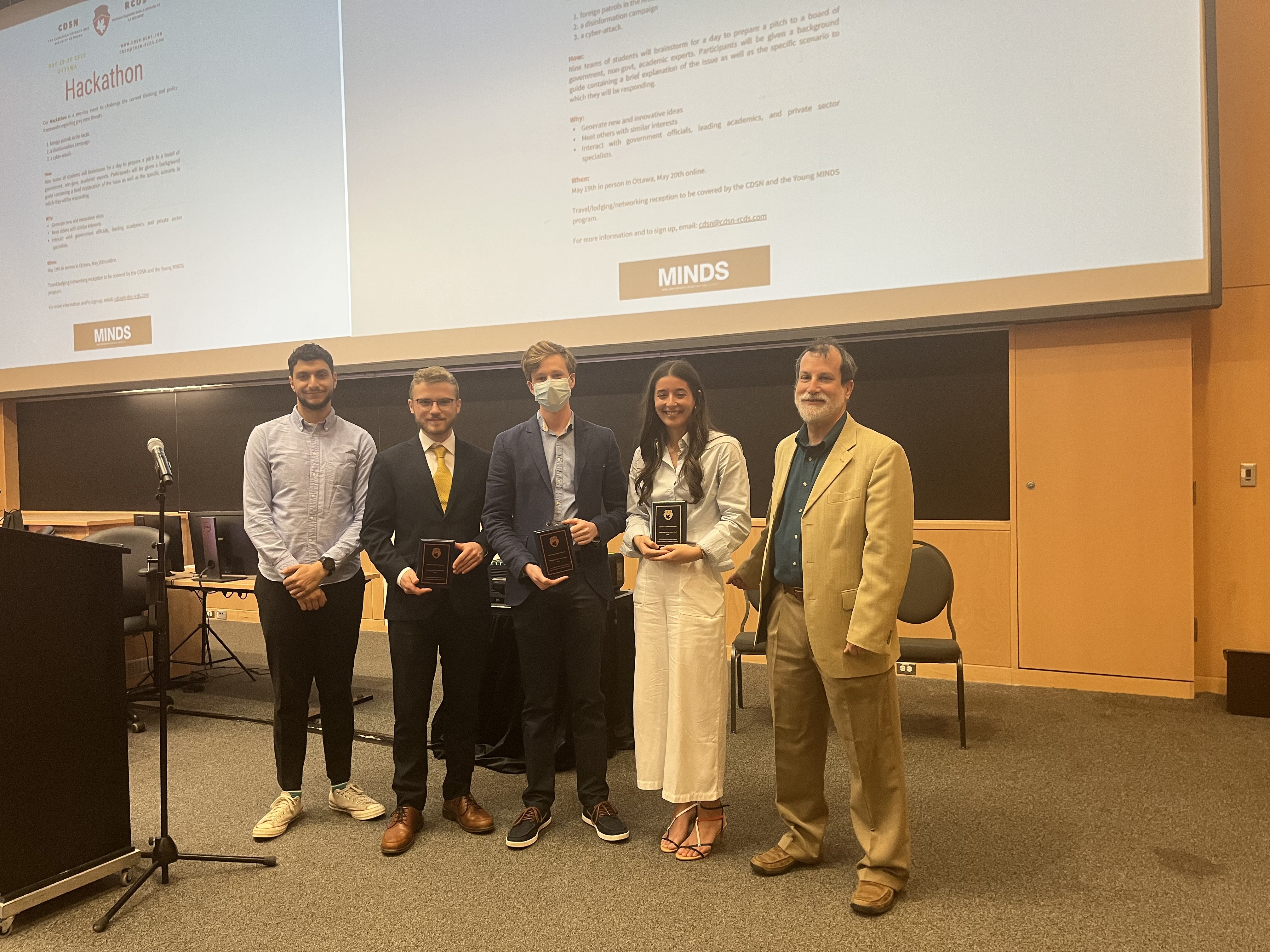
Last week, we had Safia Hafid's New Bipolarity conference.  This week, we helped Alex Rizkallah with his Hackathon.   The idea was to have groups of students brainstorm responses to three potential grey zone attacks--a ship in the Arctic, cyberspace attack, disinformation campaign.  Alex recruited students from Toronto, Montreal, and Ottawa (his budget was finite so we couldn't fly people in), and it was great to meet these folks.  We also recruited military officers, policy officers, and academics to
serve as judges.

The first day, the students were shuttled to DND's Carling Campus, where DND's Public Affairs folks hosted us.  After Alex briefed the entire group, they were sent to breakout rooms where each team of three to four students worked on one of the three scenarios.  The CAF's intelligence command offered a few officers to serve as advisers.  The Arctic person had to drop out, so I got to play that role, which was probably not so fair for these students since my Arctic understanding is meh.  Since the students only competed within each scenario, my lousy advising did not provide a competitive disadvantage. The second scenario focused on a ransomware attack from abroad aimed at a Canadian hospital system.   The third scenario involved a disinformation campaign.

This is the memorial
as it was at Camp Mirage
Our hosts at DND were terrific as we got to see a hunk of the new HQ, they provided us with snacks, and they gave us a tour of the Afghanistan memorial.  During the war, the folks at Camp Mirage (in Dubai) and in Kandahar memorialized those lost in Afghanistan.  Those memorials were moved to NDHQ after much discussion (I would prefer that this was elsewhere so you can only see this stuff if you can get access to NDHQ).  It is always striking to see how young the soldiers and others who lost their lives in war.  Reminds me of a classic MASH episode where the commander said that Rule #1 of war is that young people die, and rule #2 is that doctors can't change rule #1.  The memorial included plaques not just for the soldiers but the civilians (government and otherwise) who died there including Glynn Berry, the first leader of the provincial reconstruction team; Michelle Lang, the one Canadian journalist who was killed in the course of covering the war; a few aid workers; and a social scientist whose name I can't remember or find.  The memorial also includes some Americans. 

The second day, we hosted the students at Carleton, where each team pitched for 15 minutes (or a bit more) their ideas via slide presentations to the audience there and to the judges online.  We had three panels of judges--mostly experts on their respective topics--from DND, the CAF, academia, and other CDSN partners.  The students were given a guideline for how they would be assessed.  After the teams presented, we presented the plaques to the winning teams for each scenario.  We live streamed and posted online the event in English and French.

It was great to meet the eager folks from Toronto, Ottawa, and Montreal.  Many of the Montrealers were from McGill, so I was reminded of how sharp those folks are.  All the students made up a  terrific crew, bonding quickly with their teammates, with much better imaginations about the possible responses, great research skills, and varied perspectives.  

Much thanks to DND's MINDS program for funding Alex's event, to DND's Public Affairs folks for arranging our day at Carling, to the CAF's intel group which provided advisers to our students, to all of these and other folks who helped us find judges.  And thanks to the CDSN HQ crew--Kaha, Melissa, and Racheal--for helping Alex realize his ambitious project.

When we wrote the first big grant for the CDSN, undergrads were largely an afterthought as we focused mostly on graduate students as research assistants and as participants in our events.  This hackathon gave us a chance to include younger folks in defence and security thinking, and we benefited greatly.  We shall see what our next Undergraduate Excellence Scholars seek to do, but we may be borrowing Alex's idea again and again, as this kind of creative thinking exercise was terrific on multiple dimensions.

Wednesday, May 18, 2022

Early Admissions, NATO Edition

 So, I found this after a long day of travel:


Which raises the question of what does the NATO application look like.  In the course of my previous NATO research, I found an application form:

  1. Name of Country
  2. Proximity to the North Atlantic (being adjacent to a sea that neighbors the Atlantic is good enough)
  3. Democracy (note, this only matters when you join)?
  4. How do you feel about acronyms?
  5. Do you use powerpoint or prezi?
  6. Do you have spare Soviet equipment?
  7. What is your favorite caveat?
  8. Who do you want as the next SACEUR?  [Just kidding, the US makes the decision and sometimes pretends to consult with the alliance]
  9. What food will you bring to the force generation conferences?  Each one is a potluck. 
  10. Beer or wine?
  11. Eastern front or Southern front?  [Russia settled that question for now]
  12. If you could have a new Centre of Excellence based in your country, what would it be and why?  
  13. Related to 12, how do you feel about calling CoE's something else? 
  14. Final question: if you could create alternative aspiration to replace the 2% of GDP guideline, what would it be and why?


Friday, May 13, 2022

The New Bipolarity: Where Does Canada Fit Into US-China Rivalry

 Yesterday, one of our two Undergraduate Excellence Scholars, Safia Hafid, led a one-day conference on the changing realities in Asia-Pacific.  She applied for and received a Young MINDS grant which enabled her to bring together seven speakers from a variety of perspectives and backgrounds.  Our CDSN team helped her along the way, but this was her show and she performed wonderfully.  She not only found seven great speakers, but she did a great job of introducing the day, placing the larger question into context, managing the speakers, and moderating the question and answer sessions.  The day flowed smoothly, and I learned a great deal.  I live tweeted the afternoon so you can check out the thread here.  I will summarize some of the major points below (I will post Safia's report once she completes it).  You can watch it in English or French.


Panel 1.
Elizabeth Larus of U of Mary Washington led off by asserting that the US has not declined so much and China has probably peaked.  There was a far amount of consensus on the latter point.  I had heard the "China is going to get old before it gets rich" argument, but hadn't realized how bad their clean water problem is.
Rob Murray of McDonald-Laurier Institute discussed how Canada had spent much effort to develop a somewhat independent path from the US during the Cold War but largely stopped doing so in the US's unipolar moment.  He joined the chorus of folks seeking a strategic foreign policy review... which is not going to happen.
Thomas Christensen of Columbia University argued that the US is still far more powerful than China, but that the key flashpoints are far closer to China, mitigating some American advantages.  With the possibility of a blockade by China's navy and air force, Taiwan has to get what it needs before the fighting starts as resupply is going to be really hard.
In the Q&A, Larus explained why covid is such a threat to Xi: Xi has put much of his rep on zero covid. They vaccinated their young, not their elderly, their shots may not be as good, not as much health infrastructure, so risks of massive waves of deaths if covid breaks out. Christensen had one of the best lines of the day when talking about some far right American voices demanding MOAR: "you can't deter a war by starting one, \"referring to Pompeo's and Bolton's stances who would "love Taiwan to death."

Panel 2.
David Welch of U of Waterloo presented on China's tactics in its various territorial and maritime disputes (NPSIA has a PhD student working on this topic).  One of his most interesting findings is that China seems to be obeying the ruling about South China Seas non-islands.  We just can't say it aloud much.  He reinforced the consensus that Taiwan's term-limited president, Tsai Ing-wen, is handling this all very, very well.
Next was Lynette Ong of U of Toronto.  She argued that Xi Jinping's use of nationalism is now biting him as he is now constrained by ultranationalist forces.  She discussed the pattern of centralization and repression that is going to be challenging to ride.

Panel 3.
Stephanie Carvin, my colleague at NPSIA, discussed the absence of Canada in DC--a short flight but apparently not taken all that often, whereas the Aussies are everywhere.  We need a strategic foreign policy review (yep, she said it, too), more specifics and less vague statements, and a tech policy that is more than Huawei/notHuawei.
Last but not least was journalist Don Newman, who pointed out that the de facto ban on Huawei is less than clear to our allies.  He argued that AUKUS should not be Canada's focus but NORAD modernization. 
For the q&a, I asked whether Canada has ever been a rule maker and not a rule taker.  I was thinking in hard security, but Steph pushed peacekeeping (a long time ago), R2P (um, did that ever lead to anything), and land mine ban (which did).  In response to a question, Don argued that Canadian foreign policy got paralyzed by the two Michaels.  But I wonder if this government would have done anything on foreign policy anyhow--another consensus--this govt does not care about foreign policy.

I learned a lot, and I didn't have to do anything as Safia did all of the heavy lifting with some help from the CDSN staff.  We have another Young MINDS-sponsored event next week, organized by our other 2021-2022 Undergraduate Excellence Scholar--Alexander Rizkallah.  It will be a wildly ambitious hackathon with day one at NDHQ (Carling campus) and day two at Carleton.  

I hope y'all can join us on hackathon pitch day! 


Wednesday, May 11, 2022

Much Ado About ... Something But Not Quite That Much: ABM Edition

Minister of National Defence Anita Anand was asked at the Canadian Global Affairs Institute's annual conference about whether the government would reconsider joining the US's Anti-Ballistic Missile program.  I was at the conference, and I heard her basically say: we are doing a comprehensive defence review and that will be part of it (because comprehensive means all inclusive).

This generated a heap of media coverage including a radio spot for me.  So, let me explain some of the context, why it is fun for the media, why this is mostly a nothingburger, and my prediction on what will happen.

Canada deviated from American preferences in the 2005 as Paul Martin said Canada would not join the American program--this was part of distancing him from a toxic George W. Bush (Canadians were not fans of the Iraq war) and also Canadian support for multilateralism as US ABM efforts trashed an arms control treaty.  Since then, the ABM stuff has been third-rail-ish--that the Liberals don't want to talk about it.  I forget why the Conservatives didn't jump on this when they were in power.  So, this is a bit of a thorn in US-Canadian relations as close cooperation regarding North American airspace is complicated by the fact that the US NORAD folks are double-hatted as NORTHCOM folks who do ABM stuff.  From what I have heard, when there are ABM-related issues at the joint HQ in Colorado, the Americans go into a different room, leaving the Canadians behind.

There is partly, as a result, some Canadian uncertainty about whether the Americans would shoot down missiles aimed at Canada.  An American general said a few years ago that the US was not obligated to do so.  This created a minor storm up here, but it was silly because:

  1. The Americans will shoot down headed our way because they can't be certain a missile aimed at Vancouver is not really aimed at Seattle or a missile heading to Ottawa isn't aimed at Fort Drum.  Indeed, they would be shooting down missiles as early in their arc as possible.
  2. The Americans would shoot down a missile heading towards Vancouver, even if they were certain, because a nuke there would make for a bad day in Seattle.
  3. The Americans can't really shoot down the missiles anyway because the ABM efforts have been expensive but not so effective.
  4. Who is shooting missiles at Canada and not the US anyway?

The media like this story because they love revisiting the past and seeing the Liberals tied up in knots over a policy position that has really been overcome by events.  Bush is gone, the ABM Treaty is dead, so it is actually an easy thing to change, but they may be stuck by intra-Liberal disputes.  

This is all important now not so much because of Russia vs. Ukraine but because the joint effort to protect North America requires substantial reinvestment.  The systems in the north to warn of attacks are obsolete apparently and can't address some of the more modern threats like cruise missiles and hypersonic missiles.  So, Canada is going to invest billions in new technologies, so that they can warn the US and Canada if someone attacks.  But this seems strange if Canada is not joining the effort to try (not succeed, but at least try) to shoot them down. What good is warning if you can't respond?  You get a few more minutes to hug your family?

The obvious answer here is to say: the situation has changed (maybe even blame Putin/Russia) and say that the new investments will be part of a commitment to the defence/defense of North America including ballistic (and other) missile defenses.  But I am guessing that might not happen.  Because intra-Liberal politics can be confusing and strange

So, I would bet on inertia. The review does provide an opportunity to change policy, but the last review did not make any hard decisions.  I expect Anand's review to make some (unlike her predecessor's), but I am not sure she would want to burn intra-party political capital on this.  

That the Canadian media is freaking out slightly over this shows yet again how immature our policy conversations in Canada tend to be.  I was annoyed yesterday at the conference when a former Defence Minister, Peter MacKay said two amazingly dumb thing that he should know better--that we should work on an Asia-Pacific NATO (nope, not happening) and that we should give our tanks to Ukraine (nope, we don't have any that are compatible with those the Ukrainians have, but I am sure that training and maintenance would be easy... not).  Moving beyond ABM politics should be straightforward, but it is not.  The media already smells the blood in the water on this, so I don't expect the Liberals to move on it.  They certainly would not get rewarded domestically for moving on, so why bother?

In other words, oy.


Tuesday, May 3, 2022

Tweet Too Much? Nay

On this occasion of my, yes, 300,000th tweet, I ponder whether I tweet too much.  

Uum, yeah.  How do I know it is too much?  Well, back in the olden days of twitter, I wouldn't add someone to my feed if they tweeted as much as I did, as I tried to read everything that went through my feed.

So, why do I tweet so much?  Part of it is that I respond to folks and engage in conversations.  This can lead to a lot of tweets in a short period of time.  And I like to chat with a lot of people on twitter. 

Part of is that I prefer to retweet rather than like a tweet, as I save my likes for bookmarking tweets.  I also like to amplify emerging scholars, but I am not sure how much that adds to my tweet total.  

I almost certainly tweet less about pop culture stuff than I used to, but my work stuff has been far more relevant these days--the civ-mil crisis in Canada, the end of the allied war in Afghanistan, the failed Russian irredentist campaign--which might be replacing some of my older twitter stuff.

Oh, and twitter has replaced some of my blogging--that I will do a ten tweet thread rather than blog about something. 

Plus, these days, I do a fair amount of tweeting to advertise and amplify the CDSN and the activities/outputs of its partners/members.  

Much of it is that I lack focus, so I engage in conversations and respond to tweets all over the map--not just in my area of expertise but in pretty much anything that catches my eye. There are many squirrels out there.

This kind of covers it:

To celebrate this milestone (or is it a benchmark?), I am bringing back one of my oldest blogging bits: how twitter has surprised, troubled, enchanted, and humbled me.

  • I am surprised where twitter has taken me.  Through this app and network, I have been able to connect with journalists, policy-makers, academics, politicians, and others around the world.  This has facilitated my research as I have found important articles that I would otherwise have missed, it has connected me to people I then interviewed for my projects, it has given me new perspectives so I can see things from beyond my narrow lenses, and, yes, I have been corrected on many occasions when I professed without a good understanding of the facts of the situation.  
  • I am most troubled by how my twitter experience is so different from other people.  I haven't faced anything like the abuse some people get on twitter--that being a white straight guy is just a very different experience.  I stopped being a super twitter-evangelist when I realized that my experience is not so typical, and I started being more conscious about following and retweeting and responding to those who tend to be targeted-- women, the LGBTQ+, religious minorities, and people of color.  I could and should do more, and this milestone will remind me to do so.  
  • I am enchanted by the communities of support that have arisen in this space even though/despite of/in reaction to the stuff I just noted.  For instance, the #civmil community of scholars is a great group on twitter, where folks provide citations, feedback, info, and coordinate for panels/conferences/etc.   I am also enchanted by the interactions I have had on twitter with some of the stars that made an impact on me way back when, whether it is the Fonz, Luke Skywalker, or the muse of NatSecTwitter, Morgan Fairchild.  That Nigella Lawson responds to my tweets about her great recipes is very enchanting indeed.  Twitter may not be a leveler, but it is a connector.
  • I am humbled that people follow me and engage me even though I spew too much on twitter and am all over the place. That I have had more tweets get far more interaction than any one of my publications or even perhaps all of my publications should make me more cautious about what I say.  When people meet me in person and say they follow me on twitter, my first instinct is to blush and apologize for tweeting too much.

This reminds me of a story from my year in the Pentagon (you can hear my students groaning at another reference to that experience) where a colonel complimenting me on speaking up at a small meeting involving our three star boss.  I told him my problem is not the need to speak more but the inability to speak less.  And, yeah, at 300,000 tweets, I really haven't learned to talk less.  Yeah, I have some self-awareness but not a lot of self control.  So, there's that.

Which means I can conclude with only one song: 


Friday, April 22, 2022

Calling For New CDSN Undergrad Excellence Scholars

We launched the Undergraduate Excellence Scholarship two years ago to try to encourage more students from historically excluded communities involved not just in the Canadian Defence and Security Network but in the larger defence and security community.  It is one part of our effort to foster a more diverse, inclusive, and equitable defence and security community.

We are still figuring out how best to involve the students in our efforts.  In year two of this effort, our two scholars, Safia Hafid and Alexander Rizkallah, have

  • applied for and gained Young MINDS Grants from the Department of National Defence;
  • planned and are executing the events that they proposed in their grants--a conference on the changing power dynamics in the Indo-Pacific with a declining US, rising China, and uncertain Canada and a hackathon to generate ideas of how to address unconventional threats;
  • joined us at our Capstone Seminar where they not only asked sharp questions but got to meet and then dined with the Capstone Laureates;
  • used the CDSN to find internships with the Dallaire Centre of Excellence for Peace and Security and Project Ploughshares;
  • participated in some of the CDSN's planning meetings to give us ideas about how we can do more and do better.

We are now seeking our next cohort (is two large enough to call it a cohort?) of Undergraduate Excellence Scholars.  If you qualify (you will be a third or fourth year student next fall at a Canadian university), please apply.  If you aren't, please share news of this opportunity.  

Send applications and questions to info@cdsn-rcds.com


Thursday, April 14, 2022

CDSN Capstone 2022: In Person and Loving It

 Yesterday, we held the third annual CDSN Capstone Seminar.  The idea is to bring together some of the best presentations from last year and from across Canada to one place to give these folks a chance to strut their stuff again, to give our partners a chance for their events to live again, and share with a different audience the insights these sharp folks have developed.  We solicit nominations from CDSN Partners as well as the MINDS Collaborative Networks.  Our first one was at the Canadian Forces College in Toronto just before the pandemic closed things in North America.  Our second one was online.  This time, we did a mix--one presenter was online, our audience was primarily online, but most of the presenters were in person.  

We had two panels.  The first featured Danielle Cherpako discussing the use of sanctions, Zohra Bahrami focusing on what has been doing on in Afghanistan since the collapse last summer, and Devan Prithipaul discussing the discourse of climate change.  


Our second featured Shannon Nash presenting on how terrorism is labeled in Canada mostly in ways that target Muslims and not white supremacists, Johanna Masse talked about gender and women in the ground combat occupations of the CAF, and Caroline Batka discussed how private military contracts do and not integrate with the rest of the defence team.

Widely varying topics but we had some of the presentations speak to each other. We had good Q&A sessions with combinations of those in the audience in person and those online asking the questions.  We had our two Undergraduate Excellence Scholars, Safia Hafid and Alexander Rizkhallah, attend the event so we could finally meet them in person and feed them a nice meal with the Capstone Laureates, and they asked some sharp questions as well.

Speaking of feeding them, it was great to have an in-person event so that we could chat beyond the presentations and have the Laureates get to know each other and our staff.  We didn't build the CDSN so that we could eat well and hangout, but ...

For the video of the event:


Sunday, April 10, 2022

CDSN Book Workshop 2022: Shannon Nash and Agents of Terrorism

 One of the things I have stolen from other organizations is the book workshop.  The idea is to bring together both outside scholars and members of a person's academic community to give feedback, hopefully constructive, to an emerging scholar so that their book can be improved and then published at a good press.  I had been an outsider for a few book workshops along the way, and I also found resources and receptive audiences once or twice along the way (especially at William and Mary for the NATO book thanks to Mike Tierney, who went to grad school with me and my co-author).  

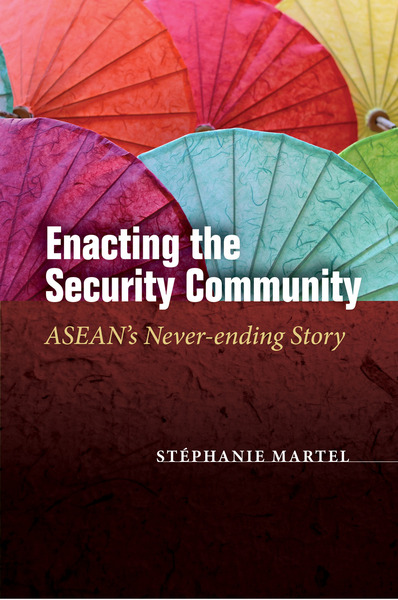
Getting published is not easy.  Turning a usually turgid dissertation into an interesting book that publishers will want is not easy either.  I thought the book workshop would be helpful so I built the book workshop into the CDSN's activities.  Last year, Stephanie Martel was our first CDSN book workshop survivor, and her book is now coming out of Stanford University Press.  Last year, it was entirely online.


This year, we worked to have the workshop be in person, and we almost got there.  Shannon Nash is based in Waterloo as the Director of Operation of one of the MINDS-funded Collaborative Networks: North American and Arctic Defence and Security Network.   Her book is this year's book workshop subject.  We had Tim Naftali and Karen Greenberg as the outside readers, Veronica Kitchen and Lorne Dawson were the "locals."  The former zoomed in, and the latter joined Shannon and myself in a conference room at the Basillie School of International Affairs.  It was great to see the three of them in person.  I didn't have much to say as I am not a terrorism expert, but I did have some suggestions about writing and organization.  Shannon got a lot of very constructive suggestions from the group, and I am sure her book will rock.  

I had not been to Waterloo since an edited volume conference about eight years ago.  I found a place that serves edible cookie dough, so that was an additional highlight of the weekend. 


It was great to see an original CDSN initiative come to fruition for a second time.  We still are looking for applications for the third one, so if you know of a Canadian scholar working on defence or security, broadly defined, let us know!

Oh, and look for Shannon and other sharp folks at the 2022 CDSN Capstone Seminar on Wednesday, April 13th! Tis online and in person!


Thursday, April 7, 2022

Civilian In Control of Military Teaches Civ-Mil Class

 Today was a pretty remarkable moment for me, as I don't think I ever had the subject of my course's content in the classroom.  Minister of National Defence Anita Anand had committed in our podcast interview a few weeks ago to join my Civil-Military Relations class, and today she followed through.  It was arranged at the last minute as her schedule is pretty crazy, what with a war going on and a budget dropping.

Minister Anand started by talking a bit about how she got here--that her academic law prof work on corporate governance caused her to enter the policy space via op-eds and other engagement.  This led to invitations for her to run for office.  She ultimately won a contested nomination and then ran in a not so safe riding, and did not expect to either be in cabinet or that the post she got (Minister of Procurement) would be so central.  But her background in contracting helped out when she was able to get vaccines for Canada quicker than most non-producing countries.*

* I tried to take the best notes I can, but having lawyers as colleagues, I have been informed that they are very precise about their words.  So, I need to be clear that I may not have gotten everything you see below word for word.

After her intro, I asked the first question.  I had noted that the coverage of the budget yesterday had indicated that we would be having a defence review which I had thought was in contradiction to an answer she gave at the CDAI Ottawa Conference on Defence and Security.  Today, she said that she very much favors having regular defence reviews as they serve to form the "backbone of defence policy."  She did note that we need to accept that some decisions must be made given the events of our time before a review will be complete. So, we will have a review, but that will not stop her from making decisions as they arise.  She said it was good to have a good, multiyear plan.

I pointed out that most IR types recommend that defence reviews best take place within a foreign policy review and that, well, we can't really expect a timely foreign policy review.  She indicated that she works closely with the Foreign Minister, but there are plenty of issues, such as procurement decisions that can essentially stand alone. 

Then the students asked questions.  The first was on continental security and NORAD.  She said that the government was already spending some $250 million to do the research to figure out what is needed--sensors, communications.  When pushed on priorities, she said that climate change was a greater concern than Russian encroachment--that is deterred in part by membership in NATO.

The second question was more civ-mil-ish (most questions were not): does one need to be an expert to be a Minister?  She said that her law degree was the key--that she could not function without understanding legislation, policy-making, processes to be accountable and to ensure others are accountable (sounds like an MA in International Affairs or Public Policy would be handy).  She notes that she has plenty of experts giving her advice and so the key is to know her authorities and to make the best rational decisions.  Her job is to "stay engaged with what Canadians need."  She "doesn't need to be an expert in military strategy, but does need to understand the National Defence Act."

A student asked if Canada might serve as a guarantor of any Russia-Ukraine agreement.  She indicated that was more of a Foreign Minister question.  She then noted all that Canada has been doing for Ukraine, including talking twice this week with their Minister of Defence.

The next question focused on China, and Minister Anand indicated she is a supporter of the sail throughs, where our ships go through international waters.  In response to a cyber question, where she noted that the Communications Security Establishment is her area of responsibility, she noted that part of Canada's assistance to Ukraine was helping Ukraine in the realm of cyber surveillance and that continues even as the training mission has been withdrawn.  That bit was the most surprising/newsy thing she said.

I wish I had primed the students to ask more civ-mil questions given the focus of the course and my desire for them to ask questions that I want to ask... but it was a fascinating 30 minutes.  We got a lot in and were most grateful she made time for us on this very busy budget day.

Sunday, April 3, 2022

The All Bad Faith Teams

 At the end of the NBA season, folks start to wonder who will make the first, second, and third All NBA teams.  Things get difficult as each team is supposed to have essentially one center, two forwards, and two guards, and sometimes the league has more terrific guards than forwards.  I raise this as I have been thinking about the All Bad Faith Teams.  That each team would have two Senators, one media person, a member of the House, and then one governor.  This makes it hard since there are so many strong competitors in most categories.

What do I mean by bad faith?  Individuals taking whatever argument they want to try to accumulate power and then hopping on the other side if it becomes more convenient.  The handy example du jour is of Tom Cotton talking about child abuse in the current confirmation hearings after spending much time codding child abusers who happen to be his pals.  The classic case, of course, that puts Mitch McConnell on the first team now and until he retires or dies, is of Mitch flipping on appointing people to the Supreme Court during an election year.  Against it, when a Democratic was doing the nominating, for it when a Republican was.  

So, who are on the 2021-22 All Bad Faith Teams?

1st Team:

Senate:  Mitch McConnell, Ted Cruz.  Neither one of them has met a principle that they would not flip on if it was convenient.  For Mitch, this is as much about past as present performance.  For Cruz, well, his performance in the hearings this week just remind us how skilled he is about being entirely without principle.  

House: Kevin McCarthy.  His turnaround on January 6th makes him an easy decision here.  

Media: Tucker Carlson.  To be fair, he is a fairly consistent white supremacists so he does have principles.  Still, he flips on all kinds of issues as soon as it is convenient.  

2nd Team:

Senate:  Ben Sasse, Susan Collins.  Sure, there are other Senators of bad faith, but these two get this honor for appearing to be moderate while actually betraying whatever commitments they appeared to make and supporting the most awful of stances.  

House:  Jim Jordan Matt Gaetz.  For the House, the 2nd team is reserved for those who engage in crime against the young or facilitate it and then claim that the Dems are the threat to the youth.

Media: Glenn Greenwald

3rd team

Senators: Josh Hawley as illustrated thusly,  Ron Johnson for being the sack of merde that he is.

House: Gosar, Gohmert   (MTGreene does not count--she is just evil, not of bad faith).

Media:  Ben Shapiro

Dishonorable Mentions: Mike Lee, John Kennedy, Marsha Blackburn, Joe Manchin.


I didn't address Governors as that would be too damned depressing, but it would be DeSantis, Abbott, and then Kenney. 


Monday, March 21, 2022

Testifying Before the Defence Committee

 Today, I got to be one of three academics to be part of a panel testifying on threats facing Canada and the military's readiness to address them. 

Here's what I said in my opening statement (and video):

Tuesday, March 15, 2022

The Challenge of Confronting Putin

 After President Zelensky spoke to parliament, we got another wave of people arguing for the No Fly Zone and other more aggressive responses.  I, of course, pushed back since a No Fly Zone = War.  As a reminder, a No Fly Zone would involve killing Russians in and above Ukraine and probably in Belarus and Russia and ... it wouldn't change much.  This is not Syria where barrel bombs and the rest were a huge part of the destruction. This is atrocities by missile and artillery, and a No Fly Zone would not stop either missiles or arty.  

Folks are rightfully frustrated, and so they end up making a bunch of arguments that I have to address.

If we don't do the NFZ, we will watch people be killed in front of us.  
--Yeah, and that is awful, but we have done that before.  Syria, Bosnia, Rwanda, Myanmar, etc.  

If we don't stop Putin now, he will keep attacking, eventually attacking a NATO country directly.
--First, it is not inevitable that he would go beyond Ukraine (more on this below)
--Second, the war in Ukraine demonstrates that the Russian army is not ready for prime time
--Third, the war in Ukraine will simply drain the Russian military so it won't be able to attack again anytime too soon.
--Fourth, thus far, Putin has treated NATO and non-NATO differently, and it is not clear why that would change.

If you let Putin win in Ukraine, you are appeasing aggression, and you can't appease dictators.
--Actually, you can appease dictators, countries do it all the time.  Not everyone is Hitler.  The US made deals with Stalin and Khrushchev, not to mention Gorbachev.  The US made deals with China in the 1970s.  Plenty of dictators don't engage in global conquest efforts.

We have to do something!
--We are doing a lot, far more than we would have expected a month ago.  Very significant sanctions, very energetic/public arms transfers, providing intelligence, giving humanitarian assistance, and more.  We are doing pretty much everything we can short of going to war.

How about a humanitarian corridor?
--Unless Russia agrees, this too involved war.  And I can't help but be reminded of the "safe havens" that the UN negotiated in Bosnia which became killing fields. 

A bigger war is inevitable so let's fight it now rather than later.
--The idea that war is inevitable is the worst self-fulfilling prophecy, making war more likely.  Let's not do that.  Because, you know what, a larger war is not inevitable.

We have been fighting limited wars since Korea where we didn't nuke China or otherwise attack the Chinese mainland (and they didn't attack Japan).  Limited war is actually more of recurrent thing in history than total wars.  Most importantly, Rule #1 of the Cold War and since has been for the US and USSR/Russia not to engage in direct conflict, and it has worked pretty well in terms of avoiding global thermonuclear war even if it mean that we watched oppression, persecution, and mass murder.  What Russia is doing in Ukraine is horrible, but intervening would probably be even more horrible as it presents a real risk of escalation.  It again sucks.  But proponents of intervention, including an NFZ, need better arguments.  Because the ones they have now are not persuasive at all.