There is always much ranting and raving about rankings and relative standings on the Political Science Job Rumors site, and now one thread tries to address the question of prestige directly: what would it cost for one to move to a place with less prestige.
It got me thinking about prestige on a slow Sunday morning. I think I cared much more such things before than now.* Why is that the case? Am I less narcissistic? No, just more aware of my narcissism. I think I care less about prestige now for a couple of reasons (noting that it is easier to care less when one is at a more highly ranked place).
My previous job was at a place that was poorly ranked. Actually, it was accurately ranked given that it could not hold onto good junior faculty. Moreover, I felt that I was outside of the professional networks due to the physical location and prestige of the institution. Now, I am at a school that is highly ranked (one of the top three in Canada and pretty visible in the US) with much better** graduate students and undergrads. I definitely feel better about the place I work, less embarrassed by the name on my badge at conferences.
But does it matter that much to me? I think it matters less because I have been around long enough. What does time do? Well, first, I feel that I have done enough via books, articles, conference presentations, networking, and the like that people know who I am and what I do. My institutional affiliation matters less to me in terms of how I feel others see me. Second, over the course of time, I have met enough folks at places that are not highly prestigious who are quite smart, producing great work, and teaching me a great deal that it is far less about what people's affiliations are than what they do (I am sure Dumbledore would agree). Third, I have seen enough idiosyncrasies in the hiring processes of the places I have worked and not worked to discover that the market does not distribute "talent" (brains, good ideas, training, ambition, whatever else) as efficiently as often averred. Plus some people end up in certain places because of personal issues. Finally, I think that the net makes a difference--that it is much easier to contact and network now than fifteen years ago with blogs, twitter, facebook, and all the rest.***
Together, this means that affiliation and, with it, prestige matter far less than many folks (especially aspiring graduate students) think. The name on one's PhD matters a great deal, especially at first, but the name of the place you work matters less so, especially over time as the individual track record, for good or bad, becomes well developed and well known. ****
* Is there any proof of this? Well, it is public knowledge that I interviewed at a school that was not among the top three in its state a few years ago, and would probably have been as a downward move, prestige-wise.
** That is, in general, they have had significant life experiences, did better in high school/college (better grades and test scores), took feedback more seriously, worked harder, etc.
*** Of course, with posts like these, I may be doing more harm to my prestige.....
**** A question--would it be better to put the footnotes at the bottom or interject in the middle perhaps in italics the way Alan Sepinwall does it?
Sunday, February 20, 2011


Lessons from Bad Repression and New Media
Andrew Exum, during a visit to Egypt, has been reporting back what he has found. He has a great take that finesses the: facebook/twitter ended the regime vs. it was all people power. That is, the social media helped with the networking, but it required real bodies out in the streets to make a difference, not just virtual protesters. In addition, the regime accelerated its demise by shutting down the web, forcing people to go outside to learn stuff, and by shutting down the cell phones, as nothing pisses folks off like lost access to their community.
Striking stuff in a very succinct package. Exum, or Abu Muqawama, his alias on twitter and elsewhere, has been clear, interesting and excellent at providing his own perspective and links to useful sites along the way. Consider this your Sunday morning web-recommendation (perhaps a weekly post, if I can remember every Sunday morning).
Striking stuff in a very succinct package. Exum, or Abu Muqawama, his alias on twitter and elsewhere, has been clear, interesting and excellent at providing his own perspective and links to useful sites along the way. Consider this your Sunday morning web-recommendation (perhaps a weekly post, if I can remember every Sunday morning).
Reviewing the Month in Civ-Mil Relations
David Sanger has an interesting piece addressing the key questions concerning the militaries and the dictators they prop up. As I have been repeating, he starts with the premise that the key is when military has to choose--to shoot at the people or not. The forces of coercion in Bahrain seem to be making a different choice than the Egyptian military. As are Libya's.
The problem for outsiders is that we can guess, expect, hope, predict and so on, but just like war, outcomes are rarely certain. Sanger focuses more on what the prospect of change means for the military. That is important, of course, but I think another key factor is the uncertainty of the situation. Unless a military has a track record of intervening and repressing, it is not clear that the officers at the top have either the resolve or the capability to use force against their people. These officers do not know whether the guys in the square with the guns will actually fire, and so they are going to be wary. To try to shoot and to fail risks their positions and perhaps their lives. They must worry about provoking a civil war, with the military fracturing with some supporting the dissenters and others supporting the government. So, in my non-Middle East expert eyes, it is not so much what change means, but whether the military elites believe that they can be successful in holding back the tide without destroying their institution. Yes, the threat of change matters, but they must consider whether they can stop the future and at what cost.
What this article demonstrates best is that the Obama Administration actually tries to figure stuff out and then reacts, rather than trying to impose their dreams on reality, which is, ironically, what Rumsfeld is trying to do with his new memoir. They have experts on democratic transition on the National Security Council, they ask ahead of events about the possibility of instability and political change in the Mideast, they consider various cases to see if there is a pattern, and they consult experts to assess the situation. Seems basic, but what a breath of fresh air.
Finally, one of the interesting parts of this article is how it so neatly sums up the Saudi perspective:
The problem for outsiders is that we can guess, expect, hope, predict and so on, but just like war, outcomes are rarely certain. Sanger focuses more on what the prospect of change means for the military. That is important, of course, but I think another key factor is the uncertainty of the situation. Unless a military has a track record of intervening and repressing, it is not clear that the officers at the top have either the resolve or the capability to use force against their people. These officers do not know whether the guys in the square with the guns will actually fire, and so they are going to be wary. To try to shoot and to fail risks their positions and perhaps their lives. They must worry about provoking a civil war, with the military fracturing with some supporting the dissenters and others supporting the government. So, in my non-Middle East expert eyes, it is not so much what change means, but whether the military elites believe that they can be successful in holding back the tide without destroying their institution. Yes, the threat of change matters, but they must consider whether they can stop the future and at what cost.
What this article demonstrates best is that the Obama Administration actually tries to figure stuff out and then reacts, rather than trying to impose their dreams on reality, which is, ironically, what Rumsfeld is trying to do with his new memoir. They have experts on democratic transition on the National Security Council, they ask ahead of events about the possibility of instability and political change in the Mideast, they consider various cases to see if there is a pattern, and they consult experts to assess the situation. Seems basic, but what a breath of fresh air.
Sanger finds that in this case the key was the military and its views on Mubarak vs the alternatives:He [Michael McFaul] spent the past few weeks churning out case studies for President Obama and the National Security Council, as it sought lessons about how to influence the confrontations that have engulfed close American allies and bitter adversaries. “There is not one story line or a single model,” said Mr. McFaul, who drew on work he did as a professor at Stanford. “There are many paths to democratic transition, and most of them are messy.”
“You could almost hear them making the calculations in their heads,” said one senior American official who was involved in the delicate negotiations. “Did they want to stick with an aging, sick leader whose likely successor was his own son, who the military didn’t trust? And we just kept repeating the mantra, ‘Don’t break the bond you have with your own people.’ ”Again, they were also calculating not just what happened if they were successful, but whether they would be successful and at what cost. Would repression work, what would it do to the military?
Finally, one of the interesting parts of this article is how it so neatly sums up the Saudi perspective:
they [the Egyptian military] ignored the advice of the Saudis, who, in calls to Washington, said that President Hosni Mubarak should open fire if that’s what it took, and that Americans should just stop talking about “universal rights” and back him.What does this say about the Saudis? That they are scared, that they may understand only too well how fragile the legitimacy of their regime is, that they would prefer others to use force openly and brutally so that they do not have to do so. They would prefer to keep their repression in the form of prevention and not on TV. Apparently, they do not imagine themselves to be the Chinese--to use force decisively and not only get away with it, but get rich as a result.
Saturday, February 19, 2011
Health is Bad
I don't have the patience to discuss at length the new GOP craze--being against health. If Michelle Obama started pushing for literacy a la Laura Bush, I am pretty sure Michelle Bachman would be for banning books. Lil' Steve does a fine job of ranting on this, so go to his blog. All I have to say is this: if they are trying to create splits based on who and who does not breastfeed, the right wing must be running out of issues.
Friday, February 18, 2011
When Plagiarism is Really Bad News
The German Defense Minister, Karl-Theodor zu Guttenberg, is in deep trouble for having plagiarized his dissertation. The funny thing is that his PhD is, well, unnecessary because he previously had the reputation for being one of the more dynamic and charismatic German politicians. Now, his extraneous PhD may bring him down since he cut and pasted his way, apparently. While he has not been perfect, I am sorry to see this happen as he had the guts to be more honest with the German people than any other politician on Afghanistan. That it is not just a crisis scenario but a real war. However, zu G may have blown his honesty resources on the nature of the war in Afghanistan and not have much left over for some incidents that occurred there and elsewhere or on his dissertation. Indeed, the key thing about plagiarism here is that it indicates a character flaw that may have also appeared elsewhere.
We shall see if he lasts through this storm. I doubt it because he had ruffled feathers by being more straightforward on some issues and much less so on others. Accountability is a funky thing--people expect consistency.
We shall see if he lasts through this storm. I doubt it because he had ruffled feathers by being more straightforward on some issues and much less so on others. Accountability is a funky thing--people expect consistency.
Crowdsourcing Human Rights
I have always admired not only the academic work of Christian Davenport (everything I know about repression comes from him and Will Moore), but his data determination. He went to great lengths to determine how Rwanda's genocide played out, at the risk of being called a holocaust denier for simply stating the truth that more Hutus died than Tutsis. He then developed the definitive repression website (a site for researchers of repression, not for repressers to pick up tips): www.staterepression.com (I reviewed that site a while back). Now, he is trying to get folks to report human rights abuses and direct data his way to crowd-source via this site: https://iii.nd.edu/.
People wonder how the internet has changed what social scientists do. Davenport keeps teaching us that we have only scratched the surface. In addition, he demonstrates how important it is to be patient. His Rwanda project took quite some time and resources to generate the findings. This new project, relying on crowdsourcing, is a very much a long-term project as the crowd will take a while to gather. It will take more than just a minor blog like mine to get enough folks to gather virtually and provide the data that Davenport needs to get the crowdsourcing to work. Spread the word.
People wonder how the internet has changed what social scientists do. Davenport keeps teaching us that we have only scratched the surface. In addition, he demonstrates how important it is to be patient. His Rwanda project took quite some time and resources to generate the findings. This new project, relying on crowdsourcing, is a very much a long-term project as the crowd will take a while to gather. It will take more than just a minor blog like mine to get enough folks to gather virtually and provide the data that Davenport needs to get the crowdsourcing to work. Spread the word.
The Downside of the Internet
The internet is so very useful for my research, but, geez, does it serve to distract*:

* Comic is from http://xkcd.com/, HT to Jacob Levy for pointing it out.
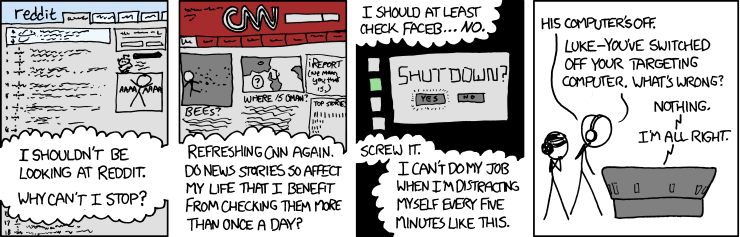
* Comic is from http://xkcd.com/, HT to Jacob Levy for pointing it out.
Thursday, February 17, 2011
Applied Political Science
A friend posted this on my FB page in response to the event: Hug a Political Scientist Day. Given the timing (so close to my anniversary with a wife who puts up with my applying political science concepts to our lives), I thought I would share it here:


Betting on the Golden Boy
I am in the middle of listening to Chad Millman's Behind the Bets podcast. As we are in between the Super Bowl and the college basketball tourneys, Chad decided to talk to a friend who is a self-styled expert on Oscar betting. Yep, there are wagers to be had. Vegas sports books cannot take bets on such things because the Nevada Gaming Commission prohibits bets on events that are judged/voted, which are seen as more subject to manipulation. The casinos can take bets on who might fumble first but not on the Super Bowl MVP. But they do set the odds anyway, and off-shore betting sites (that would be online folks) do take such bets.
This podcast had some fun stuff in it, such as the guy recommending one bet on Toy Story 3 to win best animated movie. The odds are 1/33, which means that you must bet $3300 to win $100. That seems like a stupid bet unless you take seriously the idea that it is really free money: that Toy Story 3 is not likely to win but certain to win. This is the kind of bet the "sharps" take all the time, like betting that the Super Bowl will not go into overtime. The odds are stacked so that you have to bet a lot to win a little (the opposite of a long shot), but the betting pros don't mind betting a lot on a narrow gain if it is a sure thing. And there are more sure things in Oscar betting than on a football field, like Colin Firth winning best actor, against 1/33 odds.
The most amusing but also most wrong part of the podcast: with the two guys agreeing that you have to bet on Best Director and Best Picture because why else watch the entire broadcast? One needs action to do so. Chad went on to say that we don't really care about the outcomes because we do not identify with the producers who get the big bucks out of this. A surprising assertion from a guy who writes about sports--we do not identify with the owners of teams, but we root for particular teams with which we identify.
The reality is that we also identify with movies--that we find some movies to be better than others and we feel bad when others denigrate our favorites. We feel better when our favorites do well. The logic of identification (relying on social identity theory and folks like Donald Horowitz's logic of invidious comparisons) applies to any way we distinguish ourselves into groups and that our self-esteem then hinges on how well our group does and how well those things we identify do. I remember the outrage I felt (and many others did) when Saving Private Ryan lost to Shakespeare in Love (and I liked the latter, but identified more with the former).
Overall, a very interesting podcast, including tips on how to bet on American Idol and how to parlay the obvious winners for the Oscars to bet better odds.
This podcast had some fun stuff in it, such as the guy recommending one bet on Toy Story 3 to win best animated movie. The odds are 1/33, which means that you must bet $3300 to win $100. That seems like a stupid bet unless you take seriously the idea that it is really free money: that Toy Story 3 is not likely to win but certain to win. This is the kind of bet the "sharps" take all the time, like betting that the Super Bowl will not go into overtime. The odds are stacked so that you have to bet a lot to win a little (the opposite of a long shot), but the betting pros don't mind betting a lot on a narrow gain if it is a sure thing. And there are more sure things in Oscar betting than on a football field, like Colin Firth winning best actor, against 1/33 odds.
The most amusing but also most wrong part of the podcast: with the two guys agreeing that you have to bet on Best Director and Best Picture because why else watch the entire broadcast? One needs action to do so. Chad went on to say that we don't really care about the outcomes because we do not identify with the producers who get the big bucks out of this. A surprising assertion from a guy who writes about sports--we do not identify with the owners of teams, but we root for particular teams with which we identify.
The reality is that we also identify with movies--that we find some movies to be better than others and we feel bad when others denigrate our favorites. We feel better when our favorites do well. The logic of identification (relying on social identity theory and folks like Donald Horowitz's logic of invidious comparisons) applies to any way we distinguish ourselves into groups and that our self-esteem then hinges on how well our group does and how well those things we identify do. I remember the outrage I felt (and many others did) when Saving Private Ryan lost to Shakespeare in Love (and I liked the latter, but identified more with the former).
Overall, a very interesting podcast, including tips on how to bet on American Idol and how to parlay the obvious winners for the Oscars to bet better odds.
Fun with Maps!
Sociological Images posted a few maps about the consumption of alcohol. As a student of international relations and a johnny-come-lately to beer-swilling, I thought these were interesting:

Not too many surprises here: countries with high percentages of Muslims drink less and Russians drink far more. Apparently, the reputation of Aussies to be hard-drinkers is well-deserved. That most of Europe fits into the highest categories might be a bit of a surprise. One might think it is all that wine, but not entirely so, as the next map suggestions:

Again, no surprise that it is beer for North American and Australia and spirits (Vodka) for Russia. Not sure what is other, which seems to be only widely drunk in Africa. Not surprising that Italy and France stand out as wine-drinking countries, but Spain as a beer country? This map does suggest that beer is popular in more countries (woohoo!), although with India and China in the spirits category, that is enough to make spirits #1 in total consumption (my guess).....
Any other thoughts on the distribution of boozing?

Not too many surprises here: countries with high percentages of Muslims drink less and Russians drink far more. Apparently, the reputation of Aussies to be hard-drinkers is well-deserved. That most of Europe fits into the highest categories might be a bit of a surprise. One might think it is all that wine, but not entirely so, as the next map suggestions:

Again, no surprise that it is beer for North American and Australia and spirits (Vodka) for Russia. Not sure what is other, which seems to be only widely drunk in Africa. Not surprising that Italy and France stand out as wine-drinking countries, but Spain as a beer country? This map does suggest that beer is popular in more countries (woohoo!), although with India and China in the spirits category, that is enough to make spirits #1 in total consumption (my guess).....
Any other thoughts on the distribution of boozing?
Wednesday, February 16, 2011
Betting on the Mideast
A famous bookie has set the odds on the next domino to fall in the Mideast: Yemen.* He set the odds at 15/8. But I have a quibble: what does it mean to fall when the government is already pretty close to a failed state? Jordan is next at 9/4 and then Algeria at 7/2. Bahrain is at 8/1 with Saudi Arabia and Syria set at 20/1. Interesting that Iran, Libya and Sudan are in between. I have repeatedly stated that I am not a Mideast expert, so I am not sure where I would put my money. I guess I would put it one Sudan or Libya since the odds are pretty good. Actually, if I could, I would bet that no other dominoes in the Mideast fall before the end of 2012. While there is increased protest elsewhere, the protestors are not the only ones learning. Iran is going to repress its opposition pretty successfully. I would say the same for the Saudis and the Syrians.
The bigger problem from a betting perspective is what counts as a revolution? We don't even know if either Egypt or Tunisia have experienced a real revolution. Thus far, they could easily be seen as coups. Not until we see elections and new governments arise with people who do not wear uniforms can we start to think about calling these changes revolutions. If the bets are on changes in dictators only, then we may have to re-think. Sudan would start to look as a good bet, given how hard this year is going to be.
Where would you put your money?
HT to Ora Szekely for pointing me to this article.
The bigger problem from a betting perspective is what counts as a revolution? We don't even know if either Egypt or Tunisia have experienced a real revolution. Thus far, they could easily be seen as coups. Not until we see elections and new governments arise with people who do not wear uniforms can we start to think about calling these changes revolutions. If the bets are on changes in dictators only, then we may have to re-think. Sudan would start to look as a good bet, given how hard this year is going to be.
Where would you put your money?
HT to Ora Szekely for pointing me to this article.
If You Build It, They Will?
Stunning pictures of Chinese cities with no people. Apparently massive investments have not lured people to these new developments. How can a country with over a billion people have cities that are largely uninhabited? China may be booming, but I would not be so confident in its ability to sustain either its political or economic strategies.
Lying Liars Mea Culpa
I hadn't realized that the phrase Lying Liars and the Lies They Tell was actually implanted in my brain by Al Franken's book: "Lies and the Lying Liars Who Tell Them." I did read the book when it came out, so I did see that phrase before. I didn't mean to plagiarize Franken. My apologies to Senator Al.
Tuesday, February 15, 2011
More on the Lying Liars and the Lies They Tell
Just wanted to highlight a piece written by folks who worked under Rumsfeld. They use a document that Rumsfeld posted on the web to show that Rumsfeld's memoir must just be the most outrageous bit of fiction, just second to the weapons of mass destruction intel.
Why do such dramatic failures as Rummy, Cheney, and Rice get so much attention? Why am I giving them even more?
Why do such dramatic failures as Rummy, Cheney, and Rice get so much attention? Why am I giving them even more?
Veteran Engagement
Tom Ricks has a brief summary of a longer post about how to talk to veterans. This has been a theme in Ricks's blog for a while--that people suck at talking to vets who have come back from Iraq and Afghanistan. That yellow ribbons and un-thinking workship may not be what they need.
The short list, plagiarized from Ricks' summary:
1. Do: Ask About Our Buddies
2. Do: Listen
3. Do: Try To Learn Something
4. Do: Have an Open Mind
5. Don't: Talk Politics
6. Don't: Be Cavalier with Questions. (Especially that old favorite about how many people you killed.)
7. Don't: Assume Everyone Is Crippled With PTSD
8. Do: Something
I have not had much experience except interviewing current officers about larger political issues (oops), as that is my job and my current focus. But this advice seems sharp and useful.
The short list, plagiarized from Ricks' summary:
1. Do: Ask About Our Buddies
2. Do: Listen
3. Do: Try To Learn Something
4. Do: Have an Open Mind
5. Don't: Talk Politics
6. Don't: Be Cavalier with Questions. (Especially that old favorite about how many people you killed.)
7. Don't: Assume Everyone Is Crippled With PTSD
8. Do: Something
I have not had much experience except interviewing current officers about larger political issues (oops), as that is my job and my current focus. But this advice seems sharp and useful.
A Failure in Leadership
It is a sad truth that rape is doing to happen in the military, just as it happens in society. But a few key differences stand out:
- in civilian life, you have more ability to one's tormentor.
- in civilian life, one's bosses have less power over you.
- in civilian life, your life does not depend so much on the people around you, above you and below you.
Political Science Cards and Fantasy Rules continued
I should lose a few points for posting something quickly, but I was both enthused and sleepy last night. So here are some modifications to both the player card and the fantasy rules.
What would I add to the card?
Lifetime Citations would seem to be an obvious stat, akin to Runs in baseball, if the goal is to get stuff out there. This would be the old school stat to go along with the more sabermetric-y H-index. One could also have Cites per year or Cites per Paper.
Total Number of Co-Authors or CA: I think I might be a league leader.
I would replace Home Runs with Major University Press Books or MUPB's.
Students Placed at Tenure Track Slots: SPATTS
Average Media Apperances: Number of appearances on radio, tv and newspapers per year, averaged over five years. Mine is going to spiral downwards now that the Canadians will be largely out of harm's way in Afghanistan.
Involuntary Major Service Obligations, such as chair, associate dean, director of graduate studies, etc: IMSO.
Any other suggestions?
Revised/Added Rotisserie/Fantasy Political Science Rules
These supplement/revise the classic rules.
Publishing (most of the original rules are still quite good)
+5 points if an article or book will be published two years after it has been accepted for publication.
+2 points for having an article you have revised and resubmitted getting another R&R at the same journal
+1 pity point for getting an article rejected after going through the R&R process twice
-10 if an article is destined for a journal that stops publishing for a year (the World Politics rule)
I would change the secondary category of AJPS, JoP, WPQ (what is now PRQ), and SSQ to drop SSQ but add the top journals in every subfield (IO, ISQ, WP, CP, CPS, Political Theory)
Conference Participation additions:
-1 if the paper was presented elsewhere
-3 if someone walks out in a huff during the middle of your presentation
+5 if someone ask a question so absurd that it leaves you flummoxed, like blaming the xenophobia of 1990s Europe on the Ancient Egyptians (yes, it happened to Bill Ayres and myself)
-1 if you give the paper to the discussant within 24 hours of the conference
-10 if you actually expect the discussant to read your paper while at the conference
The networking division of the rules are a bit obsolete as there is no paper room or papers to buy any more, so some changes are in order:
-5 The conference is held in your town
-1 Spend more time in the book room than in panels
+1 Flirt with book rep. Tripled if book rep flirts back. Multiplied by negative two if the player is married
+.5 For each doodad/swag one picks up in the book room (the Steve Greene rule).
+1 Each time someone looking for you assumes that you are at the conference hotel's bar
+3 Each time they are right
+3 Each time splitting the bill costs you at least 1.5 times what you would have paid on your own at a restaurant during a conference
-5 Each time splitting the bill saves you money
+20 For each meal where the participants all worked together previously but no longer at that old school (the ex-TTU faculty club rule)
+35 For bringing chocolate chip cookies for roommate to share (the Bill Ayres's wife rocks rule).
+10 Hosting the annual poker game
+20 Generously funding the winnings of the other poker players (the drunk BV rule)
-50 Bring to the poker game a new, disruptive player (the dead to me BV rule)
-3 Using one's relatively large annual salary to bully junior professors and grad students at the poker game (the Pat James rule)
Media Section
+1 for each radio appearance
+2 for each TV appearance
+5 for each appearance lasting more than 5 minutes
+1 for each op-ed piece published in a regional newspaper
+5 for each op-ed piece published in the New York Times or Wall Street Journal
-5 for each op-ed published in the Washington Post.
+50 points for each appearance on The Daily Show or Colbert Report
-1000 for any friendly appearance on a Fox ranting show (O'Reilly, Beck)
+ 1000 for an unfriendly reference on a Fox ranting show--the Frances Fox Piven rule
New Media
+5 for first blog.
-2 points for each additional blog (The Wayne Norman Rule)
-2 points for a blog that is updated less than monthly
-3 points for an unfocused blog that combines political science with commentary about pop culture, sports, whatever (The Spew Rules)
-5 points if you spend more time on a silly blog post than the academic goal of the day (like revising a chapter)
+1 for having a twitter account
+1 for tweeting at least once a day
+1 for every 25 followers
-25 if one has more robo-followers linked to illicit sites than normal followers
+3 points if someone with more than 1k followers either retweets or responds to your tweet
+1 for having a facebook account
-1 for each current undergrad that is a FB friend (the Creepy Rule)
+1 for each "like" of a snarky comment you posted on someone's page (the Saideman really is a narcissist rule)
+10 for posting as oneself on the Political Science Job Rumor's site--the Mike Munger Rule.
-3 for each anonymous post on PSJR if one has already posted as oneself
Suggestions?
Political Science Player Cards:
What would I add to the card?
Lifetime Citations would seem to be an obvious stat, akin to Runs in baseball, if the goal is to get stuff out there. This would be the old school stat to go along with the more sabermetric-y H-index. One could also have Cites per year or Cites per Paper.
Total Number of Co-Authors or CA: I think I might be a league leader.
I would replace Home Runs with Major University Press Books or MUPB's.
Students Placed at Tenure Track Slots: SPATTS
Average Media Apperances: Number of appearances on radio, tv and newspapers per year, averaged over five years. Mine is going to spiral downwards now that the Canadians will be largely out of harm's way in Afghanistan.
Involuntary Major Service Obligations, such as chair, associate dean, director of graduate studies, etc: IMSO.
Any other suggestions?
Revised/Added Rotisserie/Fantasy Political Science Rules
These supplement/revise the classic rules.
Publishing (most of the original rules are still quite good)
+5 points if an article or book will be published two years after it has been accepted for publication.
+2 points for having an article you have revised and resubmitted getting another R&R at the same journal
+1 pity point for getting an article rejected after going through the R&R process twice
-10 if an article is destined for a journal that stops publishing for a year (the World Politics rule)
I would change the secondary category of AJPS, JoP, WPQ (what is now PRQ), and SSQ to drop SSQ but add the top journals in every subfield (IO, ISQ, WP, CP, CPS, Political Theory)
Conference Participation additions:
-1 if the paper was presented elsewhere
-3 if someone walks out in a huff during the middle of your presentation
+5 if someone ask a question so absurd that it leaves you flummoxed, like blaming the xenophobia of 1990s Europe on the Ancient Egyptians (yes, it happened to Bill Ayres and myself)
-1 if you give the paper to the discussant within 24 hours of the conference
-10 if you actually expect the discussant to read your paper while at the conference
The networking division of the rules are a bit obsolete as there is no paper room or papers to buy any more, so some changes are in order:
-5 The conference is held in your town
-1 Spend more time in the book room than in panels
+1 Flirt with book rep. Tripled if book rep flirts back. Multiplied by negative two if the player is married
+.5 For each doodad/swag one picks up in the book room (the Steve Greene rule).
+1 Each time someone looking for you assumes that you are at the conference hotel's bar
+3 Each time they are right
+3 Each time splitting the bill costs you at least 1.5 times what you would have paid on your own at a restaurant during a conference
-5 Each time splitting the bill saves you money
+20 For each meal where the participants all worked together previously but no longer at that old school (the ex-TTU faculty club rule)
+35 For bringing chocolate chip cookies for roommate to share (the Bill Ayres's wife rocks rule).
+10 Hosting the annual poker game
+20 Generously funding the winnings of the other poker players (the drunk BV rule)
-50 Bring to the poker game a new, disruptive player (the dead to me BV rule)
-3 Using one's relatively large annual salary to bully junior professors and grad students at the poker game (the Pat James rule)
Media Section
+1 for each radio appearance
+2 for each TV appearance
+5 for each appearance lasting more than 5 minutes
+1 for each op-ed piece published in a regional newspaper
+5 for each op-ed piece published in the New York Times or Wall Street Journal
-5 for each op-ed published in the Washington Post.
+50 points for each appearance on The Daily Show or Colbert Report
-1000 for any friendly appearance on a Fox ranting show (O'Reilly, Beck)
+ 1000 for an unfriendly reference on a Fox ranting show--the Frances Fox Piven rule
New Media
+5 for first blog.
-2 points for each additional blog (The Wayne Norman Rule)
-2 points for a blog that is updated less than monthly
-3 points for an unfocused blog that combines political science with commentary about pop culture, sports, whatever (The Spew Rules)
-5 points if you spend more time on a silly blog post than the academic goal of the day (like revising a chapter)
+1 for having a twitter account
+1 for tweeting at least once a day
+1 for every 25 followers
-25 if one has more robo-followers linked to illicit sites than normal followers
+3 points if someone with more than 1k followers either retweets or responds to your tweet
+1 for having a facebook account
-1 for each current undergrad that is a FB friend (the Creepy Rule)
+1 for each "like" of a snarky comment you posted on someone's page (the Saideman really is a narcissist rule)
+10 for posting as oneself on the Political Science Job Rumor's site--the Mike Munger Rule.
-3 for each anonymous post on PSJR if one has already posted as oneself
Suggestions?
Monday, February 14, 2011
Political Science Player Cards and Fantasy Rules
Just one glance at the political science job rumors website is enough to demonstrate that we have heavily invested our egos in this business. It is not just aspiring grad students facing a difficult job market.* All of the ranting and raving about rankings of programs and which programs should be trashed next are in large party about self-esteem and egos. Donald Horowitz's application of social psychology--the logic of invidious comparisons--applies to more than just ethnic conflict. So, when I see something like this:

I cannot help but think about what my stats are and how my card would look. Of course, some of this would not apply or would have to be significantly revised, such as nature, science and National Geographic. For the time being, I am not going to fill in my own card, as it would take too long. I do know that I would have zero stolen post-docs and no career awards thus far. On the other hand, my winning percentage for grad students would be very good--I have only lost one potential PhD student because he needed to get more high tech training than we could provide. And my placement record for my PhD students thus far is quite good.
In an age of improved sports statistics thanks to the sabermetricians and their equivalents, we could consider new and different statistics, either in addition to or in lieu of the ones on the card. H-Index is a fancier way to measure citations (check out the software publish or perish). A baseball card for profs might include both, just as the new ones include not just batting average but OPS (combination of on base % and slugging %). I would add number of co-authors (mine would be sixteen if one includes papers that have been presented but not published). Datasets created? Job offers? Course evaluation average? Reviews for journals/presses/grant agencies? What stats would you recommend for a prof's card?
A different way to measure an athlete is not their card but their value to a fantasy team. A couple of political scientists were way ahead of the curve by making up the rules for rotisserie political science. The rules are very focused on Americanists, given the points given for particular journals. Notice no discounting for co-authoring. My favorite rule is the Kathy Kemp Rule: 65 points if you send a paper a birthday card for being under review for a year. I have only had that happen once (the paper was rejected eventually, but two subsequent pieces have been published at that journal). My favorite category is attendance--points for attending panels other than one's own. I used to get heaps of points here, but a precipitous decline as of late. I do like the loss of points for saying something serious at a conference business meeting. Minus 17 points for being named Dean! I am thinking of a new category--number of people who mistakenly think I have reviewed and rejected several of their articles. Right now, I am at 2 for that category--that I know of.
* Of course, that one phrase scares me just a bit. One of the explanations for why so many terrorists from the Middle East are engineers--frustrated career ambitions. The good news is that poli sci students would probably make lousy terrorists--they would find the lit reviews really hard to complete before moving on to the violence phase.

I cannot help but think about what my stats are and how my card would look. Of course, some of this would not apply or would have to be significantly revised, such as nature, science and National Geographic. For the time being, I am not going to fill in my own card, as it would take too long. I do know that I would have zero stolen post-docs and no career awards thus far. On the other hand, my winning percentage for grad students would be very good--I have only lost one potential PhD student because he needed to get more high tech training than we could provide. And my placement record for my PhD students thus far is quite good.
In an age of improved sports statistics thanks to the sabermetricians and their equivalents, we could consider new and different statistics, either in addition to or in lieu of the ones on the card. H-Index is a fancier way to measure citations (check out the software publish or perish). A baseball card for profs might include both, just as the new ones include not just batting average but OPS (combination of on base % and slugging %). I would add number of co-authors (mine would be sixteen if one includes papers that have been presented but not published). Datasets created? Job offers? Course evaluation average? Reviews for journals/presses/grant agencies? What stats would you recommend for a prof's card?
A different way to measure an athlete is not their card but their value to a fantasy team. A couple of political scientists were way ahead of the curve by making up the rules for rotisserie political science. The rules are very focused on Americanists, given the points given for particular journals. Notice no discounting for co-authoring. My favorite rule is the Kathy Kemp Rule: 65 points if you send a paper a birthday card for being under review for a year. I have only had that happen once (the paper was rejected eventually, but two subsequent pieces have been published at that journal). My favorite category is attendance--points for attending panels other than one's own. I used to get heaps of points here, but a precipitous decline as of late. I do like the loss of points for saying something serious at a conference business meeting. Minus 17 points for being named Dean! I am thinking of a new category--number of people who mistakenly think I have reviewed and rejected several of their articles. Right now, I am at 2 for that category--that I know of.
* Of course, that one phrase scares me just a bit. One of the explanations for why so many terrorists from the Middle East are engineers--frustrated career ambitions. The good news is that poli sci students would probably make lousy terrorists--they would find the lit reviews really hard to complete before moving on to the violence phase.
The Revolution of Writing About TV
I didn't know that there was a revolution in TV writing. I do know that I have started to follow two TV critics, Alan Sepinwall and Tim Goodman, over the past year--reading their blogs, listening to their podcasts, and following their tweets. Indeed, having my letters read by Tim and his gang in his podcast provided a thrill or two over the summer. And now, thanks to Slate, I have learned that Sepinwall was the pathbreaker in this business of TV re-caps. I don't always agree with Alan and Tim, but often do. I have been catching up on The Wire and have used Sepinwall's old re-caps to help gain perspective on a pretty complicated show. I miss stuff, and they help me see the connections. Plus their podcasts (Alan's is with Dan Feinberg, also of hitfix.com) are usually pretty amusing as well. Indeed, Tim's, which has been on hiatus while he transitions from his old newspaper gig to the Hollywood Reporter, often had very little TV content unless one counts bad imitations of live and dead TV folks.
I know that there are others who do this re-capping stuff, but if I followed more of them, I would have less time for television, and that would be so wrong. I have long been a TV addict, and I am glad that I have not just company, but excellent, often snarky company.
I know that there are others who do this re-capping stuff, but if I followed more of them, I would have less time for television, and that would be so wrong. I have long been a TV addict, and I am glad that I have not just company, but excellent, often snarky company.
The Pentagon Musical [NSFW]
New song with some slides. Brutally amusing.
To be clear, I enjoyed my time in the Pentagon, but did notice how the military guys looked at their time there as a prison sentence. Not your average military base with long commutes, long chains of command to micro-edit your work, few windows, and little career credit for good work.
This does bring me back as the banner on the slide at the 2.25 mark was one we used all the time--the purple part, not the angry officer. The slides that look like motivational posters gone awry were rife during my year in the Pentagon, as folks sent around or printed the occasional humorous power point slide.
And, yes, I did start losing my hair (and gained a bit of weight) during that year.
To be clear, I enjoyed my time in the Pentagon, but did notice how the military guys looked at their time there as a prison sentence. Not your average military base with long commutes, long chains of command to micro-edit your work, few windows, and little career credit for good work.
This does bring me back as the banner on the slide at the 2.25 mark was one we used all the time--the purple part, not the angry officer. The slides that look like motivational posters gone awry were rife during my year in the Pentagon, as folks sent around or printed the occasional humorous power point slide.
And, yes, I did start losing my hair (and gained a bit of weight) during that year.
Sunday, February 13, 2011
Democracy as Foreign Policy Priority
Lots of credit-taking for Egypt in the US, as democracy promotion seems to have become all the rage. The Bush folks are taking credit, saying that Iraq set the stage. Um, just like an arsonist might take credit for new development after he burned down a city block, I guess.
Seriously, the idea that the Bush administration was promoting democracy is pretty fantastic. As in fantasy. After all, the initial plan (if you want to call what they were thinking a "plan") was to put Chalabi in place in Iraq. How democratic was that? The resort to quick elections after state-breaking (not just here but in Bosnia and other places as well) was motivated more by the desire to get out than to build representative political systems.
So when I read Peter Baker's post-mortem on the change in Egypt, I find it really strange that anyone would consider Democracy Promotion to be a Bush thing or that the Democrats under Clinton and Obama not be Democracy promoters.
The big difference between the Bush-style and the Clinton/Obama style is that the former requires invasion and poor planning, whereas the latter involves diplomacy, public and private pressure, and some patience. Did knocking off Hussein cause the Egyptian "revolution"? Did Bush's agenda? While outside forces matter far less than inside forces, it might have been the Obama speech in .... Cairo that made some dent.
Again, lots of competition to take credit for this stuff, where the credit belongs almost entirely to the protesters that risked their lives and to the military folks for not shooting. The post-Mubarak navel-gazing is inevitable, but we don't have to buy what some folks are selling. The Bush Administration had no credibility thanks to the lack of WMD in Iraq, with even Rumsfeld's latest efforts to sell that war failing miserably.
What this crisis clearly demonstrated is that foreign policy is chock full of tradeoffs, and we cannot focus on a single priority or agenda. They have to be balanced, with serious thought about the second and third order effects. If there is anything that the Bush administration failed to do, it was thinking beyond simplest outcome. Obama and his folks clearly demonstrated that one can be decisive while taking into account the complexities.
Anybody looking back at the Bush Administration can only get sick from the lost opportunities, incredibly short-sighted decisions, the refusal to see tradeoffs, and the keen ability alienate pretty much the entire world except for Tony Blair.
Seriously, the idea that the Bush administration was promoting democracy is pretty fantastic. As in fantasy. After all, the initial plan (if you want to call what they were thinking a "plan") was to put Chalabi in place in Iraq. How democratic was that? The resort to quick elections after state-breaking (not just here but in Bosnia and other places as well) was motivated more by the desire to get out than to build representative political systems.
So when I read Peter Baker's post-mortem on the change in Egypt, I find it really strange that anyone would consider Democracy Promotion to be a Bush thing or that the Democrats under Clinton and Obama not be Democracy promoters.
President Bush, after all, made “ending tyranny in our world” the centerpiece of his second inaugural address, and, although he pursued it selectively, he considers it one of his signature legacies. The very notion of democracy promotion became so associated with him, and with the war in Iraq, that Democrats believed that it was now discredited. Never mind that Republican and Democratic presidents, from Woodrow Wilson to Ronald Reagan, had championed liberty overseas; by the time Mr. Bush left office it had become a polarizing concept.Um, the Peter Baker I knew in college only OD'ed on classic coca-cola so I am not sure how much he really believes what he is writing here. I am pretty sure that the only folks who think that Democracy Promotionwas a Bush thing reside within the Beltway. Academics and their fellow travelers were thinking about democracy for quite some time, including the whole Democracy and War debate of the 1990s.
The big difference between the Bush-style and the Clinton/Obama style is that the former requires invasion and poor planning, whereas the latter involves diplomacy, public and private pressure, and some patience. Did knocking off Hussein cause the Egyptian "revolution"? Did Bush's agenda? While outside forces matter far less than inside forces, it might have been the Obama speech in .... Cairo that made some dent.
Again, lots of competition to take credit for this stuff, where the credit belongs almost entirely to the protesters that risked their lives and to the military folks for not shooting. The post-Mubarak navel-gazing is inevitable, but we don't have to buy what some folks are selling. The Bush Administration had no credibility thanks to the lack of WMD in Iraq, with even Rumsfeld's latest efforts to sell that war failing miserably.
What this crisis clearly demonstrated is that foreign policy is chock full of tradeoffs, and we cannot focus on a single priority or agenda. They have to be balanced, with serious thought about the second and third order effects. If there is anything that the Bush administration failed to do, it was thinking beyond simplest outcome. Obama and his folks clearly demonstrated that one can be decisive while taking into account the complexities.
Anybody looking back at the Bush Administration can only get sick from the lost opportunities, incredibly short-sighted decisions, the refusal to see tradeoffs, and the keen ability alienate pretty much the entire world except for Tony Blair.
Saturday, February 12, 2011
Lying Liars and the Lies They Tell
There have been heaps of stories about Rumsfeld's book, including Fred Kaplan's excellent review. This lunch with Rummy drives me a bit crazy since it once again demonstrates that Rummy is a lying sack of poor policy (or poop, for short). Just the claim that he did not create a climate of fear in the Office of the Secretary of Defense is enough to drive me bonkers. I saw it, I felt it, I heard on a daily basis during my year in the Pentagon. It was more than palpable. I worked with folks in OSD almost every day, and I was regularly being thankful that I had tenure, as these guys just were paralyzed with fear of their boss. In a crisis, they were wary of bothering him after 7pm, delaying a decision and allowing it nearly fester into an anti-US riot.
And yet, I have to read this book for my research. Ug. It was bad enough reading Bremer's, and now I have to read 800 pages of Rummy lying about everything. He clearly was the worst SecDef in US history (but that only goes back to the late 1940's). I don't know US history well enough to figure out whether he was worse than all of the Secretaries of War as well. I will get it from a library as I don't want a single dollar from me to go to him, even if he gives some of the profits to charity.
What a great administration! The worst SecDef and probably the worst National Security Adviser. Plus a VP who shoots his friends in the face. Glad to be only looking at these folks in the rearview mirror.
And yet, I have to read this book for my research. Ug. It was bad enough reading Bremer's, and now I have to read 800 pages of Rummy lying about everything. He clearly was the worst SecDef in US history (but that only goes back to the late 1940's). I don't know US history well enough to figure out whether he was worse than all of the Secretaries of War as well. I will get it from a library as I don't want a single dollar from me to go to him, even if he gives some of the profits to charity.
What a great administration! The worst SecDef and probably the worst National Security Adviser. Plus a VP who shoots his friends in the face. Glad to be only looking at these folks in the rearview mirror.
Trends in Aspirational Cheating
Check out this graph, from a Business Week piece about Ashley Madison, the dating site for cheating married people.* Make of it what you will.

So, people register more after Mother's Day than any other day. And mostly women, with the parallel for men and Father's Day. Valentine's Day is an equal opportunity holiday, with a pretty even split of new registrants. I would be curious about the patterns before holidays.
The key appears to be that married folks become much more interested in cheating after a day that is supposed to recognize their relationship and their role. I guess lots of people are bungling the celebration of their spouses' contribution, leading to the celebrated spouse looking around. Of course, as the title to my post focuses on the fantasy of all of this--just joining a dating website for cheaters does not mean that people are then cheating (unless one has a pretty strict definition of cheating). I am sure there are no good stats on the percentage of people who join such a dating website who actually consummate.
On the other hand, it may not be that people are celebrating these holidays poorly, but rather the mere fact of a day recognizing one's status (as lover in the case of V Day, as Mother or as Father) is enough to get folks to look at escape hatches or diversions. "My identity sucks! I need to find someone else" syndrome?
I have no clue what this graph really means, but I do think the results are very funky. Almost deserving of Steve Greene's chart of the day.
* HT to Wayne Norman and his post.

So, people register more after Mother's Day than any other day. And mostly women, with the parallel for men and Father's Day. Valentine's Day is an equal opportunity holiday, with a pretty even split of new registrants. I would be curious about the patterns before holidays.
The key appears to be that married folks become much more interested in cheating after a day that is supposed to recognize their relationship and their role. I guess lots of people are bungling the celebration of their spouses' contribution, leading to the celebrated spouse looking around. Of course, as the title to my post focuses on the fantasy of all of this--just joining a dating website for cheaters does not mean that people are then cheating (unless one has a pretty strict definition of cheating). I am sure there are no good stats on the percentage of people who join such a dating website who actually consummate.
On the other hand, it may not be that people are celebrating these holidays poorly, but rather the mere fact of a day recognizing one's status (as lover in the case of V Day, as Mother or as Father) is enough to get folks to look at escape hatches or diversions. "My identity sucks! I need to find someone else" syndrome?
I have no clue what this graph really means, but I do think the results are very funky. Almost deserving of Steve Greene's chart of the day.
* HT to Wayne Norman and his post.
Unfortunate Pre-Valentine's Days Conversations and IR Theory
My daughter reminded me yesterday while we were on a chairlift that I think too much about poli sci and how to apply it to life outside of poli sci. And here is another example:
Both my daughter and my wife yelled (because I am downstairs) for me to do something. I inform my daughter that if I don't respond to my wife, I am certainly not going to respond to her since my wife has power over me and my daughter does not (or at least not so much). My wife joins in, pondering how she could have power over me when I went to Europe for two weeks, something that she did not desire much.
And that is where IR comes in (and poli sci in general): power is not control. The US has a great deal of power--with the classic definition of getting people do to what they would otherwise not do--but cannot control events, as Egypt has reminded us yet again. Of course, one of the big problems in figuring out power is whether someone did something because they were pushed or because they wanted to something. Did the Soviet Union not invade Western Europe because of US threats and efforts at deterrence or because it had no interest in French food and mayonnaise on their frites?
As important, ours is an interdependent relationship, so there are significant constrains on how we use our power. The US cannot exert too much power over China because China holds US debt, and vice versa.
So, my wife then ponders what powers does she have? Not super-powers (she would prefer telekinesis, whereas I think she would most benefit from super-speed), but what resources does she possess that give her the ability to get me to do things I would otherwise not do?*
Of course, this is all subject to confirmation bias. A spouse will notice, perhaps, the times where the partner does not do what is desired rather than notice all the times that the exertion of power actually works.
Happy Valentine's Day!
* Marriage is not a competition with adversaries competing with each other and outsiders, and is not a zero-sum game. But yet there are relative and absolute gains to be had if one is at all self-regarding.
Both my daughter and my wife yelled (because I am downstairs) for me to do something. I inform my daughter that if I don't respond to my wife, I am certainly not going to respond to her since my wife has power over me and my daughter does not (or at least not so much). My wife joins in, pondering how she could have power over me when I went to Europe for two weeks, something that she did not desire much.
And that is where IR comes in (and poli sci in general): power is not control. The US has a great deal of power--with the classic definition of getting people do to what they would otherwise not do--but cannot control events, as Egypt has reminded us yet again. Of course, one of the big problems in figuring out power is whether someone did something because they were pushed or because they wanted to something. Did the Soviet Union not invade Western Europe because of US threats and efforts at deterrence or because it had no interest in French food and mayonnaise on their frites?
As important, ours is an interdependent relationship, so there are significant constrains on how we use our power. The US cannot exert too much power over China because China holds US debt, and vice versa.
So, my wife then ponders what powers does she have? Not super-powers (she would prefer telekinesis, whereas I think she would most benefit from super-speed), but what resources does she possess that give her the ability to get me to do things I would otherwise not do?*
- Guilt: the ability to make one's partner feel bad for either doing bad things or not doing enough good things is a significant resource.
- Information: Usually one member of a relationship has a far better memory about the past (I am an absent-minded professor. Also, one member may have far greater understanding of the present (whoever manages the money, for instance).
- Service Provision: In each relationship there is a division of labor (fair or unfair). A partner could do less, making the other do more or do without. Of course, this power resource is the most subject to spirals of retaliation in a tit-for-tat manner.
- Love: If you love someone, you will heaps for them. Dumbledore would certainly think that love is powerful magic indeed.
Of course, this is all subject to confirmation bias. A spouse will notice, perhaps, the times where the partner does not do what is desired rather than notice all the times that the exertion of power actually works.
Happy Valentine's Day!
* Marriage is not a competition with adversaries competing with each other and outsiders, and is not a zero-sum game. But yet there are relative and absolute gains to be had if one is at all self-regarding.
Friday, February 11, 2011
More Pentagon Jargon

Warfighter? I guess. I was struck by folks using the word "warrior" until I realized that I was working with folks who were trained to kill people.
De-conflict: "To synthesize and eliminate inconsistencies." I do not think I ever heard this in the Pentagon, but heard it a heap during my research for the current project, as in the NATO-led International Security Assistance Force folks had to de-conflict with the Operational Enduring Freedom folks, especially since the latter often were Special Operations types wondering through somebody else's battlespace.
Stoplight charts were not a word that was used, but definitely a very common way to illustrate progress/desired endstates (never heard the word endstate until my time in the Pentagon), and my favorite argument within NATO--milestones vs. benchmarks.
Battle rhythm. Agreed, a big hooah here, as we did frequently hear this phrase to describe our schedule, including regular PT (physical training), which, in our office, meant three or four of us on a racquetball court (and yes, I got spanked on a regular basis).
This list at wired comes from the Ink Spots blog that I have linked to before, with previous Pentagon-ese.
* And yes, this is a quick and dirty blog post to make up for the fact that I spent the day skiing with my daughter, since she had no school today. Clear skies, good snow, great skiing.
Thursday, February 10, 2011
Petraeus In His Own Words
on NATO TV.
Interesting stuff. Strange camera angles--the camera folks liked General Dave's hands. But it is interesting to here the message that Petraeus wants to put out there. Transition is conditions based and thinning out. The idea is that responsibility for the safest/governed districts will be handed over to the Afghans--with the ISAF forces getting a bit smaller in those areas and not pulling out. The word "irreversible" was used a lot when I heard about transition last week at NATO HQs in Brussels, Mons, and Brunssum.
While the transition process is going to be very complex, two points stand out:
- Who chooses which districts to be transitioned? There are heaps of politics in play here as Karzai may want his pals to be transitioned first, rather than which spots deserve it the most. So, it is not clear that General Dave is going to get the districts he wants to be transitioned.
- Petraeus may want to redeploy ISAF troops from the transitioned places to where they are needed more. But most of the ISAF troops in the safer places are there for a reason--they are the more restricted troops who cannot be deployed to the South or East. Yes, there are dangerous places in the North and West, so there may be some room for moving the pieces around, but not as much as Petraeus would like.
Mutants and The Cuban Missile Crisis
Yes, really.
I wonder what lens is useful for understanding the role of the X-Men in the Cuban Missile Crisis: organizational process and non-standard operating procedures?
I wonder what lens is useful for understanding the role of the X-Men in the Cuban Missile Crisis: organizational process and non-standard operating procedures?
Super Dreams: Which Super Powers Would You Want?
A Marist poll found that more people either wanted to read minds or time travel (28% for each), over flying (16%), teleporting (11%) and invisibility (10%). Gen X and the old folks preferred mind reading while baby boomers preferred time travel. Roughly similar numbers of younger folks liked either. Gender matters more clearly as 35% of men wished they could time travel while thirty percent of women would seek to read minds.
So, what could make of this? Well, first, this poll seems to exclude some notable superpowers: super strength (Hulk, Superman), super speed (Flash, the mom on No Ordinary Family), telekinesis (Jean Grey), healing powers (Wolverine), and so on.
Still, it is interesting that baby boomers are more into time travel than anything else? Why? To go to the future and learn how things will turn out or go back in the past to fix all the things they screwed up? Probably the latter. I doubt they seek time travel to double or triple what they can do a la Hermione Granger. Men might want to time travel to fix their mistakes, while women are more interesting in understanding the people around them?
Hmmm, so I am stalling as I am pondering which power I would want, if I could only have one. The problem with time travel is that it seems driven very much by regrets--fixing the past--and that nearly all of the pop culture on time travel indicates that fixing the past leads to nastier outcomes. And getting knowledge from the future is seen as endangering the present (Back to the Future). So, time travel, while attractive for righting mistakes of the past (getting the 2nd dog and the cat, buying a house in Canada with only a one car garage, etc) is attractive, I cannot help but think that this power is the most dangerous--to myself and others. I blame pop culture for that.
Telepathy is mighty tempting, particularly if it means one can influence (Inception-esque) as well as read minds. This would require great discipline since the noise would be tremendous and one might learn all kinds of things that one would not want to know. If there is ever such a thing as too much information, then telepathy would be a bad idea. Sure, it would be useful for my career--detecting students cheating, gleaning more info from interviews than the subjects would want to give up, and so on--but, again, this power can cause as much trouble as it solves.
Flying is fun, but inferior to alternatives that would be more useful--teleportation and super speed. Invisibility would mostly be useful for stalking, so no thanks. Super-strength would be handy at times but would not fulfill a need most of the time. How often am I lifting really heavy stuff or fighting someone? Not much. Telekinesis would be pretty cool, as I could get stuff without moving, exacerbating my lazy instincts.
So, after all that, three stand out: super-healing, teleportation and super-speed. The first would be great since I now get hurt more easily playing ultimate or taking apart my daughter's bed, so I could use a power that would bring my wrist and my ankles to health. And this power would be more and more attractive as I get older (might even help with other aspects of aging).
Teleportation's attractiveness would depend on how far I could go. If I could go anywhere in the world, then it would be number 1. I do like to travel, so being able to move around the country/world would be very, very useful, and it would also allow me to avoid commutes and spending so much time in cars getting to and from work, ultimate, skiing and whatever else.
Super-speed would have many of the same advantages of teleportation (although not clear about world travel--fast enough to run on water?) plus I could do stuff at super-speed. While this would worsen my tendency to be impatient, I could get a lot done every day at super-speed.
The open question is how much of this I could share with others: could I teleport with people? could I have other people move quickly with me?
I guess I would rank these thusly: super-speed > teleportation > super healing > the rest.
What would you choose?
So, what could make of this? Well, first, this poll seems to exclude some notable superpowers: super strength (Hulk, Superman), super speed (Flash, the mom on No Ordinary Family), telekinesis (Jean Grey), healing powers (Wolverine), and so on.
Still, it is interesting that baby boomers are more into time travel than anything else? Why? To go to the future and learn how things will turn out or go back in the past to fix all the things they screwed up? Probably the latter. I doubt they seek time travel to double or triple what they can do a la Hermione Granger. Men might want to time travel to fix their mistakes, while women are more interesting in understanding the people around them?
Hmmm, so I am stalling as I am pondering which power I would want, if I could only have one. The problem with time travel is that it seems driven very much by regrets--fixing the past--and that nearly all of the pop culture on time travel indicates that fixing the past leads to nastier outcomes. And getting knowledge from the future is seen as endangering the present (Back to the Future). So, time travel, while attractive for righting mistakes of the past (getting the 2nd dog and the cat, buying a house in Canada with only a one car garage, etc) is attractive, I cannot help but think that this power is the most dangerous--to myself and others. I blame pop culture for that.
Telepathy is mighty tempting, particularly if it means one can influence (Inception-esque) as well as read minds. This would require great discipline since the noise would be tremendous and one might learn all kinds of things that one would not want to know. If there is ever such a thing as too much information, then telepathy would be a bad idea. Sure, it would be useful for my career--detecting students cheating, gleaning more info from interviews than the subjects would want to give up, and so on--but, again, this power can cause as much trouble as it solves.
Flying is fun, but inferior to alternatives that would be more useful--teleportation and super speed. Invisibility would mostly be useful for stalking, so no thanks. Super-strength would be handy at times but would not fulfill a need most of the time. How often am I lifting really heavy stuff or fighting someone? Not much. Telekinesis would be pretty cool, as I could get stuff without moving, exacerbating my lazy instincts.
So, after all that, three stand out: super-healing, teleportation and super-speed. The first would be great since I now get hurt more easily playing ultimate or taking apart my daughter's bed, so I could use a power that would bring my wrist and my ankles to health. And this power would be more and more attractive as I get older (might even help with other aspects of aging).
Teleportation's attractiveness would depend on how far I could go. If I could go anywhere in the world, then it would be number 1. I do like to travel, so being able to move around the country/world would be very, very useful, and it would also allow me to avoid commutes and spending so much time in cars getting to and from work, ultimate, skiing and whatever else.
Super-speed would have many of the same advantages of teleportation (although not clear about world travel--fast enough to run on water?) plus I could do stuff at super-speed. While this would worsen my tendency to be impatient, I could get a lot done every day at super-speed.
The open question is how much of this I could share with others: could I teleport with people? could I have other people move quickly with me?
I guess I would rank these thusly: super-speed > teleportation > super healing > the rest.
What would you choose?
Wednesday, February 9, 2011
The Chicago Way, Blizzard Style
Classic bit of movie quote.
And when it snows, if the other guy takes a shovel, you up the ante with a snow-blower:
Ending Too Soon
I have been a big, big fan of Friday Night Lights, and have long been frustrated by NBC's treatment of the show. I find it hard to wait until April when it airs on NBC, especially as the DirectTV season apparently ends this week. Heaps of stuff online to note the passing of a moving TV series. I hated living in Texas and I love this show about living in Texas. Make sense of that. Maybe I will figure it out by the end of the first season.
Check out these two reviews of the series (here and here)with some links to videos that demonstrate how moving this show was. I include one video here--the end of the pilot:
Watch out for spoilers if you have not followed the season yet. And if you never watched the series, a boxed set would be a great way to go. It is not about football, and it is not really about Texas. It is just about living in a community and dealing with each other and the 21st century. Oh, it is an equal opportunity show--great looking cast for the boys and the girls, the men and the women, the young and the not so young. I will miss Mrs. Coach.
I am sure I will have much more to say when I see the show's last season starting in April.
Check out these two reviews of the series (here and here)with some links to videos that demonstrate how moving this show was. I include one video here--the end of the pilot:
Watch out for spoilers if you have not followed the season yet. And if you never watched the series, a boxed set would be a great way to go. It is not about football, and it is not really about Texas. It is just about living in a community and dealing with each other and the 21st century. Oh, it is an equal opportunity show--great looking cast for the boys and the girls, the men and the women, the young and the not so young. I will miss Mrs. Coach.
I am sure I will have much more to say when I see the show's last season starting in April.
Guide to ISA Conventioneers and Other Visitors to Montreal
In March, the International Studies Association will be held in Montreal. This is the second time in recent years, but people have short memories, so I thought I would provide some tips for the conference folks. But first a caveat: I live in the suburbs and don't hang out that much in the city. Most of my experience eating downtown is with job talk candidates or visiting speakers. That means, I tend to eat in downtown areas when someone else is paying the bill. So, my expertise is not so expert.
First, getting from the airport to the conference hotels. The bad news is that there is no easily available rail shuttle (Montreal politicians are still fighting about this), so you have to depend on some kind of car/shuttle. Worse news--there is lots of construction right now since the airport's roads and connections were very, very poorly planned. So, unless you are coming in after 7pm or on a weekend, budget at least an hour. Plus you will have to go through customs if you are coming from the US (remember your passport--Canada is a foreign country)*. Anyhow, back to the airport to hotel trip. There are several alternatives:
Weather: Snow. Be prepared--gloves, hats, boots. If it is not snowing, chances are the leftover snow will be melting. I prefer frozen and fresh snow to slush. Our winter does not end until April. Just be prepared.
First, getting from the airport to the conference hotels. The bad news is that there is no easily available rail shuttle (Montreal politicians are still fighting about this), so you have to depend on some kind of car/shuttle. Worse news--there is lots of construction right now since the airport's roads and connections were very, very poorly planned. So, unless you are coming in after 7pm or on a weekend, budget at least an hour. Plus you will have to go through customs if you are coming from the US (remember your passport--Canada is a foreign country)*. Anyhow, back to the airport to hotel trip. There are several alternatives:
- there is a bus/shuttle (the 747). It costs $8 each way and runs right in front of the main conference hotel (Boulevard René-Lévesque--the appropriately most windy street in town). It stops at Drummond and Peel with the hotel being in between those two streets. It is frequent enough--every 11-14 minutes. I have never taken it, so I cannot say whether it gets very full (too full?) or not.
- taxi is $38. Makes sense if you are with a few people and/or have decent funding (I would use a taxi). Use a credit card.
- Rail: there is a train station for commuter trains but it is NOT easy to get to, and does NOT have a convenient schedule. DO NOT think this is a good option. DO NOT be deceived by maps google or any other resource that would suggest to you that the train is a good option.
Weather: Snow. Be prepared--gloves, hats, boots. If it is not snowing, chances are the leftover snow will be melting. I prefer frozen and fresh snow to slush. Our winter does not end until April. Just be prepared.
Karzai and the PRT's
Is that a good name for a band? Well, President Karzai has basically said that the provincial reconstruction teams should be eliminated as they represent a parallel structure to the government. And Canada gets concerned? What?! How could he? The Canadian response is really pretty amusing, given that it is not only pulling its troops out of Kandahar in just a few months (July), but the civilians will be pulled out as well. There has been some pulling and tugging, with folks (including Americans) hoping the CA civvies would stick around, but the Harper government is not interested. Plus the paperwork/controversy of having Canadian civilians riding around, protected by Americans, seems to be too much. Holy liability, Batman!
Anyhow, Karzai actually has a point here. While all of the national contingents have less NATO control than one might suspect (see the Dave and Steve project), PRTs have always been nationally controlled with no pretense of NATO control and only the barest coordination with ISAF or the government of Afghanistan. Of course, the Canadian example should raise an obvious question: why should Karzai complain about PRTs since most will be gone by the magical transition year of 2014? Yes, transition does not mean withdrawal in Petraeus's eyes, but in the eyes of most folks in most national capitals, that is exactly what transition means. So, the PRTs have a limited lifespan.
Still, having outsiders out there distributing resources, planning development and construction, and perhaps even empowering local actors might not be all that wonderful in Karzai's eyes. Given that his rule depends on patronage more so than the average corrupt, failing state (or as much as the average corrupt, failing state), other folks providing $$ are a threat. After all, Karzai is much more focused on his rule than on what is best for his country.
Anyhow, Karzai actually has a point here. While all of the national contingents have less NATO control than one might suspect (see the Dave and Steve project), PRTs have always been nationally controlled with no pretense of NATO control and only the barest coordination with ISAF or the government of Afghanistan. Of course, the Canadian example should raise an obvious question: why should Karzai complain about PRTs since most will be gone by the magical transition year of 2014? Yes, transition does not mean withdrawal in Petraeus's eyes, but in the eyes of most folks in most national capitals, that is exactly what transition means. So, the PRTs have a limited lifespan.
Still, having outsiders out there distributing resources, planning development and construction, and perhaps even empowering local actors might not be all that wonderful in Karzai's eyes. Given that his rule depends on patronage more so than the average corrupt, failing state (or as much as the average corrupt, failing state), other folks providing $$ are a threat. After all, Karzai is much more focused on his rule than on what is best for his country.
Tuesday, February 8, 2011
Thinking About Great Powers
Dan Drezner just posted a piece raising the question of what is power today and whether the US is just an ordinary big country rather than a dominant player in the system. I am going to go off on a related tangent (is that an oxymoron?) rather than consider this directly.
My problem with this discussion is whenever the European Union is introduced as an equivalent actor. That is, the US is just a big actor just like the European Union. While we are living in a time of almost unequaled paralysis within the US, it is significantly different than the EU precisely because the former is a single country and the EU is still just a bunch of countries united some of the time to deal with some issues. In my research last week, one of the last interviews went on its own, mostly unrelated, tangent--that NATO-EU relations is always, always constrained due to Greece and Turkey and their respective Cyprus obsessions. European countries still have their own interests, driven by their own audiences and shaped by their own institutions, so that they have a hard time cooperating when it comes to supporting or opposing Iraq, to fighting in Afghanistan, and even to managing the current economic crisis.
While the discussion of power focuses on such things as whether military power is fungible (I have a student working on the fungibility of military aid), on whether compellence is no longer so possible (Drezner's point), we need to remember to keep an eye on who is doing the exercising of power. The EU is a bargaining process--it is not a country, and it has yet to prove that it can act coherently during a significant political conflict. China is a threat to American hegemony because it has leaders who can deploy the resources of the state, even if civilian control of the military can be a bit shaky. Perhaps the greatest threat to American power and leadership will be the handcuffs imposed upon its leadership by both bad decisions of the past and by political processes that paralyze.
The point is that power only matters if it can be deployed. Getting a bunch of fractious Europeans to agree to a course of action is so problematic that the EU's power is much often much less than the sum of its parts.
My problem with this discussion is whenever the European Union is introduced as an equivalent actor. That is, the US is just a big actor just like the European Union. While we are living in a time of almost unequaled paralysis within the US, it is significantly different than the EU precisely because the former is a single country and the EU is still just a bunch of countries united some of the time to deal with some issues. In my research last week, one of the last interviews went on its own, mostly unrelated, tangent--that NATO-EU relations is always, always constrained due to Greece and Turkey and their respective Cyprus obsessions. European countries still have their own interests, driven by their own audiences and shaped by their own institutions, so that they have a hard time cooperating when it comes to supporting or opposing Iraq, to fighting in Afghanistan, and even to managing the current economic crisis.
While the discussion of power focuses on such things as whether military power is fungible (I have a student working on the fungibility of military aid), on whether compellence is no longer so possible (Drezner's point), we need to remember to keep an eye on who is doing the exercising of power. The EU is a bargaining process--it is not a country, and it has yet to prove that it can act coherently during a significant political conflict. China is a threat to American hegemony because it has leaders who can deploy the resources of the state, even if civilian control of the military can be a bit shaky. Perhaps the greatest threat to American power and leadership will be the handcuffs imposed upon its leadership by both bad decisions of the past and by political processes that paralyze.
The point is that power only matters if it can be deployed. Getting a bunch of fractious Europeans to agree to a course of action is so problematic that the EU's power is much often much less than the sum of its parts.
Israeli Narcissism
As a narcissist, perhaps it takes one to know one? Israel's take on the events in Egypt are all about Israel. I get that--Egypt has been an ally, more or less for more than thirty years. The one neighbor they could take for granted. And now they cannot. I find it alternatively amusing and appalling to see Israelis and fans of Israel defend Mubarak and his authoritarian rule. Israel used to stand for being a democracy, but whenever there is a choice between security and liberty, well, we know which way that goes. Yes, Israel is vulnerable, but selling one's soul is usually not a good idea. Plus supporting authoritarianism today usually means that sometime down the road things get ugly.
The future of Egypt is uncertain, but let's not over-romanticize its pas. It has been a breeding ground for extremism, including significant numbers of folks working in and with Al Qaeda. Repression has that effect. [Indeed, one way to quickly determine that Petraeus is very sharp is to see how much focus he puts on getting detention straight. He gets that prisons generally become breeding grounds for more and more extremism]
What these events should demonstrate to Israel is that the US has its own interests and values and identities, and it cannot count on the US to support whatever Israel thinks is best for Israel. Of course, the irony here is that if the US focuses on what is best for the US, it might end up doing things that are best for Israel in the long run. Certainly, Israel has been doing a crappy job of late defending its own interests. How well did that last invasion of Lebanon work out?
The future of Egypt is uncertain, but let's not over-romanticize its pas. It has been a breeding ground for extremism, including significant numbers of folks working in and with Al Qaeda. Repression has that effect. [Indeed, one way to quickly determine that Petraeus is very sharp is to see how much focus he puts on getting detention straight. He gets that prisons generally become breeding grounds for more and more extremism]
What these events should demonstrate to Israel is that the US has its own interests and values and identities, and it cannot count on the US to support whatever Israel thinks is best for Israel. Of course, the irony here is that if the US focuses on what is best for the US, it might end up doing things that are best for Israel in the long run. Certainly, Israel has been doing a crappy job of late defending its own interests. How well did that last invasion of Lebanon work out?
Last Football Game?
It is a good thing the Super Bowl was a pretty good game, as it may the last for a long time. There is an impending lockout, as owners are miffed that they gave up too much last time. They apparently need more $$ since the public is less likely to build them a new set of stadiums in an era of deficits. Sally Jenkins does a nice job of attacking the owners for their greed--their building of expensive palaces that are quite effective at separating people from their cash.
Bill Simmons, in his latest podcast, gives himself a bit more credit than he deserves, as he thinks he is the only one who is appalled that the commission of the League is taking a holier than thou approach on the concussion issue while that the same time supporting an 18 game season. Simmons is right, just not alone, in noticing the hypocrisy of this stance.
The owners seem to be out of touch with the current economy. While they have heaps of power relative to the players and can afford a lockout, they will lose money that they would otherwise make if the games are not played. Will they damage the brand the way baseball did? I doubt it, as football has always been a far more cynical exercise. Baseball has idealism--the glory day of the game, the pureness of the numbers (alleged, mythed), and so on. Football fans will not flee the stadia (except if they are priced out) or turn off the games if there is a lockout. But if the game does degrade, where third string (or in the case of the New Orleans Saints, fifth string) players are deciding the fates of many teams at the end of an 18 week season, if the games become unwatchable as the quality of play declines, then they might be in trouble.
And the funny thing is: this is not hockey or basketball. NFL teams are not losing money. This is all about maximizing relative to the players. If they were just focused on absolute gains, the likely losses from the year of lockout would deter the lockout.
There is no doubt on whose side I am: the players. While I am not a big fan of many of them with off-the-field entitlement leading to all kinds of bad behavior, we should be under no illusion the damage the game causes to these guys. Most only last a few years, earning some big bucks and then paying with it for a shortened lifetime of pain. The owners only have to worry about inheritance taxes, as the money machine is far from broken.
Perhaps football has not only replaced baseball as the national pastime but as symbol of the state of the country: the few exploiting the many. I wonder who is going to turn me into a Marxist first: Jerry Jones or the GOP? The good news is that these pressures offset and are offset by the Quebec effect--its mismanaged fantasy of what a social welfare state should look like makes me feel like a Republica: anti-tax and anti-union.
Bill Simmons, in his latest podcast, gives himself a bit more credit than he deserves, as he thinks he is the only one who is appalled that the commission of the League is taking a holier than thou approach on the concussion issue while that the same time supporting an 18 game season. Simmons is right, just not alone, in noticing the hypocrisy of this stance.
The owners seem to be out of touch with the current economy. While they have heaps of power relative to the players and can afford a lockout, they will lose money that they would otherwise make if the games are not played. Will they damage the brand the way baseball did? I doubt it, as football has always been a far more cynical exercise. Baseball has idealism--the glory day of the game, the pureness of the numbers (alleged, mythed), and so on. Football fans will not flee the stadia (except if they are priced out) or turn off the games if there is a lockout. But if the game does degrade, where third string (or in the case of the New Orleans Saints, fifth string) players are deciding the fates of many teams at the end of an 18 week season, if the games become unwatchable as the quality of play declines, then they might be in trouble.
And the funny thing is: this is not hockey or basketball. NFL teams are not losing money. This is all about maximizing relative to the players. If they were just focused on absolute gains, the likely losses from the year of lockout would deter the lockout.
There is no doubt on whose side I am: the players. While I am not a big fan of many of them with off-the-field entitlement leading to all kinds of bad behavior, we should be under no illusion the damage the game causes to these guys. Most only last a few years, earning some big bucks and then paying with it for a shortened lifetime of pain. The owners only have to worry about inheritance taxes, as the money machine is far from broken.
Perhaps football has not only replaced baseball as the national pastime but as symbol of the state of the country: the few exploiting the many. I wonder who is going to turn me into a Marxist first: Jerry Jones or the GOP? The good news is that these pressures offset and are offset by the Quebec effect--its mismanaged fantasy of what a social welfare state should look like makes me feel like a Republica: anti-tax and anti-union.
Monday, February 7, 2011
Got the Game Right, Everything Else Not So Much
I didn't blog it, but I was thinking the Packers would win because of their impressive wins on turf. If I had known the turf would actually be more of a slip and slide [the broadcasters never commented on that!], I might have had second thoughts.
But I was wrong, wrong, wrong about the Canadian feed: there was not a single Canadian Tire commercial [glad I didn't find a bookie to take that bet] and the timing was not bad, so the transition from commercial to game was pretty seamless. On the other hand, I was spot-on about the Canadian feed showing old ads and showing all of the ads again and again. I think Dairy Queen and TD Bank set the record. The oldest ad might have been the Canadian Forces recruitment ad focusing on saving folks in an arctic plane crash, proving that the CF follows the polls. We did eventually get some of the US ads, mostly in the third and fourth quarter--Thor, Captain America, and a few others.
I would have minded the Fox shot of Bush and Condi (what a way to suck the fun out of the game), but Cameron Diaz feeding A-Rod some popcorn (or whatever) more than made up for it:

The other strangeness is that my satellite feed was not Montreal based, I think, as we had ads for Ontario and for Ottawa-based businesses. So, so much for maxing the revenues of the local station.
I have been following sports betting more the past year thanks to Bill Simmons and Chad Millman at ESPN, so I guessed right that the game was a disaster for Vegas--the Packers won and the game went over the over/under on total points. Not only that, but there was a completed 2 pointer, which folks tend to bet on. I look forward to the next Millman podcast to hear about this. I didn't put any money on the game or any of the prop bets. I keep my gambling limited to my career, my driving, and, well, cards.
The game itself was pretty enjoyable as it had big momentum shifts, great plays, a surprisingly lively and relevant crowd, and an outcome that was still in doubt with a minute left. Too bad we didn't get the stories on TV of mistakes made by the stadium folk--not enough seats!
But I was wrong, wrong, wrong about the Canadian feed: there was not a single Canadian Tire commercial [glad I didn't find a bookie to take that bet] and the timing was not bad, so the transition from commercial to game was pretty seamless. On the other hand, I was spot-on about the Canadian feed showing old ads and showing all of the ads again and again. I think Dairy Queen and TD Bank set the record. The oldest ad might have been the Canadian Forces recruitment ad focusing on saving folks in an arctic plane crash, proving that the CF follows the polls. We did eventually get some of the US ads, mostly in the third and fourth quarter--Thor, Captain America, and a few others.
I would have minded the Fox shot of Bush and Condi (what a way to suck the fun out of the game), but Cameron Diaz feeding A-Rod some popcorn (or whatever) more than made up for it:

The other strangeness is that my satellite feed was not Montreal based, I think, as we had ads for Ontario and for Ottawa-based businesses. So, so much for maxing the revenues of the local station.
I have been following sports betting more the past year thanks to Bill Simmons and Chad Millman at ESPN, so I guessed right that the game was a disaster for Vegas--the Packers won and the game went over the over/under on total points. Not only that, but there was a completed 2 pointer, which folks tend to bet on. I look forward to the next Millman podcast to hear about this. I didn't put any money on the game or any of the prop bets. I keep my gambling limited to my career, my driving, and, well, cards.
The game itself was pretty enjoyable as it had big momentum shifts, great plays, a surprisingly lively and relevant crowd, and an outcome that was still in doubt with a minute left. Too bad we didn't get the stories on TV of mistakes made by the stadium folk--not enough seats!
Sunday, February 6, 2011
Kids or Adults: Who Causes More Travel Headaches?
The Economist has another rant about kids in planes. I was thinking about this since I flew back from Brussels one seat in front of a toddler and a very young baby. The toddler had a screaming, yelling, pounding tantrum on the floor of the aisle and the seat behind me, but that didn't bother me nearly as much as the guy in front of me on the flight to Europe who insisted in using the entire reclining function of his chair. I hate passing forward (or backwards) that rudeness to the person behind me so it was a good thing that I could move over a seat.
I mind more the adults who are inconsiderate than the kids who cannot control themselves. I guess in business class, which is the focus of the piece, the reclining issue is not a problems since the seats are far enough apart. I also have the advantage of having a kid. I gained significant immunity to the sound of babies crying on planes when my daughter was young. It wore off a bit as she got old, but I still mind the crying of kids much less now than in the past.
I guess I understand that folks who play extra to be in be in business class feel ripped off if their comfort is disturbed by kids. And I would be more annoyed by parents who cannot control their five year old kicking away at my seat than those who have a toddler or baby.
Again, it comes down to control and consideration and who is capable of it.
I mind more the adults who are inconsiderate than the kids who cannot control themselves. I guess in business class, which is the focus of the piece, the reclining issue is not a problems since the seats are far enough apart. I also have the advantage of having a kid. I gained significant immunity to the sound of babies crying on planes when my daughter was young. It wore off a bit as she got old, but I still mind the crying of kids much less now than in the past.
I guess I understand that folks who play extra to be in be in business class feel ripped off if their comfort is disturbed by kids. And I would be more annoyed by parents who cannot control their five year old kicking away at my seat than those who have a toddler or baby.
Again, it comes down to control and consideration and who is capable of it.
Another Advantage of Living in Canada
Yes, I whine a lot about living up here, but there are heaps of advantages as well. Right now, one of them is getting much less of the Ronald Reagan lovefest. Thanks to George W. Bush, Reagan is out of the contest for the worst President of my time as a voter. I am not a big fan of Ronnie so I am glad I am missing out on the mything and idolizing of a mediocre President.
Reagan might have done much to improve American optimism in the aftermath of Vietnam, Watergate, stagflation and all the rest, but he did heaps of damage with his policies and rhetoric. The whole welfare queen driving a cadillac idea made it easier to step on the poor. After all, poverty was a choice, right? He made hostility to taxes and hostility to government legitimate, moving the country enough to the right that it lost a bit of its balance, which then helped to keep the right going ever further to the right. The irony, of course, is that he blew out the budget deficit but still supported a number of tax increases. He probably increased the passion of the right by not being nearly as right wing as they would have liked on abortion and the rest.
The one credit I do give to Reagan is not that he ended the Cold War, but that he did allow it to end better than might have otherwise been the case. That is, as Soviet decline became a freefall, he moved away from his hard right rhetoric and negotiated with Gorbachev, making it easier to stand down and reduce the tensions of the 2nd Cold War (which he had stoked, of course). Imagine a Bush/Cheney/Rumsfeld administration and what that would have done to a rising Gorbachev. Retrenchment and repression were always options in the old USSR, and an external environment of hostility might have tipped the balance. So, I do give credit for Reagan relying on the pragmatists rather than the ideologues.
I also do not blame him much for "creating Al Qaeda" as pretty much any President would have considered arming proxies to fight the USSR in Afghanistan, if only for avenging Vietnam. He was not the first President nor the last to invest in some dubious folks to confront another threat. The failure to manage the endgame of the Soviet withdrawal out of Afghanistan is on the first Bush and Clinton.
We can revisit more of the Reagan record, but since I live in Canada, I don't have to do so and I can ignore most of the hagiography. However, I do have Reagan to thank as I have never used the word "hagiography" before in writing or in speech. Thanks Ron!
Reagan might have done much to improve American optimism in the aftermath of Vietnam, Watergate, stagflation and all the rest, but he did heaps of damage with his policies and rhetoric. The whole welfare queen driving a cadillac idea made it easier to step on the poor. After all, poverty was a choice, right? He made hostility to taxes and hostility to government legitimate, moving the country enough to the right that it lost a bit of its balance, which then helped to keep the right going ever further to the right. The irony, of course, is that he blew out the budget deficit but still supported a number of tax increases. He probably increased the passion of the right by not being nearly as right wing as they would have liked on abortion and the rest.
The one credit I do give to Reagan is not that he ended the Cold War, but that he did allow it to end better than might have otherwise been the case. That is, as Soviet decline became a freefall, he moved away from his hard right rhetoric and negotiated with Gorbachev, making it easier to stand down and reduce the tensions of the 2nd Cold War (which he had stoked, of course). Imagine a Bush/Cheney/Rumsfeld administration and what that would have done to a rising Gorbachev. Retrenchment and repression were always options in the old USSR, and an external environment of hostility might have tipped the balance. So, I do give credit for Reagan relying on the pragmatists rather than the ideologues.
I also do not blame him much for "creating Al Qaeda" as pretty much any President would have considered arming proxies to fight the USSR in Afghanistan, if only for avenging Vietnam. He was not the first President nor the last to invest in some dubious folks to confront another threat. The failure to manage the endgame of the Soviet withdrawal out of Afghanistan is on the first Bush and Clinton.
We can revisit more of the Reagan record, but since I live in Canada, I don't have to do so and I can ignore most of the hagiography. However, I do have Reagan to thank as I have never used the word "hagiography" before in writing or in speech. Thanks Ron!
Super Bowl Annual Whine Updated
I complain every year about the Super Bowl feed in Canada. This article explains the practice. I understand that the local broadcaster wants his channel to get $$ for ad revenue. I also have come to expect Canadian businesses to not really care about what their customers think:
As the has been noted, we now do not "miss" the ads as we can get them on the internet. And this year, we can get them even before the game as companies push their product early (the VW/Vader ad, for example).
My problem is now not really with missing the US commercials anymore. It is that the Canadian feed just really, really sucks:
Update at the end of the first half: Old ads with a few of the American ones imported. No CA tire, better management of the feed with less annoying music/video to fill gaps.
"Every show that you get, and we have a pretty extensive simulcast schedule, you want to be able to max out on it on all platforms because we own the Canadian rights and we want our viewers to be able to watch the Canadian feed and not the U.S. one," Bastien said. "We're competing with the U.S. stations that are brought in by the cable distributors that are not part of the Canadian broadcast system and do not contribute to the Canadian broadcast system. We do."
And if you really need to see the Super Bowl ads, there are other options, says Bastien.
"They can continue to access it over the air with an antenna if they want," said Bastien. "And they'll all be available on the Internet that night or the next morning."
As the has been noted, we now do not "miss" the ads as we can get them on the internet. And this year, we can get them even before the game as companies push their product early (the VW/Vader ad, for example).
My problem is now not really with missing the US commercials anymore. It is that the Canadian feed just really, really sucks:
- The Canadian ads are usually not only older but played out. They don't show relatively new ads but ones that have been cycling for months and months. And what makes that worse is:
- The Montreal anglophone market must be too small, since we see the same ads over and over again in a half hour. In one commercial break, you will often see the same ad twice. In a half hour segment, you will often see the same ad several times. So, the Super Bowl is frustrating because I will be watching for 3 plus hours and see the same ads over and over and over again. What is great about the US feed is not just the newness of the ads but that there are new ads to be seen in the fourth quarter. Up here, we will be seeing the same Canadian Tire (think Sears) for the 15th time.
- The feed itself is pretty lousy. That is, because they are showing a live event but substituting their own ads, the Canadian producers have to leave time after at the end of each commercial break. So, they show a few seconds of video of one of their TV shows with some lame music. Again and again and again. If they had the US feed, you would not have this noise that gets increasingly irritating.
Update at the end of the first half: Old ads with a few of the American ones imported. No CA tire, better management of the feed with less annoying music/video to fill gaps.
Friday, February 4, 2011
Policy-Makers and Political Scientists
It is apparently time for the annual (semi-annual, bi-weekly, monthly?) "what has political science ever done for us" meme/thread/whatever to go around again. Perhaps this particular bug is carried by the same processes as a chest cold, as we get it just about as frequently and it is almost as productive.
Dan Drezner has posted twice (here and here) on this of late, doing a good job of fending off those who come at political scientists with anecdotes and prejudices rather than arguments based on evidence. But that is appropriate since they are anti-science--opposed to the development of generalized understandings of how politics works.
My point is simply this: I just spent the past two weeks talking to policy-makers in The Hague and with NATO people in Belgium and the Netherlands. These folks gave up valuable time to talk to me and my co-author (Dave was with me for NATO HQ and SHAPE). Why? If they think that political science is a waste of time/money/paper, then why would they talk to me since my email and business card clearly identify me as part of that arcane guild of political sooth-sayers?
Instead, these folks tended to think I was asking significant questions and when they asked about my preliminary (or not so preliminary since the project is now in the writing stage) results, they found them persuasive, or at least, reasonable and even useful.
Indeed, the first product of this project has been accepted for publication, so we have been sending it out to folks in the policy world who inquire (I have tweeted about it, and I think I mentioned on a blog thread somewhere). Thus far, these folks found it interesting even though it was a systematic comparison, focused on types of political systems. Very, very political science-y.
Anyhow, the point is--smart folks who make policy want as much info as possible, including evidence-based generalizations. Dumb policy makers stick with their preconceptions. Didn't we get enough of that for eight years?
Dan Drezner has posted twice (here and here) on this of late, doing a good job of fending off those who come at political scientists with anecdotes and prejudices rather than arguments based on evidence. But that is appropriate since they are anti-science--opposed to the development of generalized understandings of how politics works.
My point is simply this: I just spent the past two weeks talking to policy-makers in The Hague and with NATO people in Belgium and the Netherlands. These folks gave up valuable time to talk to me and my co-author (Dave was with me for NATO HQ and SHAPE). Why? If they think that political science is a waste of time/money/paper, then why would they talk to me since my email and business card clearly identify me as part of that arcane guild of political sooth-sayers?
Instead, these folks tended to think I was asking significant questions and when they asked about my preliminary (or not so preliminary since the project is now in the writing stage) results, they found them persuasive, or at least, reasonable and even useful.
Indeed, the first product of this project has been accepted for publication, so we have been sending it out to folks in the policy world who inquire (I have tweeted about it, and I think I mentioned on a blog thread somewhere). Thus far, these folks found it interesting even though it was a systematic comparison, focused on types of political systems. Very, very political science-y.
Anyhow, the point is--smart folks who make policy want as much info as possible, including evidence-based generalizations. Dumb policy makers stick with their preconceptions. Didn't we get enough of that for eight years?
Thursday, February 3, 2011
We Weren't the Only Ones Who Were Surprised
Apparently Sam Jackson didn't know that he was after the credits of Iron Man either:
Nine movie deal? I guess it is natural to go longer after doing only three Star Wars prequels. Cannot blame Sam for those--his Mace Windu was an interesting jedi, indeed.
Nine movie deal? I guess it is natural to go longer after doing only three Star Wars prequels. Cannot blame Sam for those--his Mace Windu was an interesting jedi, indeed.
Most Amusing Swag
In the course of this trip, we went to the Polish representatives at NATO: both their Ambassador and their MilRep. A milrep is the senior military representative a country sends to NATO. Usually a three star/leaf/whatever office, the MilRep represents their country at the Military Committee. The MC, in turn, is a key part of the NATO process, advising the Supreme Allied Commander Europe [SACEUR], the Secretary-General and the North Atlantic Council [NAC]. Yep, acronym city.
Anyhow, we got a bag full of Pr materials from the Polish representatives. Some of it is quite helpful, documenting the Polish role in Afghanistan. They have been in Eastern Afghanistan in a tough province without the restrictions that handicap other forces.
Included in the bag o' swag was a publication(Polska Zbrojna) on 20 years of Transformation from a communist, authoritarian, semi-obsolete military to a modern, democratic, civilian controlled military. It is very interesting with interviews with past Ministers of Defense (MoDs) and Chiefs of Defense (CHODs), but a striking entry was on the state of women in the military. It documented that there are fewer women in the Polish military than any other NATO member. Heaps of path dependence here, but I could not help but take note of the title to the piece: Army's Prettier Side. Um, oops.
The other notable piece in the volume is by the Archbishop Major General Slawoj Leszek Glodz. That's right Archbishop Major General. Holy double hats, Batman! This project started with an interest in double hats, and the fieldwork ends with double hats. I wonder which chain of command is more likely to require caveats, calls home, and the like.
Anyhow, we got a bag full of Pr materials from the Polish representatives. Some of it is quite helpful, documenting the Polish role in Afghanistan. They have been in Eastern Afghanistan in a tough province without the restrictions that handicap other forces.
Included in the bag o' swag was a publication(Polska Zbrojna) on 20 years of Transformation from a communist, authoritarian, semi-obsolete military to a modern, democratic, civilian controlled military. It is very interesting with interviews with past Ministers of Defense (MoDs) and Chiefs of Defense (CHODs), but a striking entry was on the state of women in the military. It documented that there are fewer women in the Polish military than any other NATO member. Heaps of path dependence here, but I could not help but take note of the title to the piece: Army's Prettier Side. Um, oops.
The other notable piece in the volume is by the Archbishop Major General Slawoj Leszek Glodz. That's right Archbishop Major General. Holy double hats, Batman! This project started with an interest in double hats, and the fieldwork ends with double hats. I wonder which chain of command is more likely to require caveats, calls home, and the like.
Wednesday, February 2, 2011
Looking Back on an Amazing Project
The Dave and Steve roadshow is coming to an end. My co-author joined me for interviews at NATO this week and is returning to the US tomorrow. I have one more day of interviews and that will end my three years or four years of travel for this research. Only the writing and perhaps some speaking are left. We hope to finish the book this spring, and these two weeks of research should speed things along as we could almost see chapters write themselves via Quick-Quotes Quill. We already have much written, and the rest should be finished soon enough.
Thus, it is time to consider the travels and rank the various experiences (only research travels here, not presentations, excluding London and Konstanz):

Again, I have been incredibly lucky. This project is just inherently interesting, people seem very eager to talk about their experiences, their experiences are fascinating, the grant money has been generous, the travel has been pretty trouble-free (I am jinxing myself as I face a potential snow problem in two days), and few obstacles along the way. During most of the drives home from Ottawa back to Montreal after interviewing Canadian officers and/or civilian officials, I have had just one thought--I love my job.
I know the next project will be interesting and the one after that (I will not spend much time on stuff that does not interest me), but it is hard to imagine right now a project that involves such high stakes, such currency, so much travel, so many great people, such great food and so many opportunities to keep on learning about various places, their histories, their cultures and perhaps even myself.
Thus, it is time to consider the travels and rank the various experiences (only research travels here, not presentations, excluding London and Konstanz):

- Best trip from a tourist perspective: Australia/New Zealand. Got to go halfway around the world, pet a roo, swim on the other side of the Pacific during the tail end of the Canadian winter, walk around Wellington, and so on. Other cities have been interesting and fun, but Australia was so completely new to me, and Sydney was so beautiful to put it way ahead. Honorable mention: Berlin. Just a fascinating city loaded with heavy history.
- Most interesting military history: Netherlands/Belgium. Well, perhaps a bit of cheating since I had a car that allowed me to explore the road to the Bridge Too Far, Patton's grave, Bastogne, Luxembourg (both with a World War II cemetery and its own history as a fortified city),Vimy, and even Mons (Dave and I were walking around the town in between meetings and stumbled upon plaques marking liberation of the town during WWI by the Canadians). Australia had heaps of interesting history of which I was almost completely ignorant.
- Best interview experience: oops, Australia again. I had heaps of help along the way, but in Australia, I had a super-connected fixer, so I ended up interviewing heaps of very interesting people who served more than one role during the Afghanistan mission. And Australia was the case that surprised me the most.
- Worst travel experience: driving around Brussels. So many twisted roads, GPS almost confused as much as clarified. Driving everywhere else in Benelux was fine.
- Most over-priced food: Australia. The food was good, but way more expensive than even Paris, Berlin or Brussels. Oh, and the breakfast buffet at my current hotel in Brussels.
- Best hotel: Lord Nelson Brewery Pub and Hotel in Sydney. Great location, great beer, fantastic (although expensive) dinner, great hotel room.
- Worst hotel: I went too cheap in Canberra and Paris with small rooms that were pretty sketchy.
- Best non-Steve transportation: Berlin. Just easy to get around, easy to get tickets, straightforward mostly. Of course, Berlin was the one place where I got so turned around I missed an interview. Sydney with its ferries is a close second--more stunning, not quite has handy for getting me to where I needed to be (did get me to where I wanted to be).
- Most open interview subjects: Probably Netherlands, although we had pretty open conversations in Canberra, Wellington, Brunssum, Mons, and many spots in Brussels.
- Best Near Train Wreck to Watch: Dutch process of trying to send police mission to Afghanistan. Berlin approving AWACS while I was there was also interesting, but the uncertainty and the comparisons to the Canadians put the Dutch over the top.
- Best beer: I liked the most recent beer the most.
- Best beer museum: Carlsberg's in Copenhagen.
- Best food: Indonesian food in The Hague, heaps of meals in Paris, dinner at Doug's,

Again, I have been incredibly lucky. This project is just inherently interesting, people seem very eager to talk about their experiences, their experiences are fascinating, the grant money has been generous, the travel has been pretty trouble-free (I am jinxing myself as I face a potential snow problem in two days), and few obstacles along the way. During most of the drives home from Ottawa back to Montreal after interviewing Canadian officers and/or civilian officials, I have had just one thought--I love my job.
I know the next project will be interesting and the one after that (I will not spend much time on stuff that does not interest me), but it is hard to imagine right now a project that involves such high stakes, such currency, so much travel, so many great people, such great food and so many opportunities to keep on learning about various places, their histories, their cultures and perhaps even myself.
Measuring Guilt
I am in Europe as snow is dumped on Montreal, raising the question of how guilty I should feel about my wife having to handle it without me. So, I came up a new unit for guilt--the JGN--the Jewish Grandmother Nag. 1 JGN would be "Stephen, I bought some ice cream, would you like some." A second JGN "Stephen, I went to the store especially for you" would be 2 JGNs. A follow up of "It was raining/snowing" would make it five JGNs. The total experience might be eight JGNs.
The next task then is to figure out how much snow is equal to 1 JGN. Again, this adds up, so 5 cms or about 2 inches are probably 1 JGN; 10 cms or 4 inches is about 3 JGNs, 20cms or 8 inches are about 7 JGNs. So what does this mean? I am screwed.
Of course, the problem with JGN's is that if I have earned a debt of about five or ten JGN's, how do I pay that off? How do I feel less guilty? Any suggestions are appreciated.
The next task then is to figure out how much snow is equal to 1 JGN. Again, this adds up, so 5 cms or about 2 inches are probably 1 JGN; 10 cms or 4 inches is about 3 JGNs, 20cms or 8 inches are about 7 JGNs. So what does this mean? I am screwed.
Of course, the problem with JGN's is that if I have earned a debt of about five or ten JGN's, how do I pay that off? How do I feel less guilty? Any suggestions are appreciated.
Tuesday, February 1, 2011
Not Much To Say
Long day of interviews at and near Supreme HQ Allied Powers Europe in Mons, Belgium. Drive back was stressful due to demolished cars on sides of the road (slippery when wet, I guess). So, check out my twitter feed for a series of links about Egypt and other stuff. All I can say about Mubarak's speech today is that poker, comedy, and politics are all about timing. Too little and too late for Mubarak. Asking the Egyptians for time for him to shepherd the transition is almost laughable. He is trying to delay, delay, delay and see if the protesters are getting tired. Not so much:
 |
Leave already, my arm is hurting |
Subscribe to:
Posts (Atom)