Thursday, August 25, 2011

Holy Schadenfreude!

Twitter has been alive and yesterday with stories about South Africa making a series of mis-steps in its reactions to the events in Libya.  At a time where we might be expecting South Africa to playing a bigger role around the continent, we find, instead, that its policies are marginalizing itself.  Does this sound familiar?

Yes, it does.  We would call this Germanizing one's foreign policy after Germany's keen ability to make itself irrelevant even when it comes to events impacting Europe rather directly.  Yesterday, former Chancellor Kohl was quoted thusly:
Former Chancellor Kohl, 81, who oversaw Germany's reunification, has warned that Germany is "no longer a reliable force, internally or externally" and lacks "a compass" in matters of foreign policy.
"We have to return urgently to our old dependability. We have to make clear to others what we stand for, where we are headed," the former leader of the Christian Democratic Union (CDU) warned in the latest edition of Internationale Politik, a foreign policy journal. source
Chancellor Merkl pushed back feebly because, well, that is what she does.  Germany must be embarrassed to see France get heaps of glory along with the Brits and the Danes and the Italians????  Yes, the Italians are getting some credit while the Germans are on the sideline.  So much for Germany being the great power of Europe in the aftermath of reunification (realists will have to check their great power matrices and get back to the world on when Germany will rise again).

So, we have a new term to describe a country that tries to make itself irrelevant in the world around itself--to Germanize.  South Africa is busily Germanizing itself.  One could argue that heaps of Republican candidates would do Germanize the US if they have the chance.

Any other countries engaging in Germanization?

Wednesday, August 24, 2011

Slow Blog Day, Pre-APSA

No posts today.  Had to finish APSA paper and then IRS paperwork.  Next week is the deadline not just for the American Political Science Association, but also for declaring one's off-shore funds.  Since I live off-shore (if cross the St. Lawrence counts), I got funds off-shore.  Strange stuff, but I am pretty sure I am below whatever threshold there is.  Still, got to be in compliance.

So, watch the Libya coverage and let me know if anything happens.  It has been a slow news week.

Tuesday, August 23, 2011

Getting Older Every Year

Jacob Levy tweeted this link to Beloit's mindset list, which informs profs of the new generation of students--what they have experienced and what they have in common.  AND how different they are from the geezers who teach them.  I discussed the previous years' versions.

Let's review shall we?
  1. Ferris Bueller and Sloane Peterson could be their parents. [Only if you think they really would have stayed together.  And Ferris was too drug addled to be reliable, right?]
  2. There have always been at least two women on the Supreme Court, and women have always commanded U.S. Navy ships.  [Unfortunately, the most visible female "role models" are Palin and Bachmann.]
  3. As they’ve grown up on websites and cell phones, adult experts have constantly fretted about their alleged deficits of empathy and concentration. [Unlike the impact of the phone, the radio, the tv, etc.  Adults worry about technology--nothing new about that]
  4. Their school’s “blackboards” have always been getting smarter. [Only if their schools have unbelievable funding]
  5. “Don’t touch that dial!”….what dial?
  6. More Americans have always traveled to Latin America than to Europe. [Really?]
  7. Refer to LBJ, and they might assume you're talking about LeBron James. [Just as successful as the original, so no big change, right?]
  8. All their lives, Whitney Houston has always been declaring “I Will Always Love You.” [Um, all their lives, Whitney has been irrelevant]
  9. Jim Carrey has always been bigger than a pet detective. [Not lately, what a dated list]
  10. We have never asked, and they have never had to tell.
  11. Life has always been like a box of chocolates. [Um, if this list is supposed to get hip to the kids, I gotta wonder if the kids are Gump-aware].
  12. “Yadda, yadda, yadda” has always come in handy to make long stories short. [Please, Seinfeld did not invent that, been around much longer than that]
  13. The Rocky Horror Picture Show has always been available on TV. [Does not distinguish these folks much]
  14. Jimmy Carter has always been a smiling elderly man who shows up on TV to promote fair elections and disaster relief. [So, the line is really post 1984?]
  15. Dial-up is soooooooooo last century! [Finally a relevant one--internet has always been fast for these folks--now we can generalize about their impatience as if we aren't]
  16. Women have always been kissing women on television. [The real revolution is this one--that homosexuality is no longer entirely alien.  Rather than hating the homosexuals, it is now ok to hate the homophobes.  It does get better!]
  17. Their older siblings have told them about the days when Britney Spears, Justin Timberlake and Christina Aguilera were Mouseketeers. [No, they have probably been told about Spears and Timberlake singing songs about the other].
  18. The bloody conflict between the government and a religious cult has always made Waco sound a little whacko. [I am sure they are unaware of this one]
  19. Electric cars have always been humming in relative silence on the road. [Really, we have that many e-cars around?]
  20. No longer known for just gambling and quickie divorces, Nevada has always been one of the fastest growing states in the Union.  [Sure, the kids are aware of demographic change]
  21. New kids have always been known as NKOTB. [Again, out of date]
  22. They’ve always wanted to be like Shaq or Kobe: Michael Who? [Actually, they want to be Kevin or Blake]
  23. They’ve often broken up with their significant others via texting, Facebook, or MySpace.
  24. It seems the United States has always been looking for an acceptable means of capital execution. [This does not separate these folks from any generation since when?]
  25. Refugees and prisoners have always been housed by the U.S. government at Guantanamo. [Ah, we find a relevant one]
  26. “PC” has come to mean Personal Computer, not Political Correctness. [Um, no, both still relevant]
  27. The New York Times and the Boston Globe have never been rival newspapers. [Newspapers not so relevant]

Either I am really out of touch or the folks who made this list are.   You make the call.

    Libya and a War of Definitions

    I tend to be less precise and less insistent about definitions than some folks, but I do want to make a few un-bold assertions about the state of play in Libya (and nearby) based on my understandings of the key concepts.

    First, the war is, indeed, a civil war.  Some folks want to call it something else like a rebellion or a revolution (more on that in a second), but a civil war, to most scholars, involves two-sided combat between combatants within a country.  Usually, one of the combatants is the government.  If only one side is killing the other, as in mass killings and/or genocide, then it is not a civil war.  Perhaps the Libyan conflict started out as a mass killing, in an effort to repress the protestors, but the rebels have been fighting back, killing Qaddafy's troops for about six months now.  If one wants to get supra-technical, the usual standard is 1,000 battle deaths.  No doubt that we are beyond that. 

    Second, it is far from clear that this will produce a revolution.  I think I might have mentioned this last spring at some point, but, in my mind, a revolution involves more than just a change in leadership.  We do not know yet what the form of the new government in Libya will be.  The constitution of the rebels is vague at best, and will only be worth more than the paper if folks follow through.  Looking at the other "revolutions" of the Arab Spring, it is not clear yet that significant political change will be occurring.  Egypt is still led by its military, so thus far we would code that case as a coup d'etat and not a revolution. If we want to go all Skocpol on this, a revolution involves changes in the shape of society and how government changes to match.  Just changing the guys at the top is not sufficient for a revolution and perhaps not even really for regime change, which suggests a change in the type of political system, not just the two or three goons at the top.

    We need to be realistic and patient (six months from beginning to end of the civil war would not be a bad outcome at all).  We do not know what will emerge here and how long whatever does emerge will last.

    This is the end of the beginning, as they say.

    Monday, August 22, 2011

    New Patterns in NATO Burden-Sharing

    From the Atlantic Council:

    NATO discloses each day the total number of collective sorties flown in the previous 24 hours and the total of all sorties since the start of OUP, but it does not break it down into national contributions. Such national details can only be found sporadically and from different sources.  National levels of strike sorties flown have fluctuated since NATO took over military operations in Libya on March 31, 2011. The following information matches each country’s most recent number of strike sorties to the number of total strike sorties by that date.
    France:  33%, approximately 2,225 strike sorties (out of 6,745 total sorties by August 4)
    US:  16%, 801 strike sorties, (out of 5,005 strike sorties by June 30)
    Denmark:  11%, dropped 705 bombs (out of the 7,079 missions by August 11)
    Britain:  10%, 700 strike sorties (out of 7,223 total sorties by August 15)
    Canada:  10%, approximately 324 strike sorties (based on 3,175 NATO strike sorties by May 25)
    Italy:  10% (Not applicable until April 27 when Italy committed 4 Tornados for strike sorties)
    Norway:  10%, 596 strike sorties (out of the 6,125 missions by August 1, no longer active)
    Belgium:  8th ally participating in combat missions, no public data available on number of strike sorties.

    So, the US provided about half as many strike sorties as France.  Wow!  This makes France a more energetic, enthusiastic, committed NATO member than any other!  Sacre bleu!  The US figures are deceptive both because they are old and because the US has provided heaps of assistance besides the occasional strike.  The rest are pretty close to each other.  Belgium has shown that it can be more aggressive when it is sans government.  Norway had to duck out towards the end due to the strain on its air force. 

    What this pattern does demonstrate is that NATO, like in Afghanistan and elsewhere, is a coalition of the willing.  All countries may sign up for a mission, and all must at least grant consent for any mission to take place BUT there are no requirements for any country to contribute.  And contributing equally?  Nope.  What is striking about the stats above is actually how even the contributions are among the countries willing to strike.  France is, well, exceptional, but the rest range between eight and sixteen percent.  Drop the US and the range is from eight to eleven percent. 

    Of course, notable are those countries not listed.  Not just Germany but also Poland, Spain, the rest of the East Europeans, Greece, and Turkey.  Some of these countries have enough aircraft that they could have played as much of a role as those that did.  So, a few bore the strain while the others watched.  This is not a new story to NATO or to international relations.  NATO being NATO, it tends to make us expect equality, but does not reach it.

    Still, NATO made a difference here as an institution, doing heaps of coordination and logistics that made the mission possible.  Lots of planes in the air, coordinating with ships at sea, random special forces guys (Brits, French, who knows who else), and so on.  Very complex stuff, but handled well given NATO has much practice at interoperability even if the politics make the realities of inter-operating a bit more difficult.

    We need to be careful not to give too much credit to NATO, as the rebels on the ground bore nearly all of the risks and paid all of the costs.  Victory only is certain when one looks back, so these folks risked their lives for an uncertain outcome.  Qaddafi made their decisions easier by being capricious.  Perhaps the lesson here is for dictators to discriminate more carefully?  But that is a post for another day--how to advise the princes of the 21st century.

    What Not to Do in Libya

    I pretty much as ignorant about Libya as the next person, so let me just suggest a few generic lessons learned from other conflicts:
    • Don't hold elections immediately.  Everyone likes to do so to give the new folks legitimacy, but then it usually means empowering those who might not be the best folks to be empowered (see Bosnia, Iraq, Afghanistan). 
    • Think carefully about the guys with guns on both sides. Biggest mistake in early Iraq was firing the Iraqi military.  Helped to create the insurgency.  There has been a cottage industry in Disarmament, Demobilization and Reintegration (DDR) and Security Sector Reform (SSR), so perhaps this time folks who know what they are doing in these areas might not be deliberately excluded?
    • Don't expect tribal affiliations to go away.  Folks have been trying to ignore or do away with tribal identification and tribal loyalties in favor of national identities for generations.  Don't expect it to happen quickly or at all.  Relying on extended kin is way too convenient for politicians, particularly if they cannot easily deliver progress.
    • Promises are not reality.  The proposed constitution looks great, but it promises everything, including much stuff that cannot be readily delivered--everyone has a good job, for instance.  Don't expect the timelines to stick.
    • The international community will not coordinate well.  I have no clue as to which elements of the international community will show up--UN, NATO, EU, UNHCR, World Bank, IMF, African Union (um, never mind), and so on.  But who ever does show up will be plural--heaps of governmental and non-governmental organizations with different mandates, missions, cultures, etc.  Even when they play well together, there are big problems in getting everyone moving in the same direction.  Easy to see multiple countries getting involved, picking favorites and trying to manipulate the situation (China?).  So, don't expect the international community to be as coherent as the word community suggests.
    • Don't rely so much on the ex-pats.  They may speak English well, but if they have not been involved in the fighting over the past few months, they probably have limited credibility on the ground with those did risk and lose.
    • Don't overestimate the power of the outsiders.  Yes, the outsiders will have money and influence, but between the competition among the outsiders and the need for the folks in the country to pursue their own interests, politics will remain more local than outsiders would like.  The people on the ground will have to live with whatever decisions are made. The outsiders always can go home.
    There will be heaps of stuff on what will happen next.  I have no clue.  I just know that we will probably fall into the usual traps and have overblown expectations.  How democratic is Egypt today?

    Anyhow, if you have additional lists of do's and don't's, let me know.

    Sunday, August 21, 2011

    Why Not Blog?

    Given past posts about blogging and reputation, why not blog?  This post addresses this question. The post does not address a few significant reasons. 

    First, there is time.  It takes time--not tons of it necessarily.  It depends on how fast one thinks and types and what one wants to do with a blog.  Some of my entries take a few minutes (like this one) and some take more than thirty minutes as I look around for relevant links, pics, clips, etc, and some thinking.  But not all bloggers post daily or multiple times a day.  I fell into this routine more or less, although I average fewer posts a day than before.  Not sure why exactly.

    Second, some folks are shy.  I tried to convince Mrs. Spew and Teen Spew that I am shy.  They laughed in my face.  Oh well.

    Third, some folks like to be discreet, vet whatever they do pretty seriously, and worry about public perception.  This would slow down blogging. Just as perfection is the enemy of the good, filtering is probably adversarial to the blogging enterprise if the filter is set too tightly. 

    Any other reasons not to blog?

    Those Wacky Germans

    Seems as if some folks in Germany want to raise a big stink about German military folks remaining in various NATO HQs during the Libyan operation.  This is a classic tale of folks either being ignorant or mendacious.  Of course, there are Germans at NATO HQs, as Germany has long been one of the big providers to NATO.  But Germany has clearly not been participating in operations--it has removed its people from AWACS planes that coordinate the strikes, there are no German planes flying in any part of the mission, and even the German navy has pretty much sailed in the opposite direction.  Indeed, Germany has lost a heap of political capital by ducking this operation even as it is fits with past German support of efforts in Kosovo, for instance. 

    So, if folks want to get all Germans out of all NATO positions that have anything to do with Libya, then it does raise some questions about their intent--do they want Germany out of NATO?  Or do they want to score some points politically?  Given that it is the Green Party doing this, it could be a little of both.  In the distant past, the Greens were anti-NATO.  In the more recent past, the Greens were actually supporting Germany's participation in NATO.  Hmmmm.  Perhaps the party might be divided, but I am no expert on the Greens.*
    Updated: A friend of mine essentially confirmed this.  That there are divisions within the Greens and that I am not no expert on the Greens ;)

    The thing to keep in mind is that there is much more smoke here than fire.  Germany is not playing any role in this conflict for good or bad.  Any accusation to the contrary is either delusional or nit-picking.

    Saturday, August 20, 2011

    The Joy of Low Expectations

    We often think that having low expectations is a bad thing as it limits ambition.  But, if the news on twitter is right and that Qaddafi might be losing power sometime soon, then isn't this a tremendous victory for NATO?  That is, it has been a half-assed effort, with only a few members doing any of the work--that would be UK, France, Canada, Denmark, Belgium, Italy (sort of?) and until recently Norway.  And the big power, the US, has tried to be as behind the scenes as possible, after taking a lead role in the first few days.  Minimal effort, with fewer sorties and bombs dropped than in the Kosovo campaign, yet with high demands--regime change. 

    It is too soon to say if Qaddafi will fall and what will happen next, but if it does, all that NATO irrelevance stuff will be OBE--overcome by events.  Of course, the rebels on the ground might have something to say about who gets credit.

    Ma'am, Yes, Ma'am

    Interesting story in the WP about Brigadier General L.E. Reynolds today--the first woman to command Parris Island.  The base serves as one of the two principal training bases for the Marines and has been featured in heaps of movies (unlike the one in San Diego).  I love how matter of fact Reynolds is about her status.  She says it is "2011."  Yep, enough progress has been made that the folks taking remarkable steps are able to depict their situations as unworthy of remarking. 

    Women still cannot serve in infantry, artillery, or armor, but it seems this will change in the near future, after the end of don't ask, don't tell is absorbed into the system.  With women now allowed to serve in submarines and the head of special operations thinking about women in the elite forces, the various restrictions are following as they are exposed as most problematic in contemporary warfare. 

    Women have been hurt and killed in combat despite their designated positions as combat support, as the battlefield does not discriminate by gender as much as legislators would like to think.  The dynamics of fighting in an Islamic country also make women more necessary since it is hard/impossible for the male troops to interact with the female citizens and trainees.  Plus there is the reality that if you discriminate on the basis of anything other than talent, you will probably have less talent in the pool.  Just as there was less talent in baseball before Jackie Robinson, there has be less talent in the combat arms of the US military if one half of the population is not allowed to do it. 

    Not all women will want to serve in combat, but I would guess that many women who want to serve their country would prefer to do it without restrictions based on gender.  And their time is already here.  We just need to recognize the reality.

    Friday, August 19, 2011

    Tips for APSA in Seattle

    Dear APSA goer's,
    Apparently my guide to the ISA in Montreal has inspired the next generation of political scientists to provide a helpful guide to Seattle.  Brad Epperly of U of Washington (Box 353530, Seattle, WA 98195
    epperly@u.washington.edu) provides the following:

    First, a link to a google map with heaps of stuff highlighted.
    Second, a hunk of text below to instruct conference goes about the stuff highlighted in the map, so here is Brad talking about his town (one that I have never been to before, so this is all his expertise plus some highlighting by me):


    This map is a more geographically focused version of a map I made for a friend visiting Seattle when I was abroad last summer. It's focused mostly on places to drink, eat, and see some music. It's not so heavy on the touristy spots, because if you're interested in that, it's easy to find via google. Seattle's a good town for beer, food, and music, and that's what this is going for. It was also modified from a guide written by a grad student for another grad student, so there's no fine dining establishments included.
    The hills and water cut off a lot of Seattle neighborhoods from easy access to one another, which has created some interesting and distinct areas. I'd highly recommend getting out of the center and seeing some of them (especially Ballard, Fremont, and Georgetown). But since that might be hard during the conference, this map is focused on places that are a short walk from APSA. That means it's pretty much restricted to the downtown/Belltown/Capitol Hill area (with a few notable exceptions for those who like beer or Mexican food). Most anything in downtown, Belltown, or Capitol Hill is an easy walk from the hotels and convention center.

    So a guide to these areas for APSA-goers:
    -Downtown is a typical American downtown, with the requisite offices and chain stores and restaurants. There are some hidden gems, despite the small wheat/chaff ratio. The Pike/Pine corridor cuts through the part with the convention center, running from the Pike Place Market at the bottom (near the water) up to Capitol Hill. The Market is very touristy, but also a good spot to grab something to eat.
    -Belltown is directly north of downtown, beginning about five blocks north of the Pike/Pine corridor. It's got a lot of condos, a robust drug trade in parts, and a lot of places to eat and drink. There are some great spots, but also a lot of surbanites trying to get into clubs. Think popped collars on the guys and stilettos and mini-skirts on the ladies. Very odd for Seattle.
    -Capitol Hill is the recently (last decade) gentrified neighborhood that is directly northeast of downtown. It's historically the bohemian and gay neighborhood, and still retains some of that despite the proliferation of condo developments. The I-5 (which is sunk as it passes through Seattle) cuts it off from downtown, and gives it a very different feel, even if it's only a few blocks from the convention center. It's two main areas are Broadway, which runs north/south, and the Pike/Pine corridor (these streets are also downtown arteries). It vies for Ballard as being the most vibrant of the neighborhoods in Seattle. It has the added advantage of being in the middle of the city, not on the periphery. 

    It is worth noting that Bumbershoot (Seattle's biggest music festival) is happening over the long weekend, which is held at the Seattle Center (north edge of Belltown, where the Space Needle is). For APSA-goers, this means this part of town is going to be a madhouse. For music lovers, this means other venues are going to have limited offerings.

    Back to the Spew-ful one: The Mariners are in town, and the stadium is apparently a beautiful place to see some baseball.  Since the team, well, sucks, tickets should be easy to get.  The Seahawks have a pre-season game on Friday, so tickets for that might be available as well.  Both are pretty close to the convention.  And, for any town with heaps of water, my guess is that the best way to really see the area is to take a ferry someplace.  Just an educated guess.
    Anybody else have any Seattle tips?

    American Exceptionalism

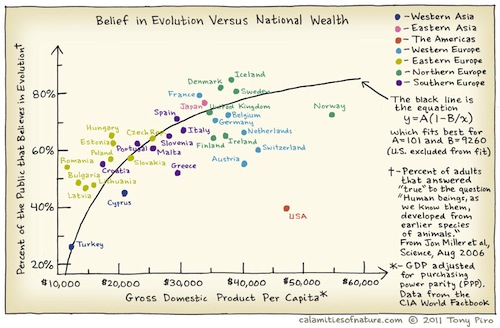
    Here is a great graph to show how the US is so exceptional (meaning different, not better):

    Thanks to Chris Blattman's blog. Hmmm. 

    Academia and Defence as Dopplegangers

    We tend to think of academic and military folks as being pretty much opposites: talkers vs. do-ers; messy vs. neat; anarchical vs. hierarchical, and so on.  But there is one way in which they are very much alike (and not different from other organizations): those who make decisions seem to be proliferating more than those who are the raison d'etre of the institution.  That is, I have blogged before about administrative bloat in universities.  Now, we have pretty good evidence of the same in Canada where the "Chief of Transformation" General Leslie has called for cutting HQ's to give the pointy end of the military stick more heft.

    There is a lot to to this in Canada (and, of course, elsewhere), but I do have one beef with the accompanying claim that the Hillier re-organizations were mistaken.  Hillier did many things--one was to create operational headquarters--CANCOM, CEFCOM.  CANCOM is for Canada, CEFCOM is for pretty much everywhere else.  The idea is that the Canadian Forces, before Hillier, had all operational decisions made by the Deputy Chief of the Defence Staff, which meant that he had a lot to do, in addition to his other jobs (sexist language is appropriate--no female DCDS's as far as I know).  CEFCOM was to run all expeditions (Haiti, Afghanistan, Libya, etc), providing a single chain of command to control the various elements of the Canadian Forces in each operation.  This is very much like the roles played by EUCOM, PACOM, CENTCOM, etc for the US.  That is, the army, navy, and air force (royal or not) recruit, train, equip, and promote the forces, but it is the job of the operational commander to send them to the field with their orders and oversee operations. 

    Canada is not alone in this kind of reform--the Aussies did it, and so did several other partners (whose identities elude me for the moment).  Of course, standing up a new HQ does not mean that one needs to stand up four--Canada Command makes sense but not sure about Support Command and pretty annoyed at Special Operations Forces Command since that could easily be folded into CEFCOM since I would guess that nearly all SOF is expeditionary in nature.  Two Operational HQs are probably better than four, but two are much better than none, me thinks.  And, of course, setting up operational HQ's probably means that each of the services (Army, Air Force, and Navy) should have cut newly redundant elements that had being doing operational planning.  Did they?  Unlikely. 

    So, there is, of course, room to cut.  And the cuts should fall hardest on the headquarters, especially since making hard decisions (really, can Canada afford a high tech navy, high tech army, and high tech air force?  How about picking just one or two?) is not their specialty.  But is it likely?  No.  People tend not to cut their own jobs.  Provosts don't get rid of vice provosts and generals tend not to eliminate jobs for other generals.  Shaggy or not, we tend to think alike.

    Grade Inflation Day

    With the fall semester rapidly approaching (yes, I should be getting real work done rather than blogging, but I am awaiting a dataset), the thoughts of students turns to orientation and meeting new folks.  The thoughts of everyone else inevitably turns to grade inflation.  The Beast has a great series of graphics here.  I tend to give more B's than A's and only a hefty number of C's in my big intro class.  So, I still have a bell-ish curve usually, just higher at the one end. 

    Actually, some of the other stats in the graphic are more disturbing: that hefty number of students think that showing up should be sufficient.  I did have a conversation with a grad student (not one of mine) in my previous job who said--if you are here long enough, you deserve the degree.  Oy, I hit the roof.  Education is more than just about endurance.

    Why less than 20 pages of writing required?  In my case, I blame .. the unions.  The teaching assistant unions to be specific.  We have a strict limit on the number of hours they can work, and those hours include showing up at lectures, email contact hours, hours in discussion sections (called conferences up here), weekly meetings (necessary for my big class where I have eight or so TAs to keep on the same page), and so on.  So, either I cut back on how much grading they do or I cut back on how much contact they have with the students, more or less.  So, my intro students get about 15-18 pages of writing (two papers and a final).  My advanced students get just a bit more than 20, with one big research paper, one shorter paper and sometimes a final.  Of course, I could just do more grading myself, but the incentives certainly do not point that way.  Plus I hate grading. 

    My students very much do have to read more than 40 pages a week to get by.  Of course, such a stat is deceptive since some courses are not as reading intensive as others.  Math?  Hmmm.  But social sciences are reading heavy.  I guess I average (if I am thinking real hard about the numbers) about 100-150 pages of reading a week, depending on the level of the class.  I am sure my students are willing to do the math to prove I assign more.  But some of those pages will be Zombie-related, so they can moan all they want to.

    What is worse than grade inflation?  That lower standards are most common in programs that focus on educating educators.  I observed early in my career and often since that students who are majoring in Education generally have the worst performance.  Not all, but I used to guess pretty accurately the majors of students who were getting low C's and D's in my courses.

    It is important to note Canada and especially McGill do not suffer as much from grade inflation.  Indeed, a few of my colleagues systematically engage in grade deflation.  I don't get that much whining about grades here because my colleagues have beaten down their expectations.  This is good for me, as I am probably easier than most of them but still more demanding, I think, than the average in the US (if the numbers in the article cited up above are correct). 

    However, it is BAD for our students who want to get into grad programs in the US.  After linking to the grade inflation pieces on twitter this morning, I got a twitter reply back from a prof at George Washington University (Dan Nexon) who noted that Canadians suffer in comparison to Americans due to grade deflation up here.  I assumed this might be a problem--nice to know for sure.  So, I include text in my recommendation letters addressing the grading differences--although that may or may not help that much.

    As Dan noted, what we really need is some sort of solution to the collective action problem since those folks who are tough grades face all kinds of problems, including lower teaching evals, flack from parents, hurting the students relative to others in jobs and grad school applications, and so on. 

    But I am skeptical. Profs are hard enough to herd when their numbers are small.  Getting all of us to agree to anything?  Ha! 

    Thursday, August 18, 2011

    Random Recognition

    Somaliland counts!


    Ok, perhaps not so great, but this map by the World Food Programme essentially recognizes the existence of Somaliland.  As the map shows, Somaliland is better off than Somalia--yet again. 

    Somaliland is a proud member of a club of countries not allowed in the club of countries.  Byman and King had a nice piece in the NYT this week documenting the problems raised by "phantom" states. They recommend:
    transparent government, free elections and a peaceful foreign policy are as vital for phantom states as they are for real ones. If phantom governments behave well, they should be offered a path toward legitimacy by the world’s major powers. Economic and political reforms can proceed parallel to, and even bolster, discussions over sovereignty.
    Good luck with that. Their orphan status is a product of political conflict, not just aversion to changing international boundaries (O-ver-RAY-ted).  The political problems that create these non-entities are very hard to resolve, so waving a magic wand is unlikely to do the trick.

    The funny thing is that I was thinking of these kinds of countries after listening to Bill Simmons's podcast with NBA commissioner David Stern.  The commish mentioned that the NBA appears in 215 countries or so, but the UN only has 192 countries or so.  Which means the NBA appears in countries that are lacking in the rule of law and then some.  Verrry interesting.  To me, at least.

    Wednesday, August 17, 2011

    Dog Days of August

    For the first time since 1992, my family is dog-less.  We got Flynn (the smaller one) shortly after we were married from a shelter in San Diego, and we got Tessa (the larger one) shortly before my daughter was born.  Flynn died a few years ago while I was away at a conference.  We had to put Tessa to sleep yesterday after she handled a week at a kennel rather poorly.  We usually used dog-sitters so that they would not have to endure the stress of a kennel, which, in our minds anyway, is too much like the animal shelters where we found them. 

    But Tessa was about 17 and was starting to lose the ability to stand and to walk even before we went on vacation.  Indeed, we faced a few points over the past six months when we thought about doing what we had to do yesterday. 

    Flynn was clearly my favorite of the two, with Tessa being more neurotic, especially early on.  Flynn was simply too cool, with our move from Vermont to Texas producing many sad-faces in New England.  He had charmed not only all the large female dogs in the townhouse development but also their owners.  Tessa was still a sweetheart, and she will be missed, even though she used to wake up the baby long ago by barking at any time a leaf flew by the front of the house.

    I post this not to get more sympathy--facebook provided aplenty--but to explain why blogging has been infrequent lately.  Losing Tessa will greatly simplify our lives and save us a fair amount of money, certainly, but she will be missed.  Perhaps Game of Thrones will show more of the black Direwolves next season to remind us of Tessa as Friday Night Lights briefly teased with a Flynn-esque Skeeter.

    And, no, we will be getting any more dogs.  We loved the dogs we had, we love the ones we encounter, but we hope to travel more in the next few years.  We were glad we could save a couple of shelter dogs, including one that had clearly been abused, giving them really, really long lives.  If you like dogs, get a shelter dog.  Pure-breds are for Slytherin.  If you want a dog with character and heart, get a Gryffindor or a Ravenclaw or a Hufflepuff at a shelter near you.

    Holy Socks! Somebody Found a Metric I Was Looking For!

    I have often complained about how hard it is to measure progress in a COIN effort, especially Afghanistan.  And I have often said that if I knew what the trends were in actionable intel tips, I would have a clue about progress.  Well, it is a good thing there are grad students who are collecting this data because: TA-DA:
    Using the infamous Wikileaks Afghan War Diary data, my advisor David Sobek and I found that collaboration between Afghan locals and U.S. forces, in terms of turning over or pointing out caches of insurgent forces has increased since the president ordered a surge in forces in early 2009. We also find that collaboration breeds collaboration. In other words, while there isn’t much cause to celebrate yet, U.S. forces are beginning to win hearts and minds in Afghanistan.
    A problem with the link is making it hard to read their paper.   And I would use the phrase credibility rather than hearts and minds--the Afghans might have found American/NATO commitment more credible and as more credible partners but that they love us and think like us (hearts and minds)?  Not so much.  But this is really cool, if the info is right.  Of course, lots of other stuff going on, but if the patterns of intel tips is what is suggested here, then we have some progress.  The question then is--what is the pattern now as the US starts to reduce and after the Dutch and Canadians have, as they say in French, skedaddled? 

    Tuesday, August 16, 2011

    Bachmann Overdrive

    I have tried to avoid paying attention to the American election campaign. I am depressed enough as it is.  Plus it is way too soon.  But Kathy Griffin is just, well, mighty terrific in this piece on Conan.  Bumping into Bachmann, Griffin asked her:
    "Were you born a bigot or did you just, like, grow into it?"
    The answer:
    "Good question.  I will have to get back to you on that."
    As Monty Python skit number 47 would say: Say no more!

    Hobbes Was Right for the Wrong Reasons

    Famously, Thomas Hobbes argued in the state of nature, life is nasty, brutish and short.  It turns out he was way ahead of his time. Turns out that watching television may shorten one's life.  So, if you notice that I stopped blogging, it might be that TV killed me.  I watch a heap--so I should be dropping dead soon.  Just fair warning.

    Afghanistan and the Pundits

    Check out this cool graphic of where the various pundits fit on Afghanistan.  Where would I fit?  Probably somewhere near the President's plan, I suppose.  My ambivalence makes me hard to code.

    The larger point is that we have a whole heap of dissensus on the issue.  This may not be a representative list of names--perhaps an accurate survey would have more folks in one corner of the circle (yes, a circle can have corners if I say so).  But the key is that we should stop saying with any sense of incredulity that the people are confused by Afghanistan when the messengers and the decision-makers (not to mention the war itself) are so very confused.  Of course, publics are confused.  The situation itself is fairly opaque, counter-insurgency is less easy to measure than conventional war (where there are often surprises as well), and the elites do not have any level of coherence on this.

    I believe it was Feaver (need to re-read civ-mil stuff for winter semester's course) who argued that public support for war correlates highly with elite consensus, which goes a long way to explaining why the war used to be popular but is no longer.  I do think he was right on this, if not on everything.

    Royally Amused

    The Canadian Department of National Defence is putting Royal back in the names of the forces that fly and sail: the Royal Canadian Air Force and the Royal Canadian Navy.  Twitter has been a fun outlet for those in favor or against.  As some noted, Canada's RCMP stands for Royal Canadian Mounted Police and the ships are Her Majesty's ....., so this is no big deal.

    But to an ex-pat American, this does seem like a strange move now.  Embracing royal-ness in the 21st century?  I guess any way to get closer to Kate Middleton makes sense.

    See here for quotes from my friends in Ottawa.

    Monday, August 15, 2011

    Good Advice to Grad Students

    Some slides that present good advice to grad students as they move past their first classes.

    Canada and NATO: Irrelevant?

    Granatstein, apparently the dean of Canadian diplomatic historians (I say apparently since I am neither Canadian nor an historian), has written a piece questioning the relevance of NATO.  If he were an American, I might have to make an argument.  However, for a Canadian, this is a relatively silly question to ask given the absence of alternatives

    The US can and occasionally does go it alone, perhaps covering its unilateralism with a fig leaf of supporting countries.  Canada simply cannot act militarily in the world without help.  So, the choice is either go bilateral with the US or multilateral with NATO, as there is no other viable security-producing institution in the world (nope, the UN does not count).  Its military is simply too small and lacking in key capabilities to do much abroad (or defend itself). 

    What about the facts in the piece?  Well, yes, the US did send 1,000 troops to southern Afghanistan, but that was part of a deal that brought a French battalion to the dangerous area of Kapisa near Kabul.  The French wanted to go East, not South, largely for logistical reasons. NATO worked in this case by facilitating the redeployment of Americans before the big surge and because Sarkozy wanted NATO to succeed.

    Granatstein is also right in suggesting that Afghanistan is not a huge success story, but consider the context--is it NATO's fault or is it due to the situation?  I would not use Afghanistan as a good measure of what NATO cannot do, after countries have bled in a war far away from Europe just to support an ally a la Article V.

    The piece does tend to overplay the "Europeans" didn't fight thing, as even an author of book on caveats (well, soon) would not say that Europeans didn't fight.  Not only did the Danes and the Dutch fight in the South, along with the Poles in the east, even the Germans and Italians, handcuffed by domestic politics, still bled and fought.  Yes, some countries fought harder, but Canada was hardly alone and the NATO blessing to the mission meant it was possible for others to participate.  Hard to get missions through parliaments without a thick gloss of multilateralism.

    Oh yeah, true for Canada as well.  Canadians are more likely to support a multilateralism mission.  Isn't that one of the lessons of 2003?

    Granatstein's final take:
    And where does this leave Canada? Ottawa has been fed up with the way most NATO members hid under the bushes to avoid Afghanistan and Libya while Canadians fought and died. That ought to lead to a serious re-examination of the utility of the alliance, of its worth to us in the immediate and longer-term future. But NATO contains most of our friends in the world and, while the grumbling among the mandarins and politicians continues, there is unlikely to be any immediate interest in pulling out.
    But in diplomacy as in baseball, it's three strikes and you're out. Afghanistan was strike one; Libya was strike two. And strike three? No one yet knows where the next call for action might be - Syria? - but if NATO funks it again, then the pressure from Ottawa and, possibly, Washington may be irresistible. NATO has lasted more than 60 years, but even historic alliances can become so attenuated and powerless that their irrelevance can no longer be ignored.
    Convenient to ignore Bosnia and Kosovo--where the casualties have been few and the peace relatively robust.  Also strange to mention Syria as no one is really thinking of doing anything there.  Is NATO really supposed to intervene and stop all violence?  Rwanda would have meant NATO was irrelevant in the 1990s.  Or Somalia?  Oops.

    As a committed skeptic of conditionality, I still see the merit NATO had in helping the democratization of Eastern Europe by both providing security guarantees and helping to develop civilian control of the militaries.  

    Back to the main point: with broken submarines and a navy with few significant platforms, a small air force, and limited defense budgets down the road, how can Canada either defend itself on its own or intervene anywhere in the world without significant help?  Relying solely on the US is one way to go, but not popular in Canada and perhaps not a wise strategy to always be a mouse with little influence on the elephant.  NATO institutions give Canada some sway, especially when Canada "punches above its weight."  No institutions means that there is no place for a LTG Bouchard to run the Libyan campaign.  If the purpose of a military is just defense, NATO is necessary.  If the purpose is to have influence, NATO is still relevant as it has amplified Canadian influence in Europe, the North Atlantic, the Med and A-stan.  Not too shabby.

    Yes, the institution has problems and caveats have been challenging (but Canada has them too).  But the reality is that there are not abundant choices, and NATO has done both better and worse than its critics/fans aver.

    Cutting Defense: First, Steal Some Underwear

    The NYT had an interesting piece on defense cuts that must occur for any serious deficit cutting to occur.  The graphics show the trends in spending:
     

    The first shows quite clearly that the "easiest" way to get back to a normal spending level is simply to stop funding war.  Getting out of Iraq will eventually pay off, once the US un-surges from Afghanistan.  War is simply expensive, but Bush, unfortunately, did not feel he needed to pay for the wars he started.  Iraq was especially expensive and will be for generations due to the injuries incurred by the Americans who fought it and survived (the US will not be paying the bills for other countries' veterans). 
    This picture also makes its clear why there is some urgency about getting done with Afghanistan.  But that is a bit harder to do simply because there is not a reliable partner to take over (yes, Karzai makes the Iraqi folks look reliable).

    So, war will continue in Afghanistan.  Libya will cost some but not nearly as much.  What else to cut?

    Here is where the tradeoffs get hard.  If you want to cut the numbers of planes purchased, do you also want to cut the older planes?  Is upkeep of those more or less expensive than the maintenance of the new planes?  The A-10 is an old, old plane but a unique platform for doing precisely the kind of stuff that needs to be done--air to ground attacks. 

    The other really hard part is reforming pay and benefits.  Mostly because there are entrenched constituencies for this kind of stuff--making the soldiers and sailors and marines and air-folk pay more for their benefits is deeply unpopular with them and their pals in the Congress.  It is funny that I resist Verizon's efforts to make their workers pay but not so much efforts to make the folks in the armed forces pay.  Perhaps because Verizon execs are getting paid far more than the President, SecDef, Chairman and the like.  Anyhow, tangent aside, the challenge is that it is easy to recommend stuff to be cut, but it is hard to figure out ways to make cuts politically possible.  Policy experts need to think more about step b (underwear gnome's shoulder shrug) between policy recommendation and policy outcome. 

    Good thing my job is simply to point this out rather than come up with ways to convince Congress to make hard decisions.

    Sunday, August 14, 2011

    Geek Bucket List

    Interesting post on what geeks would like to do before they die.  Which ones would I want to do?  Some random thoughts below:
    1. Get Superpowers.   Naturally.  Addressed this before.
    4. Become  Jedi.  Course of want I.
    10.  Ban all re-boots, re-numbering and multiverses within comic books.  Oh, my, yes!
    15.  Sit in on a film, comic book and pop culture discussion with Kevin Smith, Stan Lee, Roddenberry, etc.
    22.  Kill a Zombie w/ a vinyl record, the Batman soundtrack or Dire Straits....  Oh, I have a few albums I could toss.
    26. Go to a bar with Mal and Zoe on Unification Day (although I don't remember what Unification Day is about).  Must get Firefly series on DVD.

    32. Be able to download new skills a la the Matrix.  Ah, but which skills.
    37. Pass the Kobayashi Maru with flying colors.  Don't need to pass, just take.
    40. Solve a crime with a group of meddling kids and their dumb dog.
    47. Trick William Shatner into one last, great Kaaaaahnnnnn!!  Just tell him it is an audition for a new series.
    49. Walk through saloon doors ominously. Absolutely, rootin' and tootin'
    53. Take part in a "Fastball Special" with Wolverine.  Actually, I would want the wolvie part--to be thrown.
    62. Play a game of thermonuclear war with WOPR.
    63.  Revoke George Lucas's writing privileges.  And, more importantly, directing!
    69. Defeat the Black Knight from Monty Python and the Holy Grail.  Actually, I would prefer to heave the Holy Hand Grenade at the anarchist.
    75.  Drink Butterbeer.  Someday soon.
    76. Wield a Lightsaber.  A flashlight just is not the same.
    79.  Roadtrip with Jay and Silent Bob.
    80.  Re-kill a zombie.
    81. Train a pet dragon.
    92. Ride along with the Vegan Police.  As long as I can continue not to be a Vegan.

    Got it down to just over twenty.  Not bad.  And you?

    Blogging Vacation Ends ... Tomorrow

    Just got back from vacation, so blogging will commence with a bit more frequency and depth (well, perhaps not so much the latter) tomorrow.  Luckily, I do have some meat stored up--Granatstein wrote a pretty dumb piece on NATO while I was off boating and climbing.  So, the fish in the barrel have been lined up.  


    If anything happened in Montreal last week, let me know as I did not get any news.  I did, however, drive out of my way (west off the island) to avoid the various bridges and tunnels that were closed/failing/falling.  So, I am ready to rant about Mtl infrastructure if there is any new story to focus my ire.


    Saturday, August 13, 2011

    I am a Master-mind?

    I have blogged last month about why I blog.  As it turns out, I may have been deceiving myself and my readers.  It turns out that I am far more strategic than I thought, as blogging may increase one's reputation in the field, if political scientists are anything like economists (that is our aspiration as they make more money). 

    I do know that more folks are aware of certain scholars because of their web 2.0 (or whatever) efforts, such as Dan Drezner, Marc Lynch, the folks at the Duck of Minerva and elsewhere.  But more visibility may not mean a better reputation, just perhaps a reputation for being silly, distracted, entertaining, snarky, indiscreet, whatever.  I would guess that the nature of the heightened reputation would largely be shaped by the quality of the blog.  To use Drezner as an example, I am pretty sure he is positively viewed by most folks, although the nattering nabobs of negativism at Political Science Job Rumors see Drezner negatively.  Not a surprise, but does provide the dose of caution that more visibility can provoke jealousy as well as admiration. 

    So, the folks behind the first post asked the next question--impact on policy?  Their next post may provide some data to answer the question, but they are asking folks to provide their own views on this.  An interesting conversation to follow.  

    Friday, August 12, 2011

    Coach Finishes Strong

    I think Friday Night Lights ended wonderfully, but I don't mind hearing the speech that might have been.  Coach apparently had a speech that would have run over the ending montage.  I see why they didn't use it, but it is fun to get one last bit of the show.

    Transition Skeptic

    Check out my new post at Current Intelligence.  Consider me a transition skeptic. 

    And next one will be thoughts about ten years after 9/11.

    Thursday, August 11, 2011

    It is Not Just Me

    Check out this piece at Foreign Policy.com which applies the logic of post-conflict politics/policy recommendations to the aftermath of the War Against the Dark Lord.  See, I am not the only scholar of conflict that is excessively obsessed with Harry Potter.  I have heaps of company, and this particular piece is a particularly useful exercise.

    Academic Humor Graphic Du Jour

    From http://sotak.info/


    School's Out. Let's Talk About School

    Several interesting posts from people who know well the pro's and con's of advanced degrees and life doing foreign policy stuff.  Check out the discussion spawned by Andrew Exum and Erin Simpson and then commented on by Dan DreznerRobert Farley and James Joyner.

    Most of these folks have more policy experience than I do (one year), more experience with policy schools (none yet, although IR/PS was near the UCSD poli sci dept and I worked with profs who were based at IR/PS), but I have had students move on to policy positions and most of my PhD students have found tenure-track positions.  So, I have heaps of opinions about this stuff but I can summarize it in one line, given this job market
    • If you do not have a deep curiosity about politics, a PhD in political science is not for you. 
     The PhD is no guarantee of a job, and it does represent a serious opportunity cost (see Farley) in terms of time.  Once you are in a PhD program, it becomes mighty hard to leave as sunk cost logics tend to overcome arguments about exiting.  Having a PhD does open up some interesting alternatives but strangely closes others as one becomes over-qualified in some eyes.  Policy PhDs and academic PhDs are entirely different beasts with only some programs doing a good job of providing people enough of a background in each.  It really is a case of path dependence--you can get off the path, but it has costs.

    I do disagree a bit with Joyner who basically says don't go to a school outside the top ten or twenty-five.  Rankings are far from perfect, as I have noted beforeAnd one can end up doing great in grad school (great idea, great execution, strong pubs)* so that a very good program can be good enough.  But there is a point--that the worse the reputation of a school, the more you are daring the fates.  You can get a great education in a middling program and get a good job, but it is riskier.

    * Not referring to me, as I had good idea, good execution and no pubs.  

    Grad school is a reasonable choice, if you go in with your eyes open to what opportunities that it may or may not open up.  But there are tradeoffs, so it is not a great idea for those who simply want to delay "real life" a  few years. 

    Wednesday, August 10, 2011

    Political Science Joke!

    Really. Since I am on vacation (or holiday), I am borrowing a quote that lil Steve quotes in his blog:
    Santa Claus, the Easter Bunny, Barack Obama and an independent and pragmatic president beholden to no party, ideology or interest group are walking down the street. At the same time, all four spot a dollar bill on the ground. Who gets the dollar?
    Obama, of course. The other three are figments of your imagination.
    I am glad some folks are addressing this.  If we get any third party candidates, they are not going to be in the middle, but on the extreme wing of one of the parties, or both.  Things may not be looking good for Obama right now, but why should he be any different?  This time next year, well, it will be interesting to see who folks blame and whether the GOP can put forth a candidate that is not a joke him/herself.

    Tuesday, August 9, 2011

    Speaking of the NDP, Forget About Libya

    The NDP is opposing renewal of the Libya mission, but I do believe that it will not matter.  Majority government is new to Canada these days, but perhaps the NDP knows it can take an easy position--opposing a military mission for which it has no responsibility.  I do believe the mission will go ahead, no matter what was said a few months ago.  Libya is a good mission for the Harper government--no casualties, Canada plays a leading role via LtGen Bouchard, most other NATO countries are doing far less.  I still doubt that any Canadian troops would ever be deployed, but the air mission is one that Canada can sustain with its relatively small air force for a while longer.

    Much Ado About Party Hopping

    This piece puts things into perspective as the new leader of the NDP, Nycole Turmel (replacing Jack Layton, who has another cancer battle ahead), was found to have a history of supporting separatist parties in Quebec. 

    Party hopping is a Canadian way of life, so this is not so strange.  And as the piece linked above suggests, we ought not be surprised that a left-wing Quebec pol supported the various separatist parties.  The real problem is not so much Turmel's past but the NDP's present--that the pandering during the election made it unclear where the party really stood on the big questions of Canada: what is the role of the federal government during the next referendum?  Yes, there will be another one some day, but will it be a clear question?  Will the NDP support the Clarity Act, which gives Parliament a say, or is it all about 50% plus one? 

    I perhaps reacted too quickly on twitter when the news first came out, but I would like to correct for that.  The NDP does have a heap of Quebeckers, but not all of those folks are sovereigntists.  The party itself has an interest in national unity since the NDP would be a marginal party without Quebec.  So, I am not so worried about the NDP so much.  The PQ?  Absolutely.  Their incentives push entirely towards messing things up (as I see it).  Other than collapsing infrastructure, Quebec is doing pretty well with rising property values, growing economy, decent jobs picture, and so on. 

    Anyhow, stuff in August is likely to blow over.  I hope so.

    Civilian Role in Strategic Debates

    I found this piece posted regarding the role of civilians in Aussie military debates.  It does a nice job of arguing why civilian folks might just have both different and valuable perspectives to bring to the table even if their military experience is minimal.  Civilian strategists might not have much to contribute to tactical matters (how to fight a particular battle) and just a bit to operational planning (what the military should be military should be doing this month in Helmand.  But for questions about whether the effort is worthwhile, what are the political consequences at home, in the field and farther afield, how we might evaluate the tradeoffs, and so on, civilian experts provide a valuable perspective.

    War is too important to be left to the generals, as Clemenceau apparently said.  True, too many cooks spoil the broth, but good decision-making requires a variety of inputs.  The problem is that any one unit has a distinct culture and shared set of experiences that is likely to limit the diversity of views.  Involving outsiders is a good way to have a check on that.  It does not mean that the civilians are always right, but having to answer their concerns is a good way to force the military to think a bit more about their assumptions. 

    Of course, the MacArthurs and Tommy Franks of the world will not listen, but, luckily, not all military leaders are as impervious to insight as these folks are.

    Monday, August 8, 2011

    It Gets Silly

    I was really touched by the It Gets Better campaign.  So, I carefully post this amusing parody.  It is a wonderful imitation of Snape and his take on it getting better.


    Even for Snape, it got better.  Sort of.

    Whose Afraid of Montreal Tunnels?

    Me!  I don't need this article to influence how I drive.  I went south this past weekend and drive west off of the Island even though it meant I then had to drive southeast to dodge the broken bridges and tunnel.

    Still, tis a bad sign when a newspaper has to ask the public if they are afraid of the repaired (?) tunnel.  Transport Quebec has uttered lost any of its remaining credibility.  Maybe I should get a boat and make $$ by ferrying people?

    Sunday, August 7, 2011

    Political Science Geek Out Moment of the Week

    The New York Times Book Review does a pretty good job of explaining a key concept that I had largely learned by osmosis: Bayesian updating.  How ought we update our beliefs?  I have not read the book that is being reviewed here,"THE THEORY THAT WOULD NOT DIE: How Bayes’ Rule Cracked the Enigma Code, Hunted Down Russian Submarines and Emerged Triumphant From Two Centuries of Controversy" by Sharon Bertsch McGrayne, but I should, given how often Bayes comes up in political science.  

    The funny thing is that we live in a time where there seems to be no updating--no matter how much evidence is revealed, folks do not seem to be updating and revising their prior beliefs.  Will this book change my mind about this belief?  Um, maybe.

    Transition Update

    As part of the transition process, NATO handed over responsibility for security to the Afghans a handful of cities and a couple of provinces, including amazingly enough Lashkar Gah, Helmand's capital.  The Brits, who have borne most of the load for Helmand until recently, have a blog suggesting that things are going pretty well:

    The violence has not gone away in Lashkar Gah – on Sunday 11 Afghan policemen were killed in a suicide attack – but British military commanders in the city believe despite setbacks real progress has been made.
    In six years Lashkar Gah has gone from being Afghanistan’s most violent city to its second wealthiest and thousands are flocking in from the countryside. The real change is Afghans now run Lashkar Gah’s security and international forces have not been called in for a year.
    Police corruption is still a concern but not as widespread. The public are now said to be doing what was once unthinkable and reporting crime to the police, a sign that the city may be getting more stable.
    It really depends on one's "metrics"--what counts as progress and stability.  Violence?  Still happening.  But if the people are relying on the police, that is huge, given how their starting point and how basic that component of the "rule of law" and security sector is. 

    I cannot help but be skeptical since the British military has had a record of being overly positive about Helmand even as things were pretty horrible, not unlike some of the other militaries (Canada) operating in Southern Afghanistan.  It has been only a few weeks, and the bigger news has been the series of assassinations of Karzai appointees.

    I have ponder transition a bit further in a forthcoming column at Current Intelligence.

    Friday, August 5, 2011

    Perils of Modern Research

    One of my research assistants had her computer stolen with all of the data that she had been coding for me on it.  Backed up?  Nay.  Despite www.dropbox.com, despite the ease with which one could use an i-pod as a hard drive, nope.  I am paranoid myself precisely because I had a desktop machine stolen from my office (actually, I have had two machines taken from my office).  I remember working on my dissertation twenty years ago (oy!) and making sure I had the stuff on multiple disks in multiple places. 

    I didn't think I had to alert 21st century students about the need for backing up.  I was wrong.  So, folks out there who rely on research assistants--remind them that it pays to take care of one's work. 

    Thursday, August 4, 2011

    Collapsing Montreal Infrastructure, part deux

    Actually, I don't have much to say.  Today's news is pretty much like yesterday's.  The Transport Ministry is excusing the various problems as being due to the complicated, multi-agency organizational messes that are supposed to oversee the various projects.  As it turns out, the work in the tunnel that preceded (and probably caused) the collapse was not really vetted by the Ministry.  That had been contracted out.  To whom?  To some contractors that were already in trouble for tax evasion.  Good times.

    The premier (think governor), Jean Charest, just gave the head of the Transport Ministry, Sam Hamad, a vote of confidence.  If this were a professional sport, that would be the necessary next step before the guy gets fired.  The owner of a team almost always gives a vote of confidence to the general manager, manager, or coach before firing him/her.  If Charest actually keeps Hamad around, Charest then deserves to lose the next election.

    To continue the theme from yesterday, the buck stops somewhere--either with Hamad or with Charest.  If Charest does not hold Hamad accountable, then, well, Charest should be.

    Wednesday, August 3, 2011

    Pardonnez-moi, Où Va L'argent Arrêter?

    I thought maybe the folks in Transport Quebec might understand it better in French, but:
    Where does the buck stop?

    Apparently not with the Minister.  The latest in Infrastructure Collapsing Watch 2011™ has Transport Minister Sam Hamad blaming the contractors.  That might be believable if this event were not part of a systematic pattern and a systemic breakdown.  Check just today's top stories on the Montreal Gazette's website:
    The buck should stop with Hamad--that his ministry is UTTERLY FAILING.  Since he has been at the head of this organization as failures in infrastructure, failures in communication, and failures in responses to the infrastructure problems have repeatedly occurred, should he not focus less on the contractors and more on ... himself?  I don't know if there is anyone better to do his job, but can anyone do it worse?  We need at least some symbolic accountability--he needs to get his ass fired or he ought to resign if he has an ounce of conscience.  The last time I saw government so repeatedly and systematically fail to do its job was perhaps in the aftermath of Katrina.  At least, those folks had a huge natural disaster with which to share responsibility. 


    Hamad has now agreed to review his ministry to see if it could organize repair work better.  Um, horse, barn, get it.  Fire his ass now!  The buck stops with him.

    TV Gets Multinational Warfare Right?!

    I have been watching Combat Hospital this summer.  It is a relatively cheesy version of M*A*S*H set in Kandahar, but not as funny.  Perhaps more China Beach-esque.  It is a Canadian series picked up in the US by ABC, hence the more visible role by the Canadian folks. 

    The basic idea is that it is a jointly run/personned medical facility in Kandahar in 2006, mostly run by Canadians but also with a smattering of Americans, Brits, Aussies (mostly there to party, it seems), and others.  So, a natural plot would be to show tensions among the Canadians and the Americans, particularly given the shared Canadian sense that Americans are reckless cowboys.

    So, I was most interested, given my research on many of the challenges of multilateral operations, to watch last night's episode and see a key plot focused on a rather subtle difference in rules--that the Americans don't seem to mind their helo pilots using "go pills" (amphetamines) when they are drowsy whereas the Canadians would rather rest a weary pilot (see this scene via Hulu, if you can) I have no idea if this is true, but this kind of difference in standard operating procedure is certainly one of the challenges facing any multinational unit, just as each country operating in the skies over Libya has a different targeting process--essentially different rules of engagement--that must be finessed.

    As a result of this episode, I can feel as if I was working this summer while watching a decent but not fantastic TV show. 

    Tuesday, August 2, 2011

    Tunnel Collapse Update

    One of the questions that comes up whenever a Montreal piece of infrastructure collapses (and yes, it does seem to happen often) is: don't they inspect these things?  Yes, yes, they do.  They just don't do anything about it.  The tunnel that collapsed this weekend was found to be in deep trouble three years ago, but nothing was done.  Actually worse than nothing as repairs on the sides of the tunnel, including using high pressure water blasting the sides, may have actually destabilized the ceiling of the tunnel. 

    So, we have a two part process: ignore the results when problems are found; go ahead with some efforts to fix but ignore what these efforts might do to the rest of the tunnel.  What this tells us, as if we did not know before, is that there is something deeply and SYSTEMATICALLY wrong with Quebec's political system that allows infrastructure to fall into such a state of disrepair and then the lame efforts to deal with this problem end up causing more problems.  This would be stunning if we were not already stunned already by the previous events and revelations.

    The newspapers, including letters to the editor, are clear that we understand that there is no accountability in Quebec.  The transport ministry has tried to cover things in secret sauce by claiming that documents cannot be released as they would affect bidding, or because the civilians would not be able to understand them.  But the larger dynamic is that of nationalist politics.  Elections rarely turn on good governance or its absence but on the nationalist issues of the day, whether it is hating immigrants a few years ago or on separation.  So, politicians are not held accountable for the rubble in the streets, whether the rubble is from collapsing bridges or from World War I battlefield-like potholes. 

    While the Parti Quebecois is now criticizing the provincial government for being opaque about this stuff, I have no doubt that they will focus more on how best to get my daughter out of English schools when they come back into power, rather than on fixing the roads, bridges, tunnels, etc.

    Can I Love Matt Damon, Too?

    I don't like the hairless version, but I do like the idea (even if it is a bit idealistic) that we are not just in it for money:


    Of course, we should not be looking to our actors for political advice (that is why we poli sci bloggers are here), but when asked, Matt brings the heat--that it is not just about incentives.  And if we want to talk about incentives, how about we consider the incentives of school administrators?  That might explain why $$/administration tend to rise faster than $$ per student or per teacher/professor.

    Anyhow, Sarah Silverman, you may have to stand in line.

    Race and Religion

    Roger Cohen has a great piece about Racism, inspired by the Oslo murders but based on his experience of growing up in South Africa.  It does raise an issue that may confuse some folks: that racism applies to religious differences.  Or not.
    Nothing makes my blood boil like racism. I got a lot of angry mail over a recent column about Norway’s rightist mass murderer and his sympathy with “racist Islamophobia.” Muslims are not a race, the writers claimed.
    Funny, several of the angry notes were from Jews, who seemed to have forgotten that not being a race but a religion had scarcely saved Jews from racist persecution: Perhaps the Einsatzgruppen just got in a semantic muddle before opening fire. Perhaps the Malaysian soccer crowd who just booed Chelsea’s Yossi Benayoun, an Israeli player and a Jew, were not really racists. Dream on.
    In my career, I have often bumped into labels such as "ethnic and religious politics/conflict" or "ethnic and racial/politics/conflict."  For me, ethnic conflict is a broad category within which race and religion fit, rather than as similar but distinct phenomenon.  Why?  Well, I have always relied on Donald Horowitz's (Joseph Rothschild had a similar one) definition:

    Ethnicity is based on a myth of collective ancestry, which usually carries with it traits believed to be innate.” 

    The keys here are perception, shared sense of ancestry and associated traits.  Ethnic groups are perceived to exist by members and outsiders as any identity requires a definition of us and them.  What separates ethnicity from class are the ideas of ancestry--that you are born with this particular group membership--and of key traits, such as race, religion, language, and kinship.  Sure, one can adopt a new religion or language more than one can change one's race or kinship, but these traits serve as markers of shared identity and of opposition.  Consequently, the dynamics around race are not especially distinct from those around religion and so on.  We can think about how the differences might matter (linguistic divisions always involve jobs, religious differences are more likely to produce divisions over justice systems, etc), but there are processes, such as outbidding, that are common to all kinds of ethnic identities.

    Racism, as used by Cohen, may be a confusing term since it more than just implies race but requires race to be the focal point.  Ethnocentrism or xenophobia might seem more inclusive of the dynamics that Cohen is talking about--how hatred of a particular group, defined by its religion, can lead to assertions of racial differences.  Muslims and Jews are certainly distinct ethnic groups, whose key trait is, indeed, religion, but who are often seen as having racial ties within the group even though, for the most part, race is not really something that unites members of either religious group.  Jews of Eastern European descent see themselves as distinct from those of North African descent.  Muslims come in all colors--and folks in Africa have long seen Arabs as distinct from those with darker skin.

    But Cohen is right about the larger point: hating someone for their perceived cultural identity, be it race, religion, language or kinship, is awful and destructive.  Again, I have been delighted over the past few years that my second book suggested that xenophobia might have some positive effects, and I still believe that is the case.  Yet relying on xenophobia to keep irredentist campaigns at bay is a pretty desperate strategy that has negative tradeoffs domestically.  It is abundantly clear to me that where irredentism is not a threat, hatred of others is something that must be opposed.

    The Islamophobia that exists in Europe, anti-immigration movement in the US, the opposition to reasonable accommodation in Quebec are all part of the same problematic processes--that some members of privileged ethnic groups are finding themselves in harder times and want to keep their privileges even though they are directly counter to the bases of their political systems and cultures.  The US is a country of immigrants with the obvious exception of the Native Americans, so it is always strange yet predictable to see folks want to close the door behind them.  European countries have equality as a basic part of their DNA, but want things to be less equal for the newcomers.  Quebec is a place where there is a deep memory of being a discriminated minority, but now that Quebeckers have much power locally, much of it is aimed at today's minorities.

    The funny thing is that staying true to the core beliefs and values in each of these places is the way out.  Equality of opportunity in the US is the path for immigrants to move up and become part of American society.  Taking care of everyone from cradle to grave is the way ahead for European social democracies.  Canada's multiculturalism is the way to keep the country intact. 

    This post started as an effort to clarify some conceptual confusion--that race and religion are similar identities that fit into the larger category of ethnicity--and then moved into arguing about the values of advanced democracies as the way to address these distinctions.  Of course, as a scholar of ethnic conflict, I know that the politics of intra-group competition (ethnic outbidding) and inter-group conflict will dominate, making it hard but not impossible for those who try to build multiethnic coalitions based on the core values of these societies.   It make not require a Mandela or a Martin Luther King, but it sure does help.

    Monday, August 1, 2011

    Ok, Debt Vote Has One Positive

    Gabrielle Giffords votes.  I don't know what her future will be, but I hope she will keep moving people as she did today.

    New Blogger on the Block

    Erica Chenoweth has a new blog, where she promotes her book on how folks can engage in peaceful dissent rather than violent insurgency.  She is basically teaching people to be annoying.  While I am already an expert in annoying people, I have still learned much.  Check out blog and her book. 

    Neo-Luddite!

    I am not a luddite, but appreciate a good electronic tale of one: