Sunday, March 19, 2023

ISA 2023: So Much Gratitude

The ISA poster maker
was not wrong

 I am sticking around in Montreal after a wonderful ISA conference as I have a CDSN workshop on Climate Security.  So, I am hanging in my hotel room, marveling at how lucky I am.  I had a great time, meeting old friends, making new connections, giving feedback on a wonderful book, and being really grateful.  After two cancelled ISA's (Hawaii and Vegas, damn it!) and one strange, poorly attended one in Nashville last year, I was determined to hug longer and share my gratitude with all those who helped me along the way.  As it was a conference full of special events, this was not hard to do.


Lauren and me on
reconstructed McTavish       

Started by meeting up with a former undergrad who got hooked on IR in my Intro class at McGill . We walked around our old stomping grounds.  Lauren Konken and I had a great time, chatting about ye olde days and noticing what has changed at McGill.  The plywood instead of a real railing on my old office balcony?  Nope, that didn't change.

A ritual for Montreal conferences is for my former student Ora Szekely to take me to her favorite Chinese restaurant in Montreal's mini-Chinatown.  I am always thrilled to see my former students--they are mostly doing great, and they are mostly very funny people.  So, conferences are great for both silliness and pride.  I am quite thankful that I have had such great students over the years even if I whine about reading endless drafts.

I met with several editors to promote the Dave/Phil/Steve book manuscript, and they all indicated much interest. I feel good about our chances of getting our book out to a great press in the near future.

This was a year full of honorary panels honoring people I know.  Which means I am getting old.  I was asked to be on Victor Asal's panel, as the Ethnicity, Nationalism, and Migration section gave him an award for all of his work, and it was my honor to join Ora, Erin Jenne, Pat James, and some other folks (my memory sucks after a week of reduced sleep).  Victor has published an incredible amount of work in many areas with many, many co-authors.  And he is a mensch.  These panels are supposed involve some roasting, so I teased him gently while also noting his contributions and his mensch-ness.

For the first time, I attended the Presidential speech because the President for the past year has been Debbi Avant.  She was one of two senior IR grad students at UCSD when I arrived.  She was most welcoming, throwing a party for the prospective students, and then over my time there, most generous with her advice, and most supportive.  She was also a hell of a role model, starting with her doing security stuff at a time where no prof at UCSD did international security.  She was a pathbreaker in the field of civil-military relations, applying principal-agent theory to it before Peter Feaver made it cool to do so.  Since then, I have often asked her for advice, which she provided quickly and insightfully.  She threw yet another party when I visited Denver when I gave a talk on the Steve and Dave NATO book.  Most recently, she has served quite helpfully on the CDSN Advisory Board.  She gave a great, challenging talk, and was perhaps a little disappointed she didn't get as much pushback as she expected.

The other highlight was seeing my supervisor, Miles Kahler, be honored by various IPE luminaries.  The person assigned to talk about his work as an advisor could not make it, so I was happy to stand up towards the end and tell folks what a difference Miles has made in my career.  It was great to hear from these IPE leaders how Miles stood out, making me realize how I ended up emulating him--focusing on the domestic politics of IR, being at the intersection of comparative politics and IR, being a fox rather than a hedgehog (moving around, studying a bunch of stuff, rather than being focused on one big thing), and so on.  I was the first PhD student for whom he served as chair of the dissertation committee/primary supervisor (Debbi was the first one he worked with at UCSD).  So, maybe I made a dent on him too?  I am glad I got a chance to say a few words of thanks (and of snark) and share my appreciation of not just a great scholar but a terrific person.  I am far less intimidated of him now ;)


So, it was perfect that I ended my ISA by going out to dinner with Miles, his partner, and with another student of his.  It was a great dinner with a great beer, one that had a can that all admired.  "Any Time Is the Right Time."  Indeed. 


Friday, March 17, 2023

Talking to THE Civilian in Canadian Civil-Military Relations

 For the second straight year, Minister of National Defence Anita Anand joined my Civ-Mil class towards the end of the term.  That she is a former prof helps a great deal, I am guessing, in persuading her to spend roughly a half hour of her very busy time with us.  Last year, it was a bit of surprise.  This year, I knew ahead of time so I could prime my students to ask civil-military questions, not just Canada in the world questions.  And since the theme of yesterday's class was Culture Change, most of the questions focused on that. 

Once again, she spoke for a few minutes including discussing her background in corporate governance and how often she was in a boardroom that was far from diverse--that her previous work set herself up well for this moment.  She then talked about some of the achievements of the past 13-14 months: adopting the interim recommendation from Arbour about transferring sexual assault cases to the civilian courts, accepting the recommendations of both the Arbour panel and anti-discrimination panel, apologizing to those who were in the class action lawsuit, and more.  She noted that there is a lot of skepticism about culture change (I have heard much of that online and in person), so she noted how promotions of generals and admirals has changed (in my view, there is now much more civilian oversight than in the past, a very good thing), she mentioned a few programs that will be starting soon that I can't talk about at this moment, and more.  She said that she hoped to institutionalize these measures so they last for decades although this kind of contradicted some of her answers that focused on the right personalities and relationships at the top of DND/CAF. 

Anand then answered many questions.  So, what did they ask and how did Anand respond?

First, one student asked about whether the culture change effort was a short term effort or would require generational changes.  Anand indicated that there is no deadline, that it will require decades.

Second, how will the culture change fit into the defence policy update.  Here, she referred to a recent op-ed that suggested that she and DND were too woke and Marxist--she indicated that culture change is not something that gets in the way of operational effectiveness but is a necessary ingredient, something I have been yammering about as well on twitter and here.

Third, one student asked about the basic structure of Canadian civ-mil--that is a diarchy with the Deputy Minister and Chief of Defence Staff being equals.  Anand indicated that this structure works with the current team (which raised questions about what happens when the team is not good, and perhaps that structural change might protect against that some?).

Fourth, a student asked how do you keep this stuff prioritized?  The Defence Minister said that she needs to ensure every day that she, the CDS, the DM, her team, and everyone else is focused on this every day.

Fifth, one student asked about data sovereignty.  Anand responded by discussing how NORAD modernization is going to include a whole bunch of initiatives to improve the digital side of things.

Finally, our Visiting Defence Fellow, Colonel Cathy Blue, asked why Anand hasn't considered developing an Inspector General.  Anand noted that other agencies in Canada and beyond have IGs, but that her job as minister is to focus on implementing Arbour's 48 recommendations.  I found that a bit troubling as I understand that she is busy and the demands are high, but I didn't think the Arbour report was perfect and and should limit the imagination of what the Minister/DND/CAF need to be doing.   

I didn't get to ask any questions as I wanted the students to get their questions in during the short time we had with the Minister.  I will save mine for a future podcast interview or whenever we meet in person.  She did ask about my cookies, and my policy is always to deliver in person, so maybe some day we can actually meet in real life.  As always, I am super impressed with the current Minister of National Defence--I continue to think she is the right person in the right place at the right time.  She has faced greater challenges than she probably expected including a war in Europe.  We don't always see eye to eye on things, but she takes this whole civ-mil thing very seriously and very thoughtfully, and I really appreciate that.   I am very grateful that she is willing to hang with my students for a bit, as the students got a lot out of it.  I am also thankful to my students as they asked great questions.


Saturday, March 11, 2023

Three Years of Madness, Has the Learning Stopped?

 Two years ago, I posted about the lessons I learned in the first year of the pandemic. Quickly two years flew by, two years of vaccinations and folks railing against the vaccines, two years of death and two years of anxiety, stress, and "are we there yet?"  Sure, I marked last year's anniversary as well, noting the anger and frustration, so I am now struggling to figure out what I have learned as people start talking "post-pandemic"as if covid is gone.

More than a few relatives have been hit by Covid twice.  The only exception to all of this is my mother, who has been entirely covid-free.  Good thing given she is now over 90.  There is significant variation among my friends and family now.  Before, they all vaxxed and they all masked and most avoided most travel.  Now?  All are still getting boosted, but the mask and travel thing is now much more of a mix.  I just came back from a big family event in that hotspot of hotspots--Florida.  I saw a fair amount of masking, but very little at the big party.  

My own approach: damned if I know.  I tend to mask up when I am shopping, going to the movies (I keep on making mine Marvel!), teaching.  But receptions? Not so much because it is hard to do that networking/conversing thing behind masks.  So, I did duck out of one massive reception in Ottawa a few weeks ago.  For me, it is about risk mitigation.  I am going to a rock concert next week--which could be a superspreader event, so I am wearing a mask.  For less risky stuff, for outdoors stuff, I don't sweat it as much.  I am guessing that the vaccines have worked most of the time I have been exposed to covid, with that one exception from last summer.  

 I have been and will keep on skiing.  It is really the best anti-covid sport--distances between people outdoors, wearing stuff on one's face--with the only risky part the travel and the apres-ski.  

 My baking has slowed down, but when the occasion calls for it, I still bake up a storm.  I will be making cookies and/or brownies for next week's ISA convention in Montreal.   I have been adding new recipes at a slower rate.  Much of my time now is on planning the big kitchen renovation, which I wish we had done before the pandemic.  

Anyhow, back to the lessons of the past year.  I think the learning curve has flattened.  Most of the lessons were in the first two years of this thing.  Some of those have deepened--that leadership or its absence matters a great deal; that most politicians are craven as they are unwilling to impose any restrictions during new waves because of resistance they experienced before; that the anti-vaxxers who scream about freedom are mostly interested in dominating others; that people really are social so the mild lockdowns North America faced did leave some scars; that elections, yes, have consequences; that as long as the deaths are not so visible, they can be tolerated by the political system; that prevention remains much harder to get folks to support than response; and so on.

The biggest lesson I mentioned before remains: that COVID reveals not just pre-existing conditions in the bodies of its victims, but it reveals the flaws in our political and social systems.  It did not have to be this way--it did not have to be so partisan, that vaccines did not have to become so politicized and become an identity thing, that provinces and states could have spent money on improving health care, but many chose not to because they were led by people who want government to fail.  

Not only did this ultimately kill and disable more people than could have been the case, but it means that we are all less likely to be prepared for the next pandemic AND that we are unlikely to have politicians take the necessary steps next time.  So, yeah, either the learning has stopped or the unlearning has begun.  Damn.


Monday, March 6, 2023

Identities and Conflict: Recurring B Mitzvah Edition

I went to Florida for a relative's Bat Mitzvah.  As I have remarked earlier here, these events make me feel uncomfy as I am not a believer.  Many of the prayers and songs are burned into my memory based on the years I had to go to the various services before I left home.  My father kept reminding me of the Jewish opportunities at college, which caused me to wonder whether he was either relentlessly optimistic or just in denial.  So, the only times I go to synagogues or temples are wedding and Bax Mitzvahs.  

This time, something else helped make me feel a part of this community, reinforcing my identity as a Jew--the obstacles in the driveway that forced me to drive left/right/left/right and prevented me or anyone from entering the parking lot quickly.  Yes, this synagogue had an entrance similar to those at military bases... which speaks to the threats facing Jews in North America.  At the last BM in the fall, there was a metal detector and some heavy security at the door of the synagogue in NY.  It used to be the case that when I walked in a strange city, I knew I was near an American embassy when I noted an increase in security barriers.  These days, seeing such stuff tells me that I am near either an embassy or a synagogue.  

The threat of violence is real. Anti-semitism, along with the other hates--misogyny, racism, Islamophobia, homophobia, and xenophobia--is on the rise.  At CPAC this week, the ethnic outbidding to appeal to the whitest, most "christian" folks produced much targeting of transgender people, but these folks and their pals didn't stop there.  Nick Fuentes, who got to hang with Trump not that long ago, apparently talked about all kinds of folks (or isms, which really are targeting people) that need to go.

So, identity is about us and them.  And right now these folks out there are making me feel more Jewish because a basic part of that id is the threat, realized in pogroms long ago, in the Holocaust, and now in smaller scale violence, is increasing again.  So, I don't believe in all the religious stuff, but I do believe that there are folks out there that would love to put me and my relatives into showers and ovens.  So, I feel the us because the them is getting so toxic, so scary.

This is not going to go away anytime soon especially when major political parties--Republicans in the US--worry more about alienating the Nazi wannabe's in their base than standing up for freedom.  The supposed party of freedom is very much becoming a party of tyranny.  

While I loved seeing my extended family this weekend, I can't help but notice the dark side of identity and the threat we face. 


Wednesday, February 22, 2023

False Dichotomies And Canadian Defence

It is the season of false dichotomies as the pushback against culture change in the Canadian Armed Forces has begun.  Whether it is retired cranky dinosaur generals like Michel Maisonneuve or randos on twitter, folks have been claiming that this government has been too focused on culture change in the CAF and not enough on effectiveness/readiness/etc.  This presents reforming the CAF as a distraction, turning the focus away from preparing for the next war.  While it would have been fair to accuse the Trudeau government of being inattentive to defence before 2021, it is a serious mistake to suggest that the efforts to change CAF culture and institutions are a distraction.  

Instead, reforming the CAF is absolutely necessary for a ready, resilient, recruited, retained, effective military.  The culture of entitlement and abuse of power was not simply a minor thing that can be forgotten while one prepares to fight Russia or China.  Those dynamics have made the CAF less ready, less resilient, less effective.  It has driven out a heap of talented people who want to serve their country but in a functional organization where generals and admirals prioritize getting the most out of their subordinates, not getting into their pants and not giving their buddies breaks (Mulligan man named as chief of personnel, FFS!).  The morale problem in the CAF is not because men have been punished for abusing their power and abusing their subordinates, but because those men thrived.  If one distrusts one's commanders, that is not a recipe for an effective military.  

Changing the CAF culture means promoting people who treat their subordinates decently, people who are promoted on merit rather than by an old boy's network.  It means holding everyone to higher standards.  It means not tolerating hate within the forces--to get rid of misogynists, homophobes, white supremacists and other haters--as war is a team sport, and one can't have a good team if some members have contempt for the rest.  

There has long been much talk of what shapes unit cohesion and what harms it.  Unit cohesion was cited as a reason to keep Black soldiers/sailors/aviators segregated.  It was cited to keep women out of combat positions and out of the military entirely.  It was cited to keep LGBTQ2+ out.  But the real threat to unit cohesion was not the inclusion of these people but the reactions of those who could not tolerate having different people among them.  What the CAF needs is greater inclusion.

There is a major recruitment and retention crisis, and limiting the pool of potential recruits to straight white dudes means greatly reducing the talent available to the CAF and to Canada.  Changing the culture is necessary so that more people will join the CAF.  It is certainly true that culture change might alienate white supremacists and misogynists in the force, leading to a smaller military in the short term.  And if so, so be it--that the CAF may have to get smaller before it gets larger.  But better to recruit from all of the country (except the haters) than limit to 30-40% to protect the feelings of those who can't hang with those that are different.

I do have some qualms about CAF priorities and said so during this week's defence policy update engagement session--that domestic operations should not be a lagging fourth priority--but this government's focus on developing a military that submits to civilian control, that changes its institutions and dynamics to produce a stronger, smarter, more inclusive armed forces is exactly right.

 Anyone who says that one has to choose culture change or effectiveness understands neither.

Wednesday, February 1, 2023

Hateful Policies Work, Bill 21 Edition

It is actually pretty basic: if you pass a law that addresses a non-problem but harms a vulnerable minority, then you have no grounds to complain when other criticize you.  So, passing Bill 21 in Quebec, an Islamophobic and anti-semitic law, that didn't address an issue where there was a real problem makes those parties supporting it Islamophobic.  What was true when the proposed law was being discussed is even more true today as we see the seeds of hate producing the predicted fruit--violence and harassment of the vulnerable minorities.  When political parties and ultimately the government target groups, they are sending signals to the public to, yes, treat such groups worse.  Quebec's parties, by supporting this law, incited violence against its Muslim and Jewish communities (and probably Sikhs as well).  Intolerant laws don't breed tolerance.

This all, of course, is a product of ethnic outbidding where the various parties tried to compete with each other to rid the public square of religious symbols ... of minority groups.  These parties have agency as do those who vote for them.  Bill 21 basically said that religious minorities could not wear signifiers of their religion while working in provincial jobs--not just law enforcement officers and judges, but doctors, nurses, bus drivers, etc.  The public sector in Quebec is quite large, in part because most health care is delivered by the province.  So, this law affected a great number of people.  

Was there a study done to show how these folks wearing religious stuff was actually harmful?  Was the law designed to cover Catholics?  Not really.  Did it single out Muslims, Jews, and Sikhs?  Of course.  "We saw severe social stigmatization of Muslim women, marginalization of Muslim women and very disturbing declines in their sense of well-being, their ability to fulfil their aspirations, sense of safety, but also hope for the future."  Some folks claiming to be feminists said that the aim was to free Muslim women from having to wear hijabs.... how do they feel now that women have faced abuse and have their security threatened?  To be fair, men supported this legislation more than women, because, hey, why not another tool to dominate women, but many women supported this as well.

To be clear, it is not just that the folks who worked in the public sector were affected by this, which is bad enough.  It is also that the province sent a signal to the public that it was ok to discriminate against these groups, and the public heard this message.  So, all Muslims, Sikhs, and Jews are worse off now than a few years ago, whether they worked in the public sector or not. 

From the Association for Canadian Studies study

And, now, of course, Quebeckers are outraged.  Their parties and their politicians hate being called out for their racism, their xenophobia, their Islamophobia, and their anti-semitism.  The ire right now is aimed at Amira Elghawaby who was named Canada's first special representative on combating Islamophobia.  Why?  Because in 2019, she co-wrote a piece criticizing this awful law.  How dare a person appointed to combat hate against Muslims previously take a stand against a hateful law?

While the law is the most awful part about this, the grandstanding by Quebec politicians who claims to be victims is also pretty terrible.  It again goes to something very basic and now ritualized: those who engage in hateful behavior (Islamophobia, racism, anti-semitism, misogyny) find it more problematic to be called hateful than to be hateful.  It is worse to be called a racist than to do racism, for example.  

While this law was passed by a populist xenophobic party, other parties were part of the outbidding process, and now they are piling on Elghawaby to prove their nationalist credentials.

I left Quebec for a variety of reasons, but the awful discourse of the place was one of them.  That a people who suffered much discrimination and harm at the ends of an often insensitive majority have turned around and used their domination of provincial power centres to treat their minorities this badly again and again because it plays well in elections.  That again speaks not just to parties of Quebec, but to Quebec media who blow these stories up, and to the public that both these parties and the media pander.  To be clear, these dynamics exist elsewhere--Bill 21 was attractive to significant hunks of the Canadian public outside of Quebec--and the provincial leadership of many provinces suck mightily.  But the nationalist outbidding aimed at proving one's worth by targeting minorities is far more severe in Quebec.  And no one should call them out for it, of course.


Tuesday, January 24, 2023

Injustice or Entitlement Syndrome: A Little Self-Awareness Is Required

 I got some push back yesterday after tweeting this:

 MG Danny Fortin has had a tough couple of years.  He was the senior military officer helping the government with the vaccine rollout when he lost his job and was put on ice while an accusation of sexual misconduct was investigated.  It was ultimately sent through two procedures--civilian courts and military administration.  He was found not guilty in the first and essentially the same in the second.  And now he wants his job back.

This is where entitlement comes in.  It may have been unfair for him to lose his job due to an unproven accusation, but fairness at this stage has little to do with it.  He will always be tainted by the accusation, especially when the CAF itself has had so many general and flag officer (GOFOs) credibly accused of abuse of power and sexual misconduct and when the various justice systems have tended not to handle this stuff well.  What job could he have in the CAF now where there would not be significant concern?  Could he be chief?  Before all of this, maybe. Now?  No.  Could he be chief of the army?  Ditto.  And on and on.

This is where the entitlement syndrome that is a key part of the abuse of power problem resides--no one is owed a GOFO position.  No one is entitled to such a lofty spot.  To serve now one has to have avoided all appearance of impropriety.  When Admiral Art McDonald was suspended due to an accusation of sexual assault, once the investigators chose not to pursue the matter further, McDonald sent a letter to all of the GOFOs saying he was coming back.  That was a far clearer case of entitlement syndrome and poor judgment. 

So, Fortin's situation is not as clear.  Still, if Fortin truly believes in service before self, then he should realize that he is doing the CAF a disservice by insisting on returning to a significant position.  He is not indispensable--no one is.  He served a long career and is going to get his pension.  But another general officer billet?  No, that is not going to happen.  He doesn't have to like it, he can consider it all an injustice (his accuser continues to consider this a case of injustice), but that is just where things are now.  

What is best for the CAF?  This is difficult stuff as there needs to be a road back for those who have been accused and for those whose transgressions were relatively minor (the accusation here is not minor, to be clear).  But it also needs to be led at the highest levels by those who are above reproach.  None of this is easy, but if we combine self-awareness with a focus on service before self, we might have a shot at eroding the entitlement syndrome that has plagued Canada's armed forces.


Mama, Don't Let Your Kid Get PhDs in Poli Sci

 One could look at this figure and say things are getting back to normal.

Woot?  Well, maybe, but the old normal was awful.  The academic job market has been bad, really bad, for a long time, with a few bursts of good years.  We have been overproducing PhDs for a long time.  I wish that figure had included a line for number of PhDs produced as I am pretty sure it would exceed the line of jobs by quite a bit.  

Of course, folks will say: hey, that does not count the number of non-academic jobs that poli sci PhDs get, and that people should look there.  My responses to that are as follows:

  • Most of the folks going to academic PhD programs want academic jobs (and so too do a number of folks going to policy PhD programs).  
  • How much added value do folks get from academic PhD programs that help them get jobs in the non-academic sector?  Do the five or more extra years give them a leg up over those who just get MAs?  Is that leg up = or > the five+ years of opportunity costs?

I teach at a policy school where our aim is to train folks for the policy world, not the academic work.  In Canada, alas, there is not that much of a market for policy-oriented PhDs.  We don't have much in the way of think tanks, there are only a few govt jobs that either require PhDs or where the PhD gives one an advantage over an MA, and, the govt does not pay someone more if they have a PhD.  So, I have spent my time here wondering why we have a PhD program.  It may be a bit different in the US where there are more job opportunities for policy Phds--more think tanks, etc.

So, I have spent the last twenty plus years discouraging students who approach me about PhDs.  How many have I discouraged?  Pretty sure the answer is between zero and two.  They tend to think that what may be true for other folks is not true for them, that their interests are in demand and super-interesting.  Why am I posting this today?  Because I have a bevy of folks reaching out to talk to me about PhD programs this month.  It must be the season.

I haven't tracked what has happened to all those for whom I have written letters of recommendation.  I do know that a couple of the MA students I had at McGill got great PhDs and then great academic jobs.  I do know that all but one of my PhD students in my previous stops (McG but also TTU) have gotten tenure-track positions, and I am old enough now that all of them have gotten tenure and are either Full or Associate Professors (one is still in the tenure decision process). Oh wait, those are the PhD students who completed their PhDs.  Most did, but some did not.  One thing I have gotten better about is telling those working and flailing at their PhDs to move on.  

At Carleton, I have been asked by students: what happens if I get a policy job offer before I complete my dissertation?  I say, "TAKE IT!"  They say "but it might mean I don't finish my dissertation."  And I respond "Take the job!"  Jobs are not street cars.  So, the percentage of my PhD students who finish here is not as good as it was in the previous spot partly because these students are looking at the policy world and being done is not quite as crucial.  My ego here is not as invested in having students finish--I just want them to be happy and getting paid by someone who is not me.  

I will post this and then folks will ignore it and apply anyway.  Why bother posting it?  Because spewing is venting.


Wednesday, January 4, 2023

The Humiliation Fetish Index

Watching the Speaker of the House votes that have repeatedly rejected Kevin "I deserve it" McCarthy has led social scientists to ponder where he fits on the humiliation fetish index.   After much work and data analysis, the social scientists have left their lab, producing this:


As you can see, at this moment in time, McCarthy is near the top of the spectrum.  He may be approaching Lindsay Graham levels of self-chosen humiliation.  He has definitely exceeded that experienced by the average comedian, even beyond that by most prop comics.  He has matched those most cringe-y stars from 1960s and 1970s sitcoms.  It really is a stunning effort by McCarthy to embarrass not just himself and his party, but his country and democracy itself.  That he is being blocked by the most unsympathetic, most extreme, most moronic members of his own party just deepens the humiliation.  Yet McCarthy says: please, sir, can I have some more?  You would then an aspiring Speaker of the House would be more dom than sub, but McCarthy shows that the weakest, most craven can still potentially rise to the third highest spot in the land.  He has done it before, but this time, he needs to be especially craven.  

If humiliation put out energy, we could power the country for days from the fifth vote along.  Good thing it is not, as the potential for a meltdown would be significant.  I am not sure where this ends for the Republicans, for the House of Representatives, or for the United States.  But I am pretty sure that McCarthy will be bumping into Prince Humperdinck as they live in ignominy.  

Saturday, December 31, 2022

The Year in Spew, 2022!

Do Spew and 2 rhyme?  I sure hope so as I begin my review of the year that was.  The last time I blogged less than I did in 2022 was ... in 2008, when I didn't blog at all.  What explains the decline?  Partly exhaustion, partly a decline in imagination, partly other social media sucking up my time (the podcasts, now tooting as well as tweeting), and partly the reality that I have written enough stuff before that when the topic comes up, it is just easier to repost.  Maybe a look at this year's posts will tell me a bit about what inspires me to write here and what does not, although survivor and recency biases may mesh nicely with my confirmation bias to prevent me from learning that much.  Hmmm.

January

I started by pondering whether JK Rowling has utterly destroyed her legacy--whether I can still consume Harry Potter stuff.  While I concluded that I could still enjoy the world she created, even as she betrays damn near all of it, my behavior, my choices, says otherwise as I had multiple opportunities to watch HP movies while hanging out at my mother-in-law's over the holidays and dodged all of them.  Something I had not done in the past.  Later in the month, I returned to the theme of what kinds of stuff can I read and enjoy given the complex realities of our time.  I wrote about how it has become harder to watch and read cop shows given what we know about cops these days.  I am finishing the latest John Sandford book which features multiple cops, Virgil Flowers and Lucas Davenport, solving a serial murder spree by bitcoin assholes, and have found it fairly compelling (unlike the most recent Jack Reacher book).  So, maybe I am less affected by the topics than by the behavior of the artist?

The month ended with the start of the occupation of Ottawa by extremists--far right white supremacists.  The year ended with an examination of whether the government should have invoked the Emergency Act.   Um, yeah, but because the emergency was that the provincial leaders were cowards who wanted the feds to own it.

February

The extremists in Ottawa became a focus for me, as it did for most of my city, for most of the month with posts on:

  • outbidding, explaining why the Conservatives were pandering to the extremists
  • anger, discussing how pissed off this made me, triggered indeed.
  • policing, as I learned that Canadians think that the cops should not be directed by the politicians as if policing is not inherently political,
  • my take on the Emergency Act.

And then the past came back to bite Ukraine and me.  My previous work on irredentism became relevant again with Russia's invasion of yet more Ukrainian territory. In this post, I explained the basics of irredentism--that it is always bad for the country doing the invading even as it may or may not be bad for its leader, that domestic dynamics are key, and so on.

March

The focus of March was very much on the war in Ukraine.  I argued via a bit of screenwriting why a No Fly Zone was a bad idea. I elaborated about the disease of MOAR.  And, yes, I then invoked my work on irredentism to explain why Putin was willing to kill Russia's kin in order to "save" them.  I wrote about limited war, a topic that got new energy this week as some retired generals expressed much frustration at the unwillingness of the US to send deep strike weapons to Ukraine.

I also blogged about my appearance before the House of Commons Defence Committee.

April

This month had only a few posts, with nearly all focused on CDSN events.  The outlier was a post discussing the appearance of Minister of National Defence Anita Anand in my Civil-Military Relations class. That was super-cool--a great way to finish off that course.

May

I marked my 300,000th tweet before twitter's death spiral... maybe I caused it?

I discussed the two events organized by the CDSN Undergraduate Excellence Scholars--a conference and a hackathon.  I also went to Germany for another conference. Woot!

My last post took a first look at the Arbour report, where a retired Supreme Court Justice assessed the Canadian Armed Forces and why it has fallen short, yet again, on reforming itself when it comes to sexual misconduct.  I took a quick tour of the 48 recommendations.  

June

I didn't write much in June, but two of my posts continued my examination of the Arbour Report: here and here.  In the first one, I pushed on a point that will become a key question in my next project--what is the proper rule of a defence department or ministry or agency?  Arbour says DND is to support the CAF, and, no, nope, nuh uh.  This does help to explain a big problem with this and previous reports--having a very limited view of what DND's job is.  I also focus on the lack of a recommendation for an Inspector General, which is now a topic of research of this year's Visiting Defence Fellow.

I also marked my 10 years in Ottawa with this post. I am so glad that the tides of the academic job market washed me ashore here.  It was not my plan, but it has worked out wonderfully.

July

July was a month of ups and downs.  I started the month by pondering how long might the autocratic moment in the US last if Democracy were to give way.  The most pivotal building at my old summer camp burned down, but there was much resilience that day and beyond to give me hope for its future.

One of the ups was the new season of Battle Rhythm.  I am forever grateful to Stéfanie von Hlatky for helping us launch our podcast, and I was sad to see her move to admin stuff at her university.  But we got re-energized by a new crew of co-hosts.  Artur, Anessa, Erin, and Linna have provided a variety of perspectives since they joined us.  I am most grateful to Melissa Jennings for doing most of the heavy lifting in this effort and to Carelove Doreus and Racheal Wallace for their carrying the rest of the load. 

It has been a big year in Canadian civil-military relations, and one of the highlights was the decision to adjust the uniform standards to make the CAF more welcoming to more people.  I addressed these changes with some accidental foreshadowing of the awful Vimy speech by one of those responsible for the culture crisis that prevented the CAF from adapting sooner.

The month, which started with COVID finally hitting me and Mrs. Spew thanks to a conference trip to Berlin, ended in an upswing with both Beulahfest as my mom celebrated her 90th birthday and, yes, Stevefest, as I did a heap of stuff to celebrate another year of me.


August

Not many posts this month as I was very busy organizing and then

hosting the first in-person CDSN Summer Institute.  It was one of the original ideas animating the big grant application, and it was great to see it finally come to fruition with so many sharp people speaking and participating.  Plus it was an excuse to have a reception or three.  Just a great week worth all the effort by the CDSN team.

Much news about classified documents thanks to Trump hoarding documents he should have had anymore, so I shared what I had learned during the year I had a top secret clearance and worked every day in a SCIF--secure compartmented information facility.

Finally, I said goodbye to a key part of my life--ultimate frisbee.  I just kept getting injured and could not stay on the field.  I could still throw well, but that whole running thing proved to be too much.  I very much miss it, it gave me friends across North America, it gave me some level of fitness, it gave me heaps of silliness, and nothing can fill the hole it left behind, alas.  

September

Another light month for blogging.  I wrote a guide for those visiting Montreal for the American Political Science Association meeting.  

The focus of the month and of my career these days was/is civil-military relations.  I wrote about the retired generals and SecDefs providing advice on how to manage this relationship. And then I addressed a recurring challenge up here--should the Canadian military prioritize domestic emergency operations? Whether the CAF wants to or not (not), climate change is going to make this happen.  It already has.  I am getting more and more interested in studying domestic emergency ops in part because few defence scholars have done so.  Nothing like having a wide open field to pass the disk into.  Oh wait, that was last month's post about ultimate.

One reason I didn't post more in September is that I was headed west to Disneyland and to visit my daughter (not necessarily prioritized that way?).

October

I gave thanks for all kinds of stuff as Canada celebrates Thankgiving in October when Americans debate the role of Columbus.

I spent the rest of the month preparing both the CDSN Midterm Report for one of our funders and a conference to mark the midway point in our SSHRC grant.  It was great to hear from the co-directors of the various research efforts--Civ-Mil Relations, Personnel, Security, and Operations.  We were once told that the CDSN was just me and my friends dong stuff, but, to be clear, when it started, many of those who joined as co-directors were not friends and some were barely acquaintances.  Now, we are friends, but isn't that how networking works when it works well?  I am very proud of what we have put together even if it put a major dent in my blogging.

November

Was the theme of the month commenting on other people's mistakes?  Seems like it with a post on twitter's dramatic decline thanks to Musk and then the craptastic speech by a retired general.  That post generated more hits than any other this year and is in the top five of my 13 years of blogging.  The related tweet was also the most tweeted/impressioned tweet of the year and then some.  

It led to a post addressing "woke" and being "anti-woke," which helped me think about vice-signaling, the flipside of virtue-signaling. 

I got to put on my old NATO hat when some errant missiles from Ukraine's war with Russia landed in Poland.  I did much media as well to explain that NATO does not work the way may folks think--that there is nothing automatic about it, even if the attack had been deliberate.

One reason I blog less is that I simply have not been writing that much about pop culture here.  Why?  Mostly due to lack of time.  One exception to this was thinking about the International Politics of the second Black Panther movie.

December

The year ended with much CDSN and much cookies!

I went to Winnipeg for the first time for a CDSN workshop on Domestic Emergency Operations.  This is the focus of one of our four MINDS (DND) funded research projects.  I learned a great deal from sharp people both in and out of the government.  There is much work to do here, and I am glad we have made this one of our foci over the next three years.

Once again, we held an end of the year conference, the Year Ahead, which addresses some of the issues on the horizon.  This year, we also launched the new CDSN Podcast Network at the event!  The CDSN Podcast Network brings together four podcasts--Battle Rhythm, Conseils de Sécurité, SecurityScape and NATO Field Report.  We are open to adding others down the road.  Along the way, we fixed our Apple podcast feed.  I am most excited not just for having a new home for BattleRhythm but connecting and amplifying some student-run podcasts.

I finished the year with a heap of baking--cookies for friends around Ottawa.  The basic idea is this: I want to eat a lot of different kinds of cookies.  But then making so many different kinds means finding people who are willing to take most off my hands or else I will gain a heap of weight (winterfest did that anyway).  I enjoyed my first cookiefest in 2020, which was the first time I saw many people after months and months of quarantining.  So, I keep doing it, now armed with better equipment (kitchen aid stand mixer makes it much easier than the first cookie fest) and more recipes.  It is not just the baking and the eating.  I got to chat with a bunch of great people as I delivered the cookies.  If the cookies are joy (and, yes, they are), giving joy leads to receiving much joy.


One of the interesting dynamics of 2022 was the re-emergence of blogging.   That many folks started writing on substack, which, to me, seems like blogging but with the chance of income.  I have not moved over there as I am pretty happy with this perch. It does not make me money, but I doubt that people would pay that much for my half-baked (semi-spewed) writings.  One of my New Year's Resolutions is to blog more.  My guess is that I will be more successful at that than the ones focused on dietary restraint.

May you and yours have a terrific 2023!


Friday, December 23, 2022

I Have A Problem: Too Many Cookies!

One of the ways I have responded to the pandemic has been to bake.  In the first winter of the pandemic, I saw an article that discussed cookie boxes and had a number of recipes.  I couldn't decide on just a couple to try, so I made a lot of cookies.  And then I had to get a bunch of them out of the house so that my wife and I would not eat them all.  I drove around Ottawa after grades were submitted, delivering cookies to friends and acquaintances who volunteered to try them.  That was really the first time I broke quarantine--I had so much fun chatting with these folks even if I didn't go into anyone's house with one exception. And thus a new winterfest tradition was born.

This year, I discovered that one could not just freeze cookie dough but also baked cookies.  So, that stretched out how long I could make cookies, rather than rushing to complete a bunch of recipes in a few days.  So, yeah, I went a bit crazy, and Mrs. Spew thinks I have a problem.  I made 13 different recipes which produced over 350 cookies so she may have a point. I delivered the cookies to 13 households, held onto one batch for my sister-in-law, and kept a set for ourselves.  

I realized the first year but learned anew that giving out joy (sweet cookies) leads to receiving joy (mostly just chatting with people, but also got some sweets and some beer along the way).  Oh and more joy--I met three wonderful dogs and an amazingly friendly cat along the way, plus a few kids of friends who muttered thanks through cookie-filled mouths.

Sparkle cookies--soft inside
What did I make?  I present the top five below, but in addition to those, I made:

  • orange crumble shortbread
  • two different versions of the standard butter cookie (my decorations were limited by both a few cutters [mostly Star Wars-related] and poor art skilz)
  • shortbread
  • snickerdoodle (really worked nicely this year--always under-bake!)
  • chocolate crinkle (Sally's Baking Addiction)
  • sparkle cookies (more SBA)


The top 5 are: 

1.   Grammy's Spice cookies (NYT) which makes all other gingerbread cookies superfluous.  Tis reliable, sweet, and very tasty with or without frosting.

2.  Chocolate mint with candy cane shards (NYT, will revise to add link when I get back home).  Nice mix of chocolate and peppermint in the cookie and then a smattering of battered candy cane on top--and yes, it is fun to bash candy canes.  No pics available.


3. Candied ginger shortbread (NYT).  Super sweet and fun new ingredient for me--candied ginger.  Packs a punch. 


4. Brownie Rollout cookies (Smitten).  Super easy, very tasty, very stable for cutting into different designs.  Tastes great with or without frosting.


5. Black and white cookies (NYT).  Very cake like--the only downsides are that the recipe does not make many and the cookies do not last as long.


Wednesday, December 21, 2022

Reforming the CAF--More Oversight Needed?

 This might be a mighty strange take from me, but, no, Virginia, you don't always need to add a new oversight body. In the aftermath of the Royal Canadian Air Force dudes assigning a very problematic call sign, there is now an effort to build a committee or board to review call signs.  Oy.   Let me explain.

I do think that the CAF has long had insufficient oversight--that is, the civilians tended not to provide oversight, CAF did its best to avoid oversight.  The defence committee in Parliament is delightfully ignorant, preferring to know less (no security clearances, small staffs) so that they can say a lot, rather than be careful critics.  This article documents that (although I am still resentful that the editors changed the title from "Ignorant Critic versus Informed Oveseer).  The former defence minister didn't think it was his job to oversee the person directly under him--the Chief of the Defence Staff.  I think that former Supreme Court Justice Louise Arbour missed an excellent opportunity when she said she didn't recommend an Inspector General in her report.  So, yes, more oversight is necessary.

However, the response to every problem or bad news story is not to invent a new oversight body.  Not every problem requires a new institution--or else all the institutions compete or throw the hot potato to the next one.  While I have been emphasizing institutions (what is the promotion process) when folks talk about culture, some problems require culture to change more than institutional reform.  This is one of those cases.

Essentially, the RCAF officers need to understand what is stupid shit and then not to do stupid shit.  Creating callsigns that punch down should be a no-brainer--don't do it.  If the CAF makes adequate progress in improving its culture, this kind of stuff will happen less and less.  It won't go away entirely because, well, you always get people who don't learn yet still survive in the institution.

The government did create a new institution and commander--Chief Professional Conduct and Culture.  The CPCC's job is to foster not just more professionalism but a better understanding of what it means to be a profession.  Up until very recently, apparently one could consider oneself the epitome of professionalism but apply the rules only to subordinates, not to oneself (Vance, Maisonneuve, etc).  How can professionals tolerate/engage in abuse of power and sexual misconduct?   Either they are "unprofessional" or their sense of professionalism allows or rewards that kind of behavior.  

I chatted yesterday with a field grade officer about this stuff over coffee and cupcakes, and they pointed out that good leadership is not abusive, that it should be setting a higher standard.  Punching down via shitty callsigns should be viewed as unprofessional.  If we can start to change the CAF's sense of what is professional or not, just maybe we won't need additional review boards.

Of course, the more important question is this: are my cookies sufficiently professional?

Time to make the deliveries.

Monday, December 12, 2022

The Year Ahead 2023

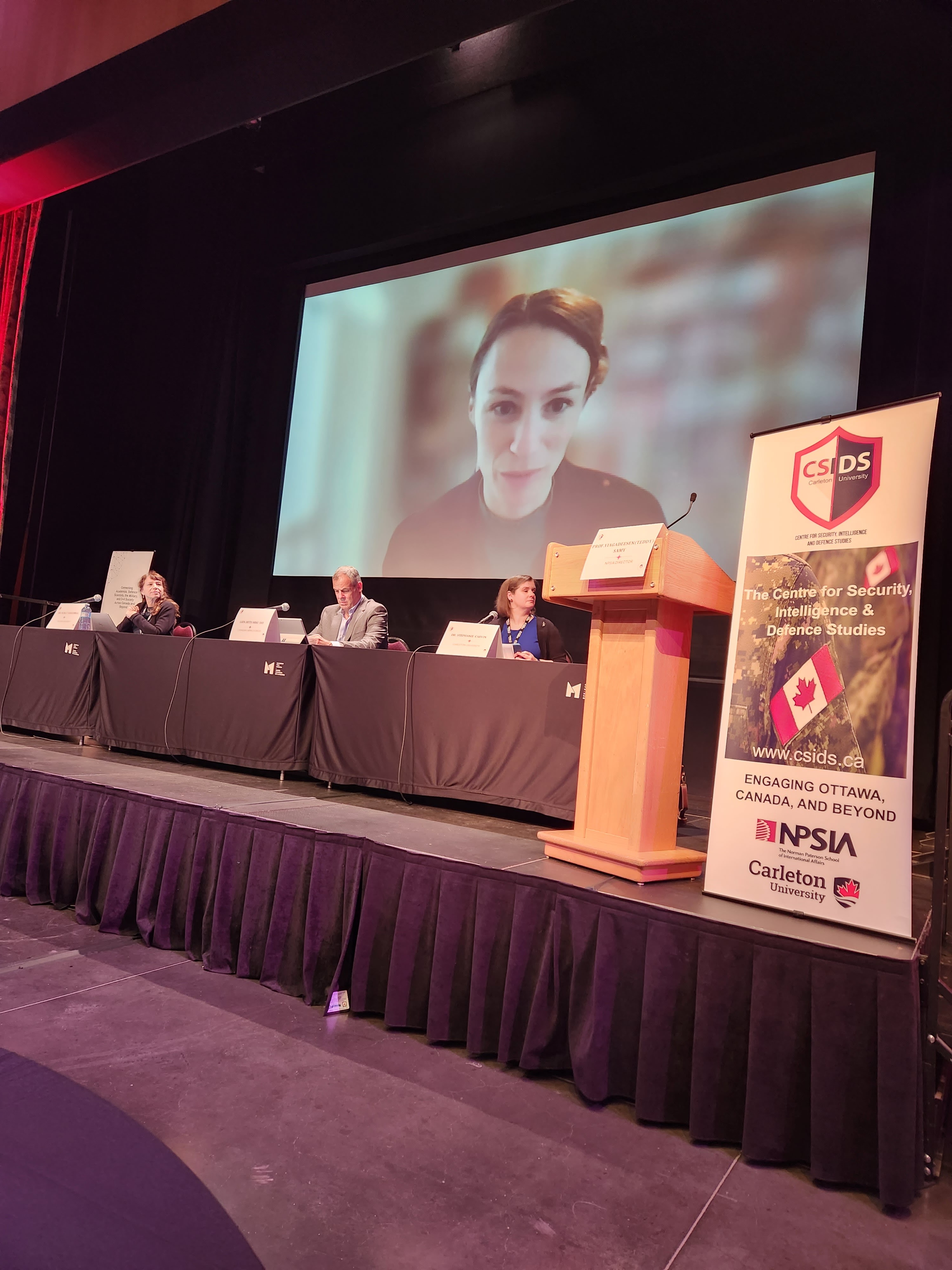
 The Year Ahead conference, which started before the CDSN came into existence, has become a flagship event for both the Carleton research center, Centre for Security, Intelligence, and Defence Studies, and the CDSN.  It provides NPSIA-based scholars with a chance to interact with experts we bring to town and folks from in and around government who attend the event.  We consult our partners in government to see what is on their radar screen for the next year, and try to have panels that are relevant to them.  This year, we had panels on:

  • learning from Ukraine's successes and Russia's aggressive failures
  • the state of Canadian civil-military relations
  • xenophobia and national security, organized by our collaborator Women of Colour Advancing Peace and Security.

We also had a fourth session that was a little different.  We started with a Q&A between myself and Colonel Cathy Blue, our visiting Defence Fellow.  An Air Force officer, she is spending the year with us, auditing a few classes, working on a research project, advising us, providing us with a military point of view, engaging the students, and continuing her professional military education program that comes out of the Canadian Forces College.  She has been an incredible asset this year, a great sounding board.  

After that, we launched the CDSN Podcast Network!  We decided to build our own network so that we could provide opportunities to new podcasts across the country to be heard.  In addition to BattleRhythm, the CDSN's podcast for the past 3.5 years and Conseils de Sécurité, our partnered podcast with RAS/NAS en français, we will have SecurityScape and NATO Field Report.  SecurityScape is a podcast by graduate students at Calgary's Centre for Military, Security, and Strategic Studies, a partner of the CDSN.  They have had one season thus far, and they will drop six episodes of season two in 2023.  NATO Field Report will be a completely new podcast, run by the students and professions involved in the NATO Field School, which brings students to Vancouver for classwork and then onto Europe to various NATO facilities and headquarters.  They will be be dropping episodes episodically--as the field school approaches and then have interviews and reports during the field school's trips to Brussels, Latvia, and wherever else they go.  That we include a podcast that is a different model from the original ones helps to open our imagination for future additions to our network.

Along the way, we fixed a problem with had with our Apple feed. While we have consistently been producing episodes of BattleRhythm, those that relied on our Apple field were not getting automatic downloads of episodes.  Our stuff has always been available at the other outlets (Soundcloud, Spotify, Stitcher, etc.), but now we fixed this problem.  Folks just have to go to the Apple podcast app and search for CDSN and subscribe to get all of our podcasts.  

At the conference, we did a Q&A with the producers and hosts of the various podcasts.  We are very excited about all of this.  If you have an idea for a podcast on defense/security broadly defined, let us know, as we are looking to connect and amplify--the basic CDSN mission.

Nina Tannenwald
Back to the panels, we had Brown University Professor Nina Tannenwald, who discussed the nuclear weapon issues related to the war, retired LGen Mike Day who delineated the lessons from the war itself, and, via zoom, U of Texas Professor Sheena Greitens, who analyzed China's responses to the conflict.  It was a fascinating discussion.  

I moderated the Civil-Military Relations panel where Calgary Prof. Jean-Christophe Boucher and Charlotte Duval-Lantoine of Women in Defence and Security presented a survey they (and me and Lynne Gouliquer) are working on whether the various scandals are affecting Canadians' trust in the military, Andrea Lane of Defence Research and Development Canada presented the challenges posed to the Canadian Armed Forces by political polarization, and Alexandra Richards of Simon Fraser U. analyzed differences among the various generations and their attitudes.  

The final panel on Redefining National Security, organized by WCAPS-C, included Dr. Nadia Abu-Zahra of both Carleton and U of Ottawa, Azeezah Kanji of the Noor Cultural Centre, Jillian Sunderland and Aaron Francis of U of Toronto.  They presented critiques of the defence and security apparatus and community, especially the treatment of historically excluded communities.

We streamed the event, and it will appear on our youtube channels (CDSN and CSIDS) once we get things cleaned up. We will also be circulating a report and related policy notes in January.

I am very grateful for Team CDSN, especially Melissa Jennings, Sherry Laplante, Cathy Blue, Carelove Doreus, Racheal Wallace, Robyn Lalecheur, David Le, Duncan Herd, and Daniel Kholodar, and to the presenters and moderators.  It was great meeting both presenters and audience members, as the event is also a great networking opportunity.  We will do a "hot wash" to figure out what worked best and what could use improvement.  We are open to feedback so if you have suggestions, let us know.

And, yes, we do this stuff so we can eat food and hang out.  

Indeed it was.


I love Charlotte's expression as she realizes
that I am taking a mid-meal pic


Wednesday, December 7, 2022

Nature-Triggered Emergency Operations in Canada

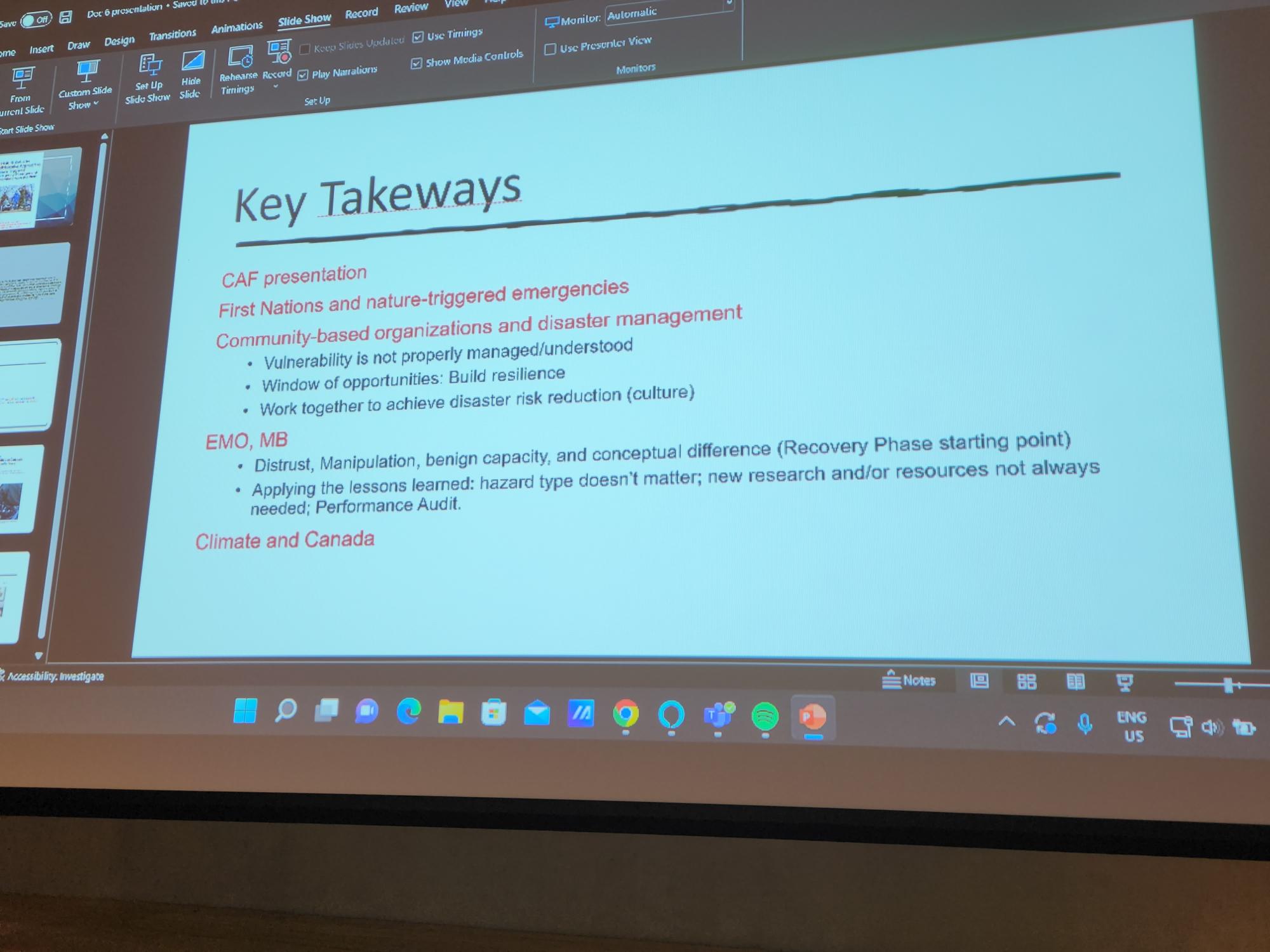
 This week, I went to Winnipeg in the coldest temps of the year thus far to observe one of the new CDSN research efforts: understanding the dynamics of Canadian domestic emergency operations in response to natural events.  Paraphrasing Emdad Haque, one of our co-directors,  nature will create extreme conditions, but whether they are disastrous is up to people and government.  Emdad, Nira Agrawal, and Kawser Ahmed brought together a sharp group of folks, including the army's liaison to Manitoba, the ADM for Emergency Management in Manitoba (a survivor of my big IR class at McG), researches from the universities in the area, and more (see here for details).  

What did I learn?

  • Emergencies are rare for any individual but they are increasingly common collectively.  Climate change is already fostering more and more floods, fires, and other extreme events.  So, this is not just a thing that happens from time to time but is an every day thing now.
  • The notion of the CAF as a last responder needs to die.  Yes, the military wants to be called on only in the most extreme emergencies when no one else can do what they can do.  But there are plenty of incentives for folks to ask for help and for the CAF to be unable to say no.
  • That most of this stuff ends being led by the most local folks--that the feds don't take over but are there to supplement.  Which means the military is following orders, not ordering people around.
  • As always, prevention is the least expensive route but often there are not political incentives.  It seems to me that the real opportunity to make changes to manage/mitigate is as the cycle goes from response to the emergency to recovery--that building back better is a thing.  Rebuild out of harm's way, away from the flood plains, for example.
  • As always, the Indigenous people are put into awful positions by the past and by the present.  Limited infrastructure means they need assistance, but then they are seen as objects, those to be rescued, rather than agents with their own expertise and preferences.  Evacuations need to be rethought--they are very disruptive physically, economically, culturally, mentally.
  • Federalism in Canada continues to suck mightily.  Some provinces understand that they need to build back better, so the Winnipeg floods didn't recur with the same level of damage.  Others understand that they can save money by doing less preparation and then call the feds in when help is needed.
  • There is a lot more work, coordination, planning, preparation going on in this area in between emergencies, that many bad storms and other events do get mitigated.  But again, it is going to get much harder as storms and other conditions get more intense.

I was very pleased to see the CDSN idea work out here--that we had engaged people in different parts of government and society, there was a real exchange of information, the students were super engaged, and it is the start of a more comparative analytical conversation.  


I also learned that Winnipeg is cold, full of friendly folks, and one can lose one's mittens in a cab and then get them back when one happens to take the same cab back to the airport.


So glad I could hang with Andrea Charron,
who has done so much for the CDSN